President Ho Chi Minh (May 19, 1890 – September 2, 1969) is so famous that not only Vietnamese people but many people around the world know him. Although he has been away for more than 50 years, his dedication to our nation is still remembered through many generations. When visiting Hanoi, you should visit the Ho Chi Minh Complex at least once, because it is well worth a visit to understand why Vietnamese people love him so much. Today, let us introduce more about this tourist destination.
Ho Chi Minh Mausoleum
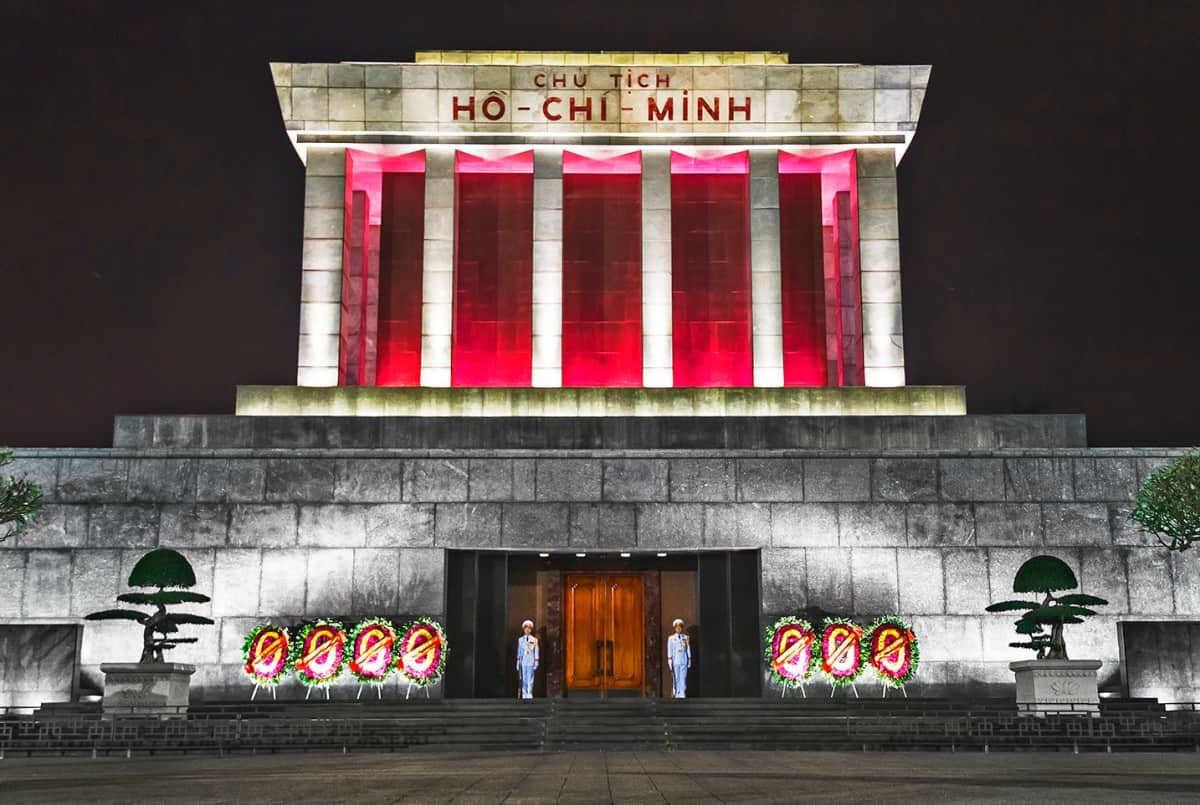
 
 
During the resistance war against the US to save the country, Vietnam was divided into two regions. At that time, the North was under the control of the Vietnamese government. It brought the Vietnamese to fight against the dominating American army in the South. People in the South always miss and look forward to the day when the country is unified and see off their great father. When Uncle Ho was still alive, Uncle Ho’s great wish was also to see the unified Vietnam and to visit the people in the South again. Unfortunately it didn’t happen. Therefore, the Vietnamese government decided to build a mausoleum to store his body so that later people from all over the country and foreign friends could visit him.
 
With the great help of the Soviet Union, the construction was started on September 2, 1973 and completed on August 21, 1975. Built at the very place where President Ho Chi Minh read the Declaration of Independence in 1945.
 
It is inspired by the Lenin Mausoleum in Moscow but incorporates distinct Vietnamese architectural elements, such as the pitched roof. The exterior is made of gray granite, while the interior is gray, black and red polished stone. The gate of the mausoleum has the words “President Ho Chi Minh” engraved on it. While the banner next to it reads “Long live the Socialist Republic of Vietnam”
 
The body of President Ho Chi Minh is preserved in the cool room, the central hall of the mausoleum, protected by the military honor guard. The body was lying in a glass cabinet with dim lights. He is wearing a khaki outfit with a pair of rubber sandals.
 
The coffin is a work of art made by craftsmen of the two countries Vietnam – Soviet Union. The bed is made of copper with lotus motifs, placed on a stone pedestal, with an automatic lifting system.
 
You can also see in here the saying “nothing is more precious than independence and freedom”, which is a famous quote of President Ho Chi Minh.
 
Ba Dinh Square
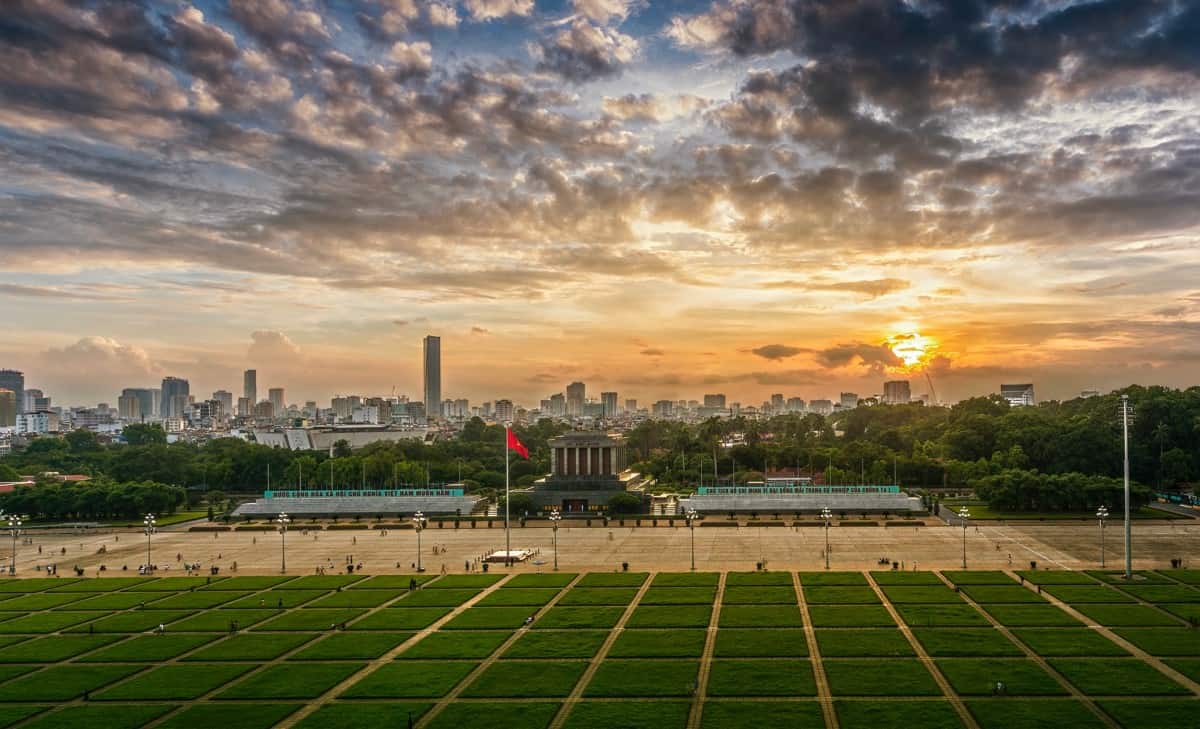
 
 
Ba Dinh Square (Independence Square) is the largest square in Vietnam. Here on September 2, 1945 in front of thousands of Vietnamese compatriots, President Ho Chi Minh read the Declaration of Independence of Vietnam – marking the establishment of the Democratic Republic of Vietnam. That’s why Ho Chi Minh mausoleum was built here.
 
Ba Dinh Square has a campus of 320 m long, 100 m wide, with 196 grass plots, interspersed with a 1.4 m wide walkway. In the middle of the square is a flagpole 25 meters high. This is also the place to organize parades on the major holidays of Vietnam. In addition, the Square also has two daily activities: Flag raising ceremony (at 6 am) and Flag lowering ceremony (9 am). It will be a memorable moment if you witness the Flag Salute Ceremony with soldiers wearing white military uniforms, solemnly marching to the music of the Vietnamese army at Ba Dinh Square at 6am or the Summer Ceremony. flags at 9pm.
 
It’s also a favorite spot for locals to get some morning exercise or simply stroll around the pretty square at night.
 
Ho Chi Minh’s stilt house
 
 
Address: No. 1 Bach Thao Street, Ngoc Ha Ward, Ba Dinh District, Hanoi City
 
Opening hours: From 7:30 am to 4:00 pm, lunch break from 11:00 am to 1:30 pm.
 
Entrance fee: 25,000 VND for international visitors.
 
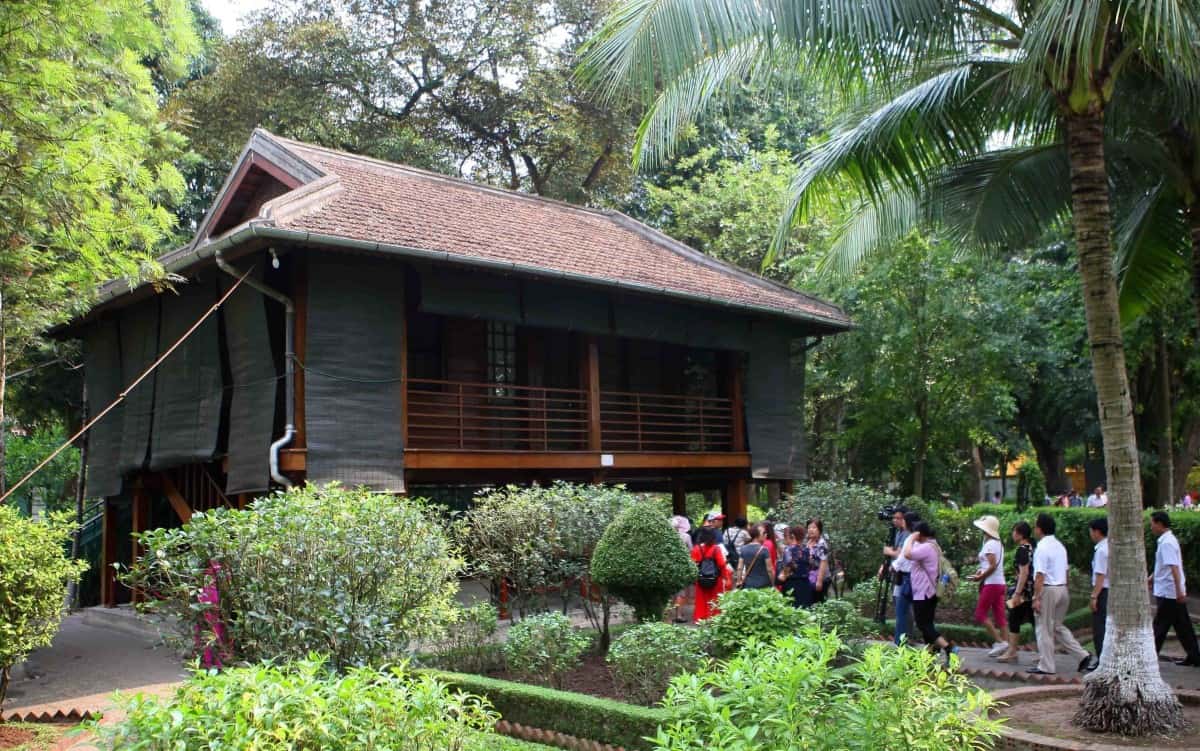
The house is called Ho Chi Minh’s Residence or Ho Chi Minh Stilt House. This building is located within the Ho Chi Minh Complex and is worth your visit to learn more about one of the greatest men of the 20th century. It is for simplicity that Uncle Ho’s stilt house in the Presidential Palace has become a symbol of Ho Chi Minh’s style and morality. This house has left a deep impression in the hearts of everyone who has ever come here.
 
Instead of living in the Presidential Palace, Uncle Ho chose to live in a more simple place. During a visit to the Northwest and saw the traditional stilt house architecture of ethnic minorities, Ho Chi Minh was inspired and requested a similar design to make his residence. A newly built house, simply furnished with wood and with only two small rooms – this is where Ho Chi Minh spent his life as the president of Vietnam until his death in 1969.
 
In terms of form, it looks no different from the traditional wooden stilt house of the mountainous ethnic group in Vietnam. Stairs lead up to two small rooms inside the house. Besides, the area of ​​the rooms is quite small, leaving only minimal space for personal activities – a testament to the simple lifestyle of the Ho Chi Minh people.
 
Ho Chi Minh’s office is a room equipped with books, old newspapers, and a typewriter. The bedroom consists of a simple bed, a vintage-style telephone, electric clock and old-fashioned radio.
 
Under the house is an empty space, used as a reception “office”. Communist generals and foreign guests visiting Ho Chi Minh were invited to sit on simple bamboo chairs. It also contains a number of concessions of the fierce war of the time such as telephones to call other parts, steel helmets and protective equipment against bombs.
 
One Pillar Pagoda
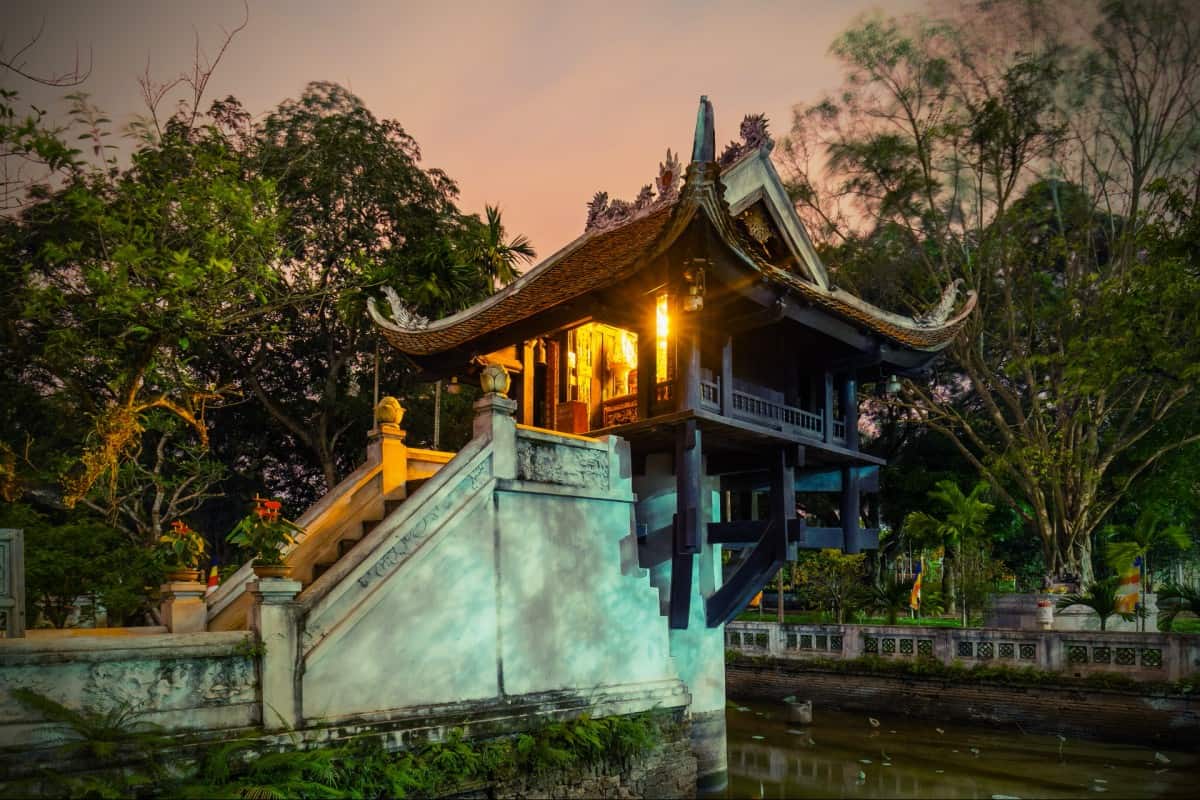


Rising from a pillar in the center of an elegant square lotus pond, the One Pillar Pagoda is said to represent a lotus flower rising above the water.
 
Opening hours: daily from 08:00-17:00
 
Location: One Pillar Pagoda in the park behind the museum, near Ba Dinh Square, Ong Ich Khiem Street, Ba Dinh District. It is also located within the Ho Chi Minh Complex.
 
Legend has it that King Ly Thai Tong (1028-1054) was old but had no son. One night, the king dreamed that Guanyin Buddha was sitting on a lotus platform, carrying a boy and giving it to the king. Not long after, the queen gave birth to a son. Then the king built a lotus-shaped pagoda and named it Dien Huu Pagoda, which means “long-lasting happiness and good luck”
 
The pagoda was built of wood on a single stone pillar with a diameter of 1.25m, a height of 4m (excluding the part submerged in the ground). Besides, One Pillar Pagoda has a unique architecture: square wooden floor, resting on a stone pillar in the middle of the pond. Around the stone column, there is a system of bent ironwood bars to support the floor; so the whole structure looks like a lotus standing upright on the water. As time went by, the pagoda has withstood much of the destruction of the colonial forces. In 1954, the French Union army destroyed the pagoda before withdrawing from Vietnam after the First Indochina War and rebuilt later.
 
Form Today: What you see today of the pagoda is a new form that was restored in 1955 when it was refurbished by the Vietnamese government with a concrete column from the remains. The structure today can be called a copy of the original temple, which is a large building. Locals believe that if you pray here, it will bring good things and prosperity.


Notes when visiting Uncle Ho’s Mausoleum Complex
 
  • Short shorts, mini skirts, blazers, tank tops, etc. are not allowed.
  • Style and attitude: Civilized, polite; no noise or disorder; Speak quietly and stand in line.
  • Cameras, cell phones and daytime packs cannot be brought inside. The guards will collect those before you enter the mausoleum.
  • Do not film or film in prohibited areas, especially inside the mausoleum
  • It is forbidden to put your hands in your pockets and take pictures.
  • Carry out luggage according to regulations and arrangements of the Mausoleum Management Board.
  • Do not bring food, electronics, jewelry or you may not be allowed to post items.
  • Children under 3 years old are not allowed in.
Opening hours: 
 
  • From April to the end of October: 7:30 to 10:30 (Weekend from 7:30 to 11:00)
  • From November to the end of March next year: 8:00 to 11:00 (Weekend from 8:30 to 11:30)
Ticket price: 25,000 VND for foreigner tourists
You might be interested

Hang Ma Street Hanoi during Mid-Autumn Festival 2026: A Local Guide to Hanoi’s Most Colourful Street

Every September, one of Hanoi’s oldest streets transforms into a colourful world of lanterns, paper masks, drums and traditional toys.

Hanoi Autumn 2026: Why September to November Is the Best Time to Visit the Capital

Ask any local when Hanoi is at its most beautiful, and the answer almost always comes back the same: Hanoi autumn.

Hoa Sữa Hanoi 2026: The Fragrant Milk Flower That Defines Autumn in Hanoi

Every October, a distinct sweetness drifts through the streets of Hanoi at dusk, thick enough to stop passersby mid-step.

Bánh Cốm Hanoi 2026: Hanoi Iconic Green Rice Cake and Where to Find the Best of It

Among all the edible souvenirs that visitors carry home from Vietnam, few are as tied to a single street as bánh cốm Hanoi.

Bánh Cuốn Hanoi 2026: The Complete Guide to Hanoi Steamed Rice Rolls

Few dishes capture the quiet elegance of Vietnamese cuisine quite like bánh cuốn Hanoi.

Bánh Rán Hanoi 2026: The Complete Guide to Hanoi’s Iconic Vietnamese Donut (Sweet and Savory)

If there is one snack that captures the rhythm of Hanoi street food, it is bánh rán Hanoi.

Temple of Literature Hanoi 2026: The Complete Guide to Vietnam’s First University

Before Hanoi had skyscrapers or scooters, it had scholars. The Temple of Literature Hanoi, known locally as Van Mieu Quoc Tu Giam, was founded in 1070 to honor Confucius and expanded six years later into Vietnam’s first university

What to Bring Home from Hanoi: 20 Hanoi Souvenirs Worth Every Bit of Luggage Space

Every great trip deserves something tangible to take home. Not a generic keychain from an airport gift shop, but something that actually holds the texture of the place you visited.

Hanoi Immersive Experiences 2026: Night Tours in Hanoi That Reveal the City’s Hidden Soul

When the afternoon heat softens and the city’s famous golden streetlights flicker on across the Old Quarter, a completely different version of Hanoi comes to life, one that most visitors, focused on temples and street food and lake walks, never quite find their way into.

Moc Chau: Vietnam’s Most Underrated Highland Escape 2026

Four hours from Hanoi and a world away from it, Moc Chau sits on a plateau in Son La Province at an elevation that gives it something rare in northern Vietnam: genuine seasons, each one with its own distinct character and its own reasons to visit.

Ha Long Bay 2026 – A Complete Travel Guide for First-Time Visitors

Few destinations in Southeast Asia leave as lasting an impression as Ha Long Bay. With its surreal seascape of limestone pillars rising dramatically from emerald waters, this UNESCO World Heritage Site has become one of the most iconic travel destinations in Vietnam.

Best Local Markets in Hanoi to Visit Beyond Dong Xuan 2026

Exploring the local markets in Hanoi is one of the most authentic ways to understand the city’s rhythm.

7+ Hanoi Museums and Hanoi Relics You Should Never Miss

As the political and cultural heart of Vietnam, Hanoi is home to a remarkable collection of museums and historical landmarks.

Temples and Pagodas in Hanoi: A 2026 Guide to Spirituality

Western spirituality often emphasizes personal introspection, whereas in Vietnam, spirituality is a living practice deeply rooted in the city’s culture. In Hanoi, this connection blurs the line between the sacred and the mundane.

Top 10+ Best Bars in Hanoi

To help you navigate the city’s vibrant evening scene, we have put together a carefully curated list of Hanoi’s best bars.

West Lake Hanoi: 1 Peaceful Escape from the Old Quarter

West Lake Hanoi (Hồ Tây) is one of the largest lakes in Hanoi, featuring a 17-kilometer shoreline that spans a significant portion of the city.

Ta Hien Street – The Street That Doesn’t Sleep In The Heart Of Hanoi

Referring to Hanoi, besides familiar places such as Sword Lake, West Lake, Cathedral, Bat Trang Pottery Village, … the image of old streets always appears in everyone’s mind.

Top 5 Malls where you can have fun in the center of Hanoi

Short vacations always make you hesitate to choose a place to play? If so, Hanoi commercial centers will be the right suggestion to help you have relaxing and comfortable moments next to your loved ones.

Top 10 unique things in Hanoi that you can bring home.

Everyone who travels loves to buy gifts for family and friends after the trip. Indeed, shopping is a way to immerse yourself in the local culture during the holidays.

Water puppetry – a unique folk art form of Vietnam

Water puppetry is a unique and creative folk theater art form imbued with the traditions of the wet rice agricultural civilization, born at the same time as the Dai Viet culture.

Activities when in Hanoi make you like a Hanoian

The capital of thousands of years of civilization, rustic with the old town has incubated the old timeline, bustling with the sound of car horns at peak hours, poetic in the afternoons with cool breezes by the lake.

Thang Long Imperial Citadel – Feudal legacy in Hanoi

Thang Long Imperial Citadel is a place associated with thousands of years of history of nation building and defending the country, one of the cultural heritages recognized by UNESCO.

Hoa Lo Prison – Where the brutal war history is kept

As a clear testament to a period of history of hardship and hardship, Hoa Lo prison in Hanoi also symbolizes the indomitable and resilient spirit of patriotic Vietnamese children.

Hanoi’s Old Quarter – An ancient space in the bustling capital

Packed with charming colonial architecture, Buddhist temples and pagodas, the Old Quarter, located near Hoan Kiem Lake in Hoan Kiem District, is Hanoi’s major commercial district. Its heart and soul is exposed in the ancient commercial streets which are named after their original businesses dating back about 1,000 years.

Top 10 Tourist attractions in Hanoi that you don’t want to miss

Hanoi – the capital of Vietnam – is a destination that is not too strange for tourists from all over the world.

Top 10 Restaurants in Hanoi’s Old Quarter that you need to dive in!

Hanoi not only has a rich cultural and historical background but also contains a unique cuisine, converging with the rice civilization of the Red River. Hanoi culinary is also the crystallization of the cuisine of all regions of the country, which is the absorption and acculturation of the quintessence of two French and Chinese cuisines through historical eras.

Oc Hanoi 2026: The Snail Streets That Come Alive After Sunset

On a cool evening in Hanoi, somewhere around eight o’clock, a particular sound starts up on certain streets.

Kem Trang Tien 2026: The Ice Cream Hanoi Has Queued For Since 1958

On a warm evening on Trang Tien Street, a few hundred metres from Hoan Kiem Lake, you will find something that makes no sense until you see it: a hundred people standing on a pavement and in a covered courtyard, eating ice cream on sticks, saying very little, and leaving within four minutes.

Quang Ba Flower Market 2026: Hanoi’s 3AM Flower Market and How to Visit

At three in the morning, most of Hanoi is as quiet as it ever gets.
×

BEST PRICE HERE

BOOK NOW
×