



Hoan Kiem Lake Hanoi 2026: The Complete Travel Guide to the Lake of the Returned Sword
Quick Facts
| Vietnamese Name | Hồ Hoàn Kiếm |
| Alternative Name | Ho Guom (Lake of the Sword) |
| Location | Hoan Kiem ward, central Hanoi |
| Circumference | 1.6 kilometers (walkable loop) |
| Ngoc Son Temple Hours | 8:00 AM to 5:00 PM daily |
| Ngoc Son Temple Fee | 30,000 VND adults / free for children under 15 |
| Weekend Walking Street | Friday 7:00 PM to Sunday midnight (free, no ticket) |
| Best Time to Visit | 6:00 to 8:00 AM (daily life) or Friday to Sunday evenings (walking street) |
| Distance from Old Quarter | Walking distance, 5 to 10 minutes on foot |
| Nearest Landmark | Hanoi General Post Office, St. Joseph’s Cathedral |
The Center of Everything
Every city has a place that functions as its soul: the spot where locals gather at dawn and at midnight, where legend and daily life overlap, where the city’s self-image is most legibly written into the landscape. In Hanoi, that place is Hoan Kiem Lake.
Known in Vietnamese as Ho Hoan Kiem (Lake of the Returned Sword) or simply Ho Guom (Lake of the Sword), this 12-hectare body of water in the heart of the city is at once a park, a temple site, a weekend festival ground, and one of the most resonant mythological landscapes in Southeast Asia. It has been here, at the center of Hanoi’s life, for centuries.
For international visitors arriving in Hanoi for the first time, Hoan Kiem Lake is the natural starting point. Not because a guidebook says so, but because the city orients itself around it. The Old Quarter wraps around its northern shore. The French Quarter begins at its southern edge. Nearly every walk through central Hanoi either starts at the lake or passes through it. Understanding Hoan Kiem Lake is the quickest way to begin understanding Hanoi.
The Legend of the Returned Sword
No visit to Hoan Kiem Lake is complete without knowing the story that gave it its name. It is not a minor piece of folklore. It is one of the founding myths of the Vietnamese nation.
In the 15th century, Vietnam was under the occupation of the Chinese Ming Dynasty. A resistance leader named Le Loi organized a decade-long guerrilla campaign against the occupiers, fighting from the forests and mountains of Thanh Hoa Province. According to legend, a divine golden turtle rose from the depths of a small lake near his home and presented him with a magical sword. With this weapon, Le Loi’s forces defeated the Ming army and drove them from the country.
In 1428, Le Loi established the Later Le Dynasty and became emperor of a reunified Vietnam. Returning to Hanoi by boat, he crossed the waters of a lake then known as Luc Thuy (Green Water Lake). A great golden turtle rose from the lake, took the sword gently from the emperor’s scabbard, and dove back beneath the surface, returning the weapon to the gods who had sent it. The emperor, moved by this event, renamed the lake Ho Hoan Kiem: the Lake of the Returned Sword.
The Turtle Tower (Thap Rua), which stands on a small islet near the lake’s southern end, was built in the late 19th century to commemorate this legend. And the legend itself remains alive in Hanoi in a way that goes beyond tourism: as recently as 2011, the last confirmed specimen of the giant Hoan Kiem soft-shell turtle (the species long associated with the golden turtle of the myth) was seen swimming in the lake. Its death in 2016 was mourned citywide. A preserved specimen of this turtle species is displayed inside Ngoc Son Temple.
The lake does not carry this legend lightly. It carries it the way the city carries its entire history: present, deliberate, and deeply felt.
A Brief History of Hoan Kiem Lake Hanoi
The lake’s history as a sacred and civic space predates the Le Loi legend. Archaeological evidence suggests that Luc Thuy Lake (as it was originally called) was already significant to the inhabitants of this area during the early centuries of settlement in the Red River Delta.
During the Ly Dynasty, when Hanoi was established as the capital of Dai Viet in 1010, the lake formed part of the city’s natural landscape. Over the following centuries, as the city developed around it, the lake gradually took on the role it still plays today: a place of ceremony, leisure, spiritual practice, and civic gathering.
The construction of Ngoc Son Temple on the small jade island (Jade Island) in the lake gave the site its clearest architectural expression. The temple was formally restored and restructured in its current form in 1865 by the Confucian scholar Nguyen Van Sieu, who also built the Huc Bridge and the Pen Tower (Thap But) that visitors cross and pass today.
The French colonial period transformed the banks of the lake. The streets of the French Quarter extended to the southern shore, and the lake became a geographic boundary between the ancient Vietnamese city to the north and the planned colonial city to the south. This boundary is still legible today in the architectural character of the streets on each side of the water.
What to See at Hoan Kiem Lake
The Lake Circuit (Ho Guom Walking Loop)
The 1.6-kilometer path circling the lake is Hanoi’s most important public space. Walking it at different times of day reveals different versions of the city.
At 6:00 AM, the path is shared with dozens of Hanoians doing morning exercises: tai chi groups on the northern banks, badminton games on the western path, elderly men playing chess at stone tables, joggers completing circuits in the blue early light. This morning ritual has been happening around this lake for generations. It is one of the most genuinely Hanoian experiences available to any visitor, and it costs nothing.
By mid-morning, tourists and cyclos begin to appear. By midday the banks are busy and warm. Late afternoon brings another shift in mood: the light on the water turns golden, and the Turtle Tower silhouette becomes one of the most photographed images in the country. At night, the lake is lit with lanterns and the reflection of city lights. On weekend evenings, the surrounding streets become a pedestrian zone and the whole area transforms into a festival.
The Huc Bridge Hanoi (Bridge of the Rising Sun)
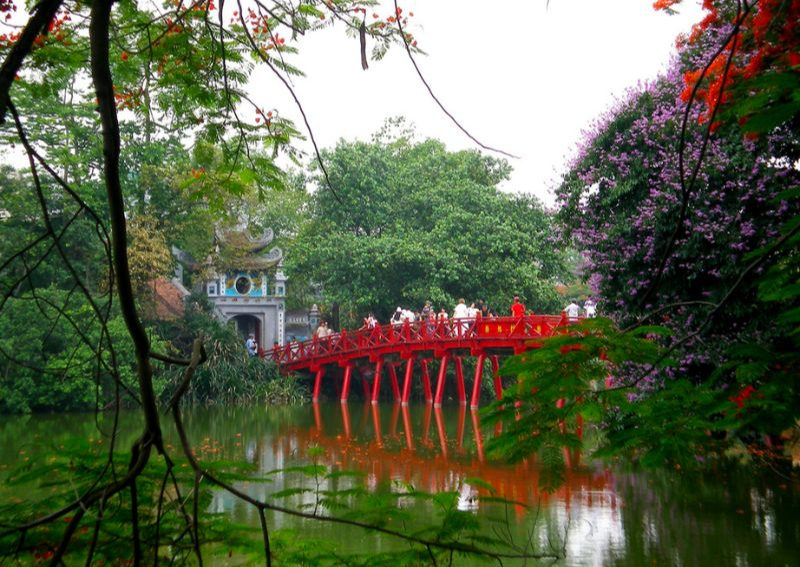
The bright red wooden bridge extending from the lake’s northern bank to Jade Island is one of the most recognizable images in Vietnamese photography. Its name in Vietnamese, The Huc, means “where morning sunlight gathers” or “Bridge of the Rising Sun.”
The bridge was built during the 1865 restoration of Ngoc Son Temple by Nguyen Van Sieu. Its arched, lacquered wooden form, painted entirely in a deep red vermillion, is a deliberate design choice: in Vietnamese culture, red is a color of luck, protection, and celebration. Walking across the Huc Bridge, with the green water below and the temple ahead, is one of those small travel moments that stays with you longer than the monuments.
The bridge is narrow enough that a small queue often forms during busy hours. Arrive before 8:30 AM for the quietest crossing.
Ngoc Son Temple (Temple of the Jade Mountain)
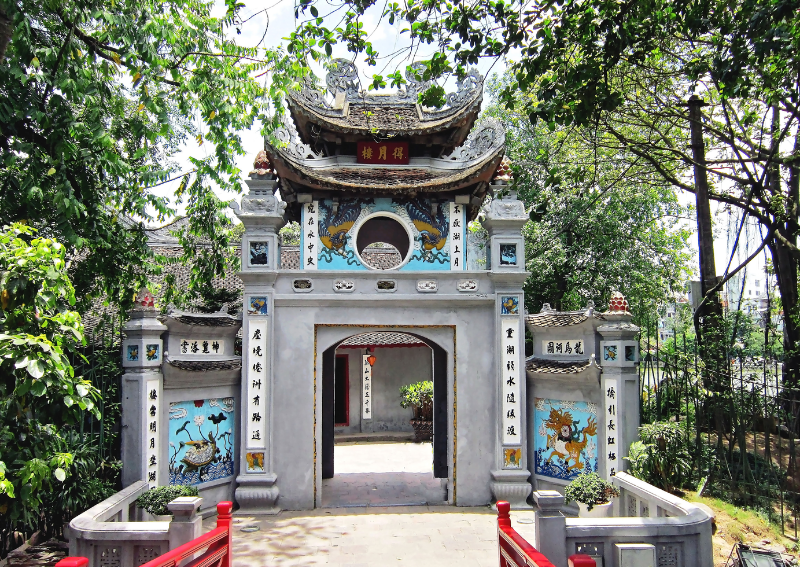
At the end of The Huc Bridge, on Jade Island in the northern part of the lake, stands Ngoc Son Temple. The temple was originally built in the 18th century, and its current form dates from the major 1865 restoration. It is a functioning place of worship as well as a heritage site, dedicated to three figures: General Tran Hung Dao, the 13th-century military commander who defeated two Mongol invasions of Vietnam; Van Xuong, the god of literature and scholarship; and La To, the patron saint of physicians.
The approach to the temple passes through the Tam Quan Gate (Three-Door Gate), decorated with Chinese characters and stone carvings representing harmony and protection. The interior of the temple fills with incense smoke and the soft light of candles burning at the altars. The atmosphere is genuinely sacred, not merely decorative.
The most remarkable exhibit inside is the preserved specimen of a giant Hoan Kiem soft-shell turtle (Rafetus leloii), displayed in a glass case. This is one of the rarest turtle species on earth. The preserved specimen is approximately 2 meters long and dates from an animal that died in the lake in the early 20th century. Seeing it in person makes the Le Loi legend feel considerably less mythological.
- Opening hours: 8:00 AM to 5:00 PM daily. Ticket: 30,000 VND per adult, free for children under 15.
- Visitors should dress modestly for temple entry. Shoulders and knees should be covered, or wraps are available at the entrance.
Turtle Tower (Thap Rua)
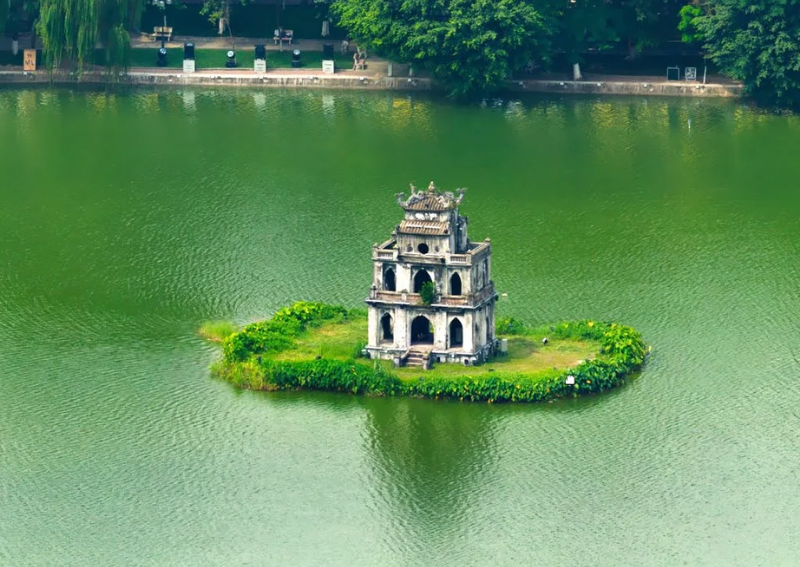
Rising from a small islet near the lake’s southern end, Turtle Tower is the most iconic silhouette in Hanoi’s skyline. Built in the late 19th century and named in honor of the golden turtle legend, the three-story tower cannot be visited (it sits on an island with no public bridge), but its reflection in the lake at dawn, dusk, and during rainy weather is a photographic subject that Hanoians and visitors have returned to for generations.
Prime photography positions: the western bank near Le Thai To Street for sunrise shots between 5:30 and 6:30 AM; the northeastern corner near Dinh Tien Hoang Street for afternoon water reflection photos between 4:00 and 5:00 PM.
Pen Tower and Inkstone Platform (Thap But and Dai Nghien)
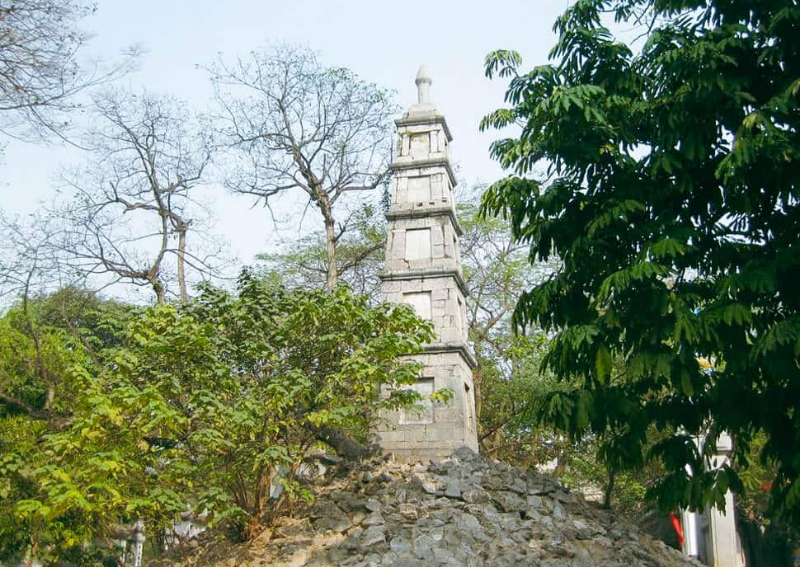
At the entrance to The Huc Bridge, before crossing to the island, visitors pass through a gateway that includes the Pen Tower (Thap But) and the Inkstone Platform (Dai Nghien). The Pen Tower is a stone column topped with a brush pointing skyward, symbolizing the pursuit of learning and literature.
The Inkstone Platform below it represents the inkstone used in classical Vietnamese scholarship. Both were constructed during the 1865 restoration by Nguyen Van Sieu, himself a celebrated scholar, and together they signal the temple’s traditional role as a site connected to learning, wisdom, and the arts.
The Weekend Walking Street: Hoan Kiem Lake on Friday and Saturday Nights
Every weekend, Hoan Kiem Lake undergoes a transformation that few first-time visitors to Hanoi anticipate and that almost everyone who experiences it describes as one of the highlights of their trip.
From 7:00 PM on Friday through midnight on Sunday, sixteen streets surrounding the lake are closed to all vehicular traffic and become a pedestrian zone. The area covered stretches approximately 7.2 kilometers of walkable streets. The atmosphere shifts from the quiet of an evening park to something closer to a street festival.
- live music performances at multiple stages around the lake, including traditional Vietnamese forms like hat xam (folk singing) as well as contemporary and pop performances
- traditional Vietnamese folk games that visitors can participate in (including o an quan, bamboo jacks, and shuttlecock kicking)
- portrait sketching stations along Dinh Tien Hoang Street, where an artist will draw you for roughly 100,000 to 150,000 VND in about ten minutes
- street food vendors selling everything from banh mi and bun cha to grilled corn and fresh fruit
The main performance stage at Dong Kinh Nghia Thuc Square hosts scheduled events with professional performers. During Vietnamese holidays (Tet, Mid-Autumn Festival, National Day), the atmosphere intensifies further with themed events and larger crowds.
Entry to the walking street zone is completely free. It is one of the best genuinely free experiences in any Asian capital city.
How to Get to Hoan Kiem Lake
Hoan Kiem Lake sits at the heart of central Hanoi. Getting there from almost anywhere in the city is straightforward.
On foot from the Old Quarter: Most streets in the Old Quarter lead toward the lake within a 5 to 10-minute walk southward. The lake is impossible to miss.
- By Grab (ride-hailing app): From hotels in the French Quarter, a Grab ride costs 20,000 to 40,000 VND and takes 5 to 10 minutes. From further afield (Tay Ho, Ba Dinh), expect 50,000 to 80,000 VND and 15 to 25 minutes depending on traffic.
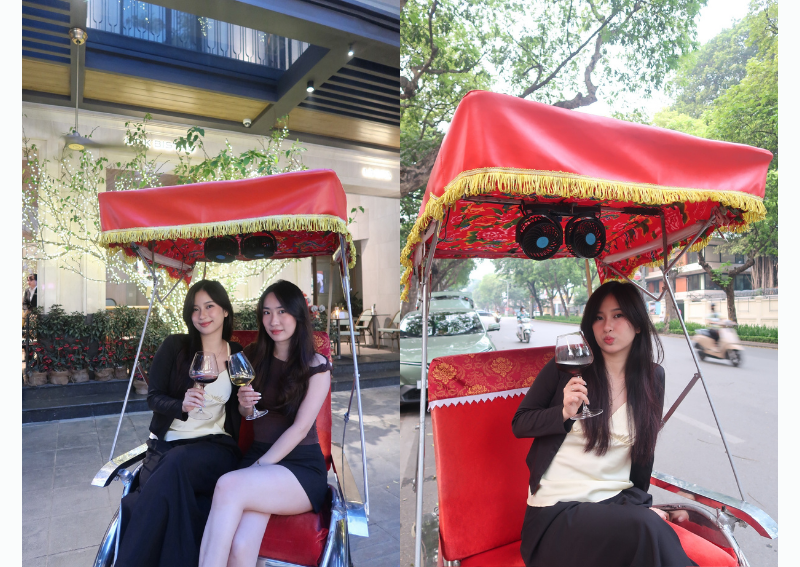
- By cyclo: A traditional cyclo ride Hanoi from the Old Quarter to the lake offers one of Hanoi’s most atmospheric short journeys. Agree on a price before boarding, typically 50,000 to 100,000 VND for a short ride. See more about Sip & Ride at Link Bistro Hanoi where you can sip the chilling wine while Hanoi on the icon cyclo.
- By public bus: Routes 09, 14, and 36 stop close to the lake. Fare: 7,000 to 15,000 VND.
- By taxi: All major Hanoi taxi companies serve the area. Use the meter or confirm pricing through Grab before committing.
From La Siesta Premium Lakeside: The hotel’s French Quarter location puts Hoan Kiem Lake within a pleasant 5 to 8-minute walk through some of Hanoi’s most characterful streets. On a cool morning or a calm evening, walking is the obvious choice.
Best Times to Visit Hoan Kiem Lake
- Early morning (5:30 to 8:00 AM): The most atmospheric time. Locals exercise, the light is beautiful, the air is cooler, and the tourist traffic is minimal. This is when the lake feels most like the living heart of a real city rather than a visitor attraction.
- Late afternoon (4:00 to 6:00 PM): Good light for photography, particularly for Turtle Tower reflections. The pace of the lakeside slows as the working day ends.
- Friday to Sunday evenings (from 7:00 PM): The weekend walking street is a different experience from the lake at any other time. Busy, festive, and genuinely joyful.
- Seasonal considerations: October to April brings the most comfortable weather for an extended lakeside walk. Hanoi summers (May to September) are hot and humid, making the early morning visit even more advisable during those months.
What to Do Around Hoan Kiem Lake: A Half-Day Circuit
The lake sits at the center of Hanoi’s most visited neighborhood. A well-planned half-day can weave together the lake itself with the best of the surrounding streets and sites.
Morning circuit (3 to 4 hours starting at 7:00 AM)
Start at the lake’s western bank for the morning light. Walk north to watch morning exercises in progress. Cross The Huc Bridge to Ngoc Son Temple when it opens at 8:00 AM. Return and walk south along the eastern bank for Turtle Tower views. From the southern end of the lake, walk west five minutes to Hoa Lo Prison (a powerful complement to the lake experience, covering a very different register of Vietnamese history). Return to the lakeside for a coffee at one of the cafes on Dinh Tien Hoang Street, where pavement seating overlooks the water.
Old Quarter extension (additional 2 to 3 hours)
From the lake’s northern end, enter the Old Quarter via Hang Dao Street, the traditional silk street, and navigate the 36 ancient guild streets that have given this neighborhood its identity for centuries. Hang Gai (silk and embroidery), Hang Ma (paper goods and decorations), Hang Buom (spices and confectionery), and Ta Hien Street (known as “Beer Street” for its concentration of bia hoi corners) form a logical and enjoyable loop.
Weekend evening (from 7:00 PM)
Return to the lake for the walking street. Start at Dong Kinh Nghia Thuc Square to see the main performance stage, then follow the crowds counterclockwise. Stop for grilled corn or banh mi from a street stall. Watch the portrait artists at work along Dinh Tien Hoang. Cross The Huc Bridge one more time in the evening light and look back at the lit towers from the island.
Nearby Attractions to Combine With Your Visit
- Hoa Lo Prison (Hanoi Hilton): 1 kilometer southwest. One of Hanoi’s most significant and sobering historical sites. The pairing of a morning at the lake (legend, beauty, public life) with a visit to Hoa Lo (colonial history, suffering, resilience) creates a genuinely complete picture of the city.
- St. Joseph’s Cathedral: 600 meters west. Hanoi’s principal Gothic Catholic cathedral, built by the French in 1886. Its twin towers are a striking piece of colonial architecture, and the square in front is a good early-morning coffee spot.
- Vietnam Museum of Women: 800 meters south. An excellent and underrated museum, particularly strong on the role of Vietnamese women in the independence movement and in daily life across the country’s diverse ethnic communities.
- Hanoi Opera House: 700 meters southeast. The grandest surviving building of the French colonial period, modeled on the Paris Opera. Check the program for evening performances, which often include traditional Vietnamese music and dance.
- Hanoi Old Quarter: Immediately north. The 36 guild streets of the Old Quarter are the natural complement to any Hoan Kiem Lake visit. Allow at least two hours for a proper exploration.
Stay at One of the Best Hotels near Hoan Kiem Lake: La Siesta Premium Lakeside
The name says it: Lakeside. Hanoi La Siesta Premium Lakeside is located in Hanoi’s French Quarter, within 1-minute walking distance of Hoan Kiem Lake and positioned at the crossroads of everything the city center has to offer.
This is the hotel that Hoan Kiem Lake visitors are looking for, whether they know it by name or not. Consistently ranked among the best boutique hotels in Hanoi, Hanoi La Siesta Premium Lakeside puts you within a 5 to 8-minute walk of the lake’s southern bank, close enough to arrive for the 6:00 AM morning Tai Chi scene without a taxi, and close enough to wander back after the weekend walking street ends without worrying about transport.
The French Quarter location means you are not just near the lake. You are also minutes from Hoa Lo Prison, St. Joseph’s Cathedral, the Vietnam Museum of Women, and the Hanoi Opera House. The Old Quarter is a short walk north. Ba Dinh District and its cluster of major historical landmarks (the Imperial Citadel, Ho Chi Minh Mausoleum, One Pillar Pagoda) are easily reached by a 10-minute Grab ride.
The lake is what you come for. This is where you stay while you are here.
Frequently Asked Questions
What is Hoan Kiem Lake famous for?
Hoan Kiem Lake is famous as the symbolic and geographical center of Hanoi, the site of the Vietnamese legend of the Returned Sword, and the location of Ngoc Son Temple on Jade Island. It is also known for its weekend pedestrian walking street, which brings thousands of Hanoians and visitors together every Friday through Sunday evening.
What does Hoan Kiem mean in English?
Hoan Kiem translates as “Returned Sword” or “Lake of the Returned Sword.” The name comes from the 15th-century legend of Emperor Le Loi, who was given a magical sword to defeat Chinese invaders and later returned it to a golden turtle god in this lake.
Is Hoan Kiem Lake free to visit?
The lake itself and the circuit path around it are always free and always open. Ngoc Son Temple on the island has an entrance fee of 30,000 VND per adult. The weekend walking street (Friday 7:00 PM to Sunday midnight) is also completely free.
What is the best time to visit Hoan Kiem Lake?
Early morning between 5:30 and 8:00 AM offers the most atmospheric experience, with locals exercising around the lake and beautiful light on the water. Friday to Sunday evenings from 7:00 PM are ideal for experiencing the walking street. October to April is the most comfortable season weather-wise.
What is the red bridge at Hoan Kiem Lake?
The red bridge is called The Huc Bridge, or the Bridge of the Rising Sun. It was built in 1865 and connects the northern lake bank to Jade Island, where Ngoc Son Temple stands. It is one of the most photographed landmarks in Hanoi.
How long does it take to walk around Hoan Kiem Lake?
The circuit around the lake is 1.6 kilometers. At a comfortable pace, this takes around 20 to 30 minutes without stopping. Most visitors spend 60 to 90 minutes around the lake combining the circuit walk with a visit to Ngoc Son Temple.
Is Hoan Kiem Lake walkable from the Old Quarter?
Yes. The Old Quarter’s southern streets lead directly to the lake’s northern bank. Most locations in the Old Quarter are within a 5 to 10-minute walk of the lakeside.
What hotels are closest to Hoan Kiem Lake?
La Siesta Premium Lakeside, located in the French Quarter, is among the closest and most highly-rated boutique hotels to Hoan Kiem Lake in Hanoi. It offers comfortable walking access to the lake and is centrally positioned for the broader Hanoi city center.