

Hue Vietnam 2026: Vietnam’s Imperial City and Everything Worth Knowing Before You Go
There are cities in Vietnam that surprise you, and then there is Hue Vietnam, which does something rarer: it slows you down. The former imperial capital of the Nguyen Dynasty sits along the banks of the Perfume River in central Vietnam, surrounded by a landscape of hills, pagodas, and royal tombs that feel less like tourist attractions and more like the remnants of a world that genuinely existed here not so long ago. Hue was Vietnam’s seat of power from 1802 to 1945, and that century and a half left behind a density of history and architecture that no other Vietnamese city can match.
It is also, by most accounts, the country’s most serious food city, a place where the royal court’s obsession with refined, precisely composed cuisine has filtered down into street stalls and family kitchens and produced a culinary tradition unlike anything in the north or south. Plan for more time than you think you need.
A Brief History of Hue Vietnam
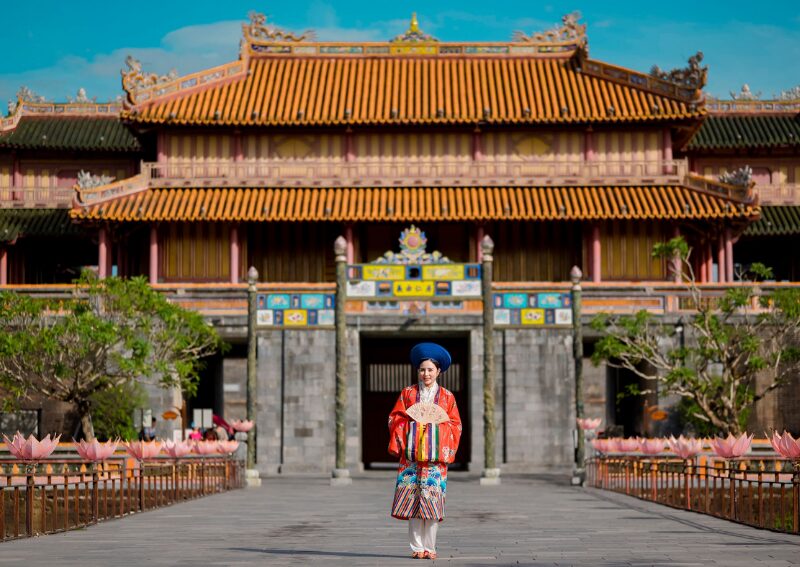
Hue’s roots as a center of power stretch back to the early 17th century, when Nguyen Hoang, a nobleman fleeing political rivalry in the north, established the Nguyen Lords in central Vietnam and began building a regional capital. The city’s strategic position, protected by the Perfume River to the south and the Truong Son mountain range to the west, made it a defensible and symbolically significant location.
In 1802, Emperor Gia Long unified Vietnam for the first time under a single ruler and established Hue as the imperial capital of the Nguyen Dynasty, the last ruling dynasty in Vietnamese history. The emperors who followed built the Imperial City, the royal tombs, the pagodas, and the network of ceremonial structures that still define the city’s landscape today. Thirteen emperors ruled from Hue over 143 years until Emperor Bao Dai abdicated in 1945, ending the dynastic era.
The city suffered serious damage during the 1968 Tet Offensive, one of the most intense urban battles of the Vietnam War, when the ancient Citadel walls became a battleground for nearly a month. The scars of that conflict are still visible in sections of the Imperial City, adding a layer of 20th century history to the dynastic monuments that surround them. UNESCO inscribed the Complex of Hue Monuments as a World Heritage Site in 1993, recognizing the outstanding universal value of what survived.
Top Things to Do in Hue
The Imperial City and Hue Citadel – UNESCO World Heritage Vietnam
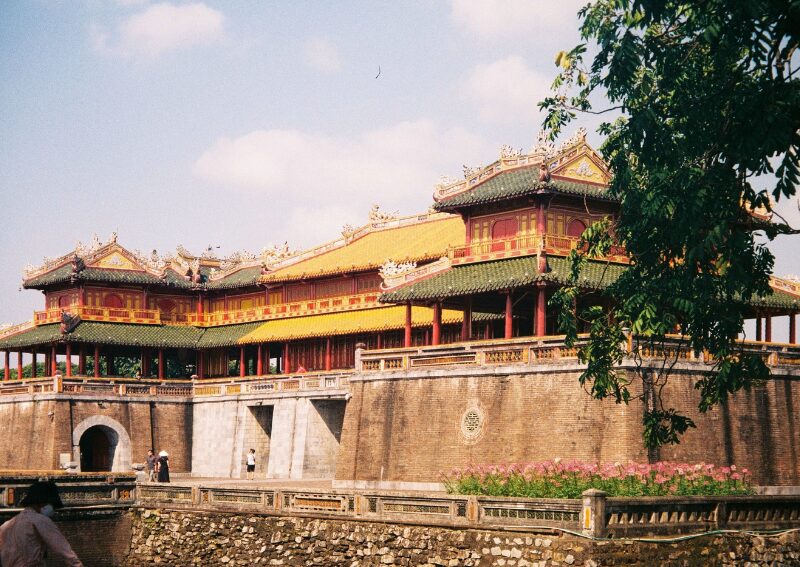
The heart of Hue’s historical heritage is this vast, moat-encircled complex on the northern bank of the Perfume River. Built by Emperor Gia Long beginning in 1804, the Citadel encompasses the Imperial City itself within its walls, a layered system of fortifications, palaces, temples, gardens, and ceremonial spaces that once housed the emperor, his family, and the entire apparatus of the imperial court. The most prominent landmark is the Flag Tower, erected under Gia Long and still standing at its original height, flying the Vietnamese flag over the entrance to the Noon Gate.
Allow at least two hours inside, wear comfortable shoes, and consider hiring a guide at the entrance since the scale of the complex can be disorienting without context. Morning visits are cooler and better lit for photography.
Thien Mu Pagoda
Built in 1601, Thien Mu is Hue’s oldest pagoda and one of the most recognizable structures in all of Vietnam, its seven-tiered Phuoc Duyen tower rising above the Perfume River on a wooded hillside just upstream from the city center. The pagoda is still an active place of worship for resident monks, which gives it a living quality that purely archaeological sites sometimes lack. The most atmospheric way to arrive is by boat along the Perfume River rather than by road, an approach that gives you the view that Vietnamese poets have been describing since the 17th century. Entry is free and the pagoda is open daily from 8:00 AM to 5:00 PM.
The Royal Tombs of the Nguyen Emperors
Seven of the thirteen Nguyen emperors built elaborate tomb complexes in the hills surrounding Hue during their own lifetimes, each one reflecting the personality, philosophy, and aesthetic preferences of the ruler who designed it. The three most visited are Minh Mang, Tu Duc, and Khai Dinh. Minh Mang’s tomb is the largest and most classically proportioned, built around a series of lakes and terraced gardens that follow strict Confucian symmetry.
Tu Duc’s is more romantic and intimate, set in a pine forest with pavilions built for the emperor’s personal retreat. Khai Dinh’s is the most visually dramatic, a hybrid of Vietnamese imperial and French Art Deco architecture covered in mosaic glass and porcelain that looks unlike anything else in the country. Each tomb is a half-day excursion from the city center, reachable by bicycle, motorbike, or taxi.
The Perfume River – The Hương River
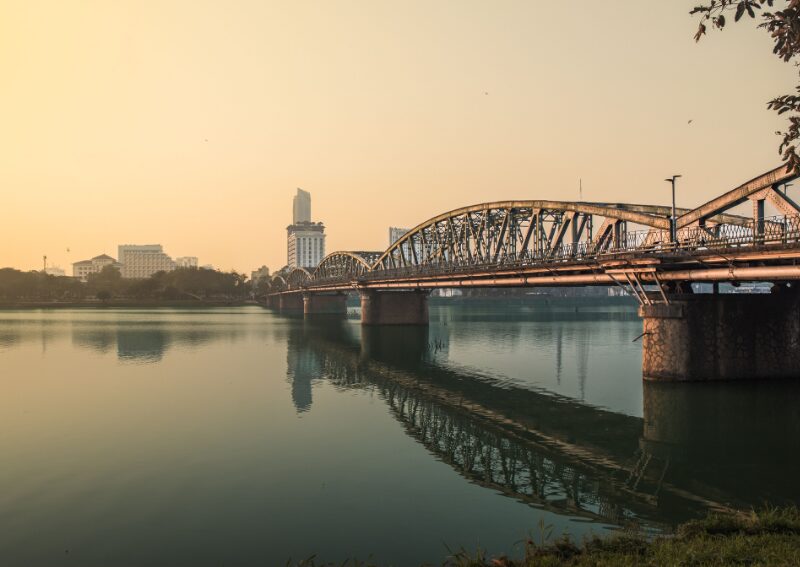
The Huong River, known in English as the Perfume River, winds through Hue for roughly 30 kilometers before reaching the sea, and it is central to the city’s identity in ways that go beyond geography. A dragon boat cruise along the river, taking in Thien Mu Pagoda, the riverside park, and the bridges illuminated at dusk, is one of Hue’s most recommended experiences and one of the more genuinely pleasurable ways to spend a half day in the city. The Truong Tien Bridge, a six-arched steel structure that lights up in rotating colors after dark, is the most photographed point along the river at night.
Dong Ba Market
The largest and most atmospheric market in Hue, Dong Ba sits at the northern end of the Truong Tien Bridge and has been a center of commercial life in the city for well over a century. Beyond the practical business of buying and selling, it functions as a live inventory of Hue’s food culture, with vendors selling conical hats, incense, local spices, and the raw ingredients for the city’s most distinctive dishes all within the same crowded, fragrant space.
An Dinh Palace
Built in the early 1900s as the private residence of Emperor Khai Dinh and later Emperor Bao Dai, this compact palace on the southern bank of the river is a beautifully preserved example of the hybrid Vietnamese-French architecture that characterized the late Nguyen period. Twenty restored period rooms are open to visitors, and the ornate exterior with its Italian-style facade and imperial yellow walls makes it one of the most photographed buildings in the city that most visitors haven’t heard of before arriving.
Kim Long Garden House District
North of the Imperial City along the river, Kim Long is a quiet residential area of traditional garden houses that gives the most authentic sense of how prosperous Hue families lived in the imperial era. The district rewards slow exploration on foot or by bicycle, with signposted garden houses that are open to the public, atmospheric canal-side lanes, and a pace that feels entirely removed from the tourist circuit.
Thuan An Beach
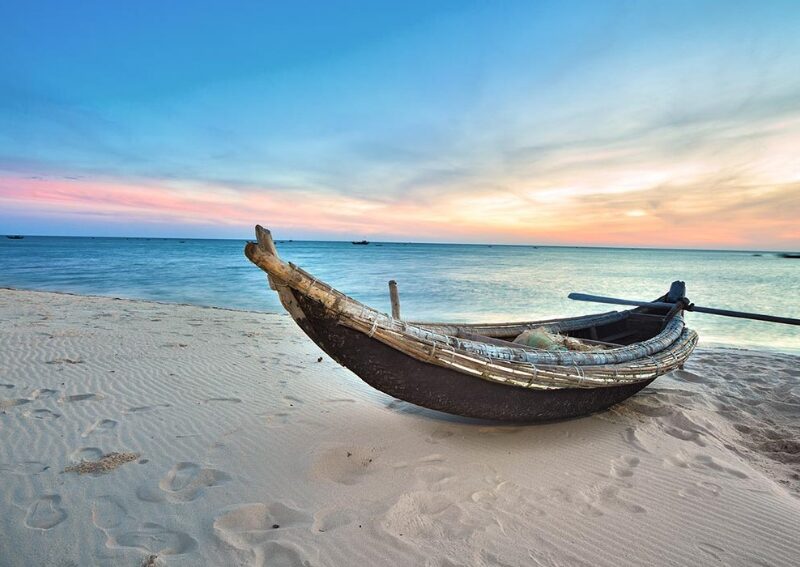
About 13 kilometers from the city center, Thuan An is Hue’s closest beach and a genuinely attractive stretch of coastline popular with local families and travelers who want a half-day break from history. The shallow, calm waters make it good for swimming, and the seafood restaurants along the beach serve some of the freshest catches in the province.
Hue Cuisine: The Most Refined Street Food in Vietnam
Royal cuisine is not just a historical concept in Hue. It is an active, living culinary tradition in which the influence of the Nguyen court’s kitchens can be traced directly to the dishes served at plastic-stool street stalls every morning across the city. The imperial chefs who fed thirteen emperors over 143 years developed a cuisine defined by small portions, complex preparation, precise seasoning, and a presentation standard that reflected the court’s insistence on beauty as part of the meal itself. That sensibility never entirely left.
Bun Bo Hue
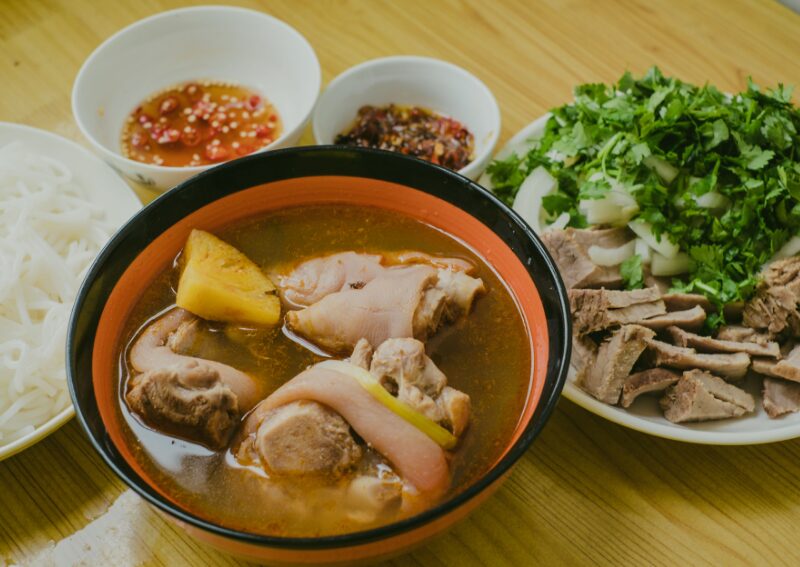
The city’s most famous dish and, for many food travelers, the single best bowl of noodle soup in Vietnam. A deeply savory beef and pork broth seasoned with mam ruoc, the pungent fermented shrimp paste native to central Vietnam, and finished with lemongrass, dried chili, and annatto. Served with thick round rice noodles, cha cua (crab patty), pork trotters, and a full garnish plate of banana blossom and fresh herbs. Born in Hue’s imperial kitchens and eaten here at its most uncompromising, using mam ruoc with a generosity that the dish’s northern and southern adaptations rarely match.
Banh Beo
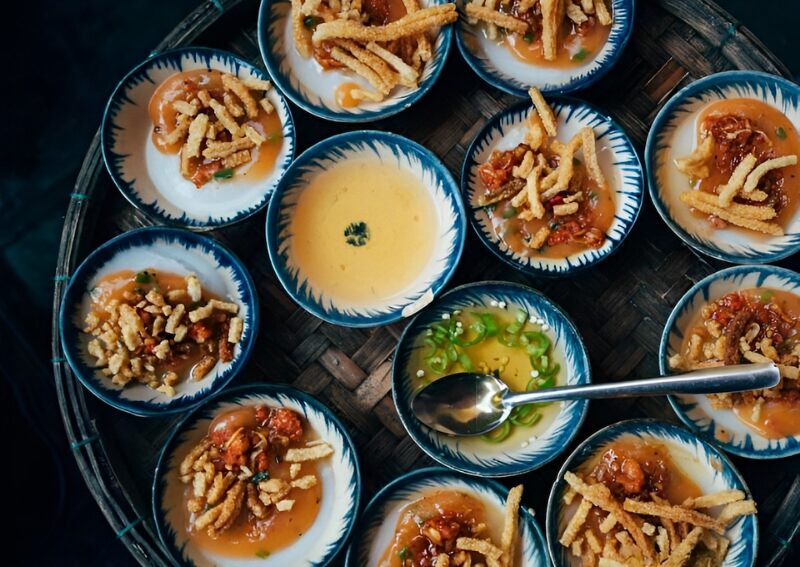
Small steamed rice cakes served in shallow clay dishes, topped with dried shrimp, crispy pork skin, and scallion oil. Eaten with a light dipping sauce and consumed in multiples, since each individual piece is barely more than two bites. One of the royal dishes that has become thoroughly democratic in Hue’s street food culture.
Banh Khoai
A crispy rice flour pancake filled with pork, shrimp, and bean sprouts, eaten wrapped in mustard leaf and rice paper with a thick peanut and sesame dipping sauce. Often described as Hue’s answer to banh xeo, the southern sizzling pancake, but with a different batter and a distinctly central Vietnamese dipping sauce.
Com hen
Rice mixed with tiny baby mussels, pork crackling, peanuts, sesame seeds, fermented shrimp paste, fresh herbs, and chili, served either warm or cold in a composed bowl that manages to contain ten or twelve distinct flavors and textures simultaneously. One of Hue’s most distinctive and most unfairly overlooked dishes among visitors who haven’t done their food homework.
Banh Mi Hue
Hue’s version of the banh mi uses a longer, softer roll than the crunchier Saigon standard, filled with the city’s own pate, cold cuts, and pickled vegetables. A small but meaningful regional variation worth comparing if you’ve already eaten your way through the southern version.
For Hue cuisine at its best, look beyond the restaurant dining rooms and find the morning street stalls that open before 7:00 AM and close when the pot runs out. That is where the most serious cooking in the city happens, and it has been happening that way for a very long time.
Practical Visiting Information
Getting to Hue
Phu Bai International Airport, located about 15 kilometers from the city center, receives domestic flights from Hanoi and Ho Chi Minh City, with the flight from Hanoi taking approximately 1 hour 10 minutes. The airport transfer into the city takes around 30 minutes by taxi.
Hue is also a major stop on the Reunification Express train line connecting Hanoi and Ho Chi Minh City. The train journey from Hanoi takes between 13 and 17 hours depending on the service, passing through some of the most scenic coastal terrain in the country. Traveling overnight in a sleeper cabin is the most practical option on this route.
From Da Nang, Hue is about 100 kilometers north, reached in approximately 2 to 2.5 hours by road through the Hai Van Pass, one of the most dramatic coastal stretches in Southeast Asia. Many travelers choose to cover this route by motorbike or with a private driver rather than by bus, since the scenery demands a pace that allows stopping.
Best time to visit
Hue’s most comfortable visiting months are February through April, when temperatures are warm but manageable and rainfall is at its lowest. March and April in particular offer ideal conditions for spending full days outdoors at the tombs and pagodas. From June to August, temperatures rise significantly and the humidity intensifies. October and November bring the highest rainfall and some risk of flooding. December and January see cooler temperatures and occasional rain but remain perfectly workable for a visit.
Getting around Hue
The city center and the Citadel are walkable from most hotels on the southern bank. For the Imperial City, a 25-minute walk or a short taxi or motorbike ride covers the distance. For the royal tombs, scattered across the hills south and west of the city, a hired bicycle (for the more energetic), rented motorbike, private car, or organized day tour are all practical options, with motorbike rides within the city costing around 15,000 VND. The Perfume River itself provides a natural navigation axis.
How much time to allow
Two full days is the minimum to cover the Imperial City, two or three royal tombs, Thien Mu Pagoda, and the Perfume River without feeling rushed. Three days allows for Kim Long, Dong Ba Market, An Dinh Palace, a half-day at Thuan An Beach, and the kind of unscheduled morning food eating that Hue genuinely rewards.
Combining Hue With a Hanoi Trip
Hue and Hanoi sit at opposite ends of northern and central Vietnam, connected by the Reunification Express train, a one-hour domestic flight, or an overland route through some of the country’s most scenic terrain. The two cities complement each other in a way that few other Vietnam combinations manage: Hanoi offers 1,000 years of dynastic and colonial history layered into a dense, living urban culture, while Hue offers a more contained, quieter encounter with the Nguyen imperial world and the most serious food culture in the country.
A practical combined itinerary runs three to four days in Hanoi followed by two to three days in Hue, or the reverse depending on your entry point. Flying between the two cities takes just over an hour, making the combination straightforward to manage without a long overland transit.
For the Hanoi portion of any trip that includes Hue, the base matters considerably. Hanoi La Siesta Classic Ma May, one of the best hotels in Hanoi Old Quarter, sits at the center of everything the capital has to offer. Located on Ma May Street, one of the Old Quarter’s most historically layered corridors and within easy walking distance of Hoan Kiem Lake, the Temple of Literature, the best pho and bun rieu cua stalls in the neighborhood, and the morning tra da setups that define street life in this part of the city, it offers the kind of stay that makes Hanoi feel like it belongs to you rather than the other way around.
Whether you are returning from a morning at Hoan Kiem Lake, stepping out to find bun bo Hue at a nearby Old Quarter stall before your flight south, or simply watching Ma May Street come alive at dusk after a day of planning the next leg of your itinerary, Hanoi La Siesta Classic Ma May is the kind of base that makes every part of the Hanoi experience feel unhurried and entirely your own. Consistently celebrated as one of the best boutique hotels in Hanoi Old Quarter, it is the right starting point for any central Vietnam journey that begins or ends in the capital.