



Bui Vien Walking Street 2026: The Complete Guide to Saigon’s Backpacker Street
At ten o’clock on a Saturday night, Bui Vien Street is four hundred metres of competing sound systems, plastic stools spreading halfway across the road, neon on every facade, and several thousand people who have decided that this is the correct way to spend an evening.
It is the loudest place in Vietnam, and visitors divide into two camps about it with unusual firmness. Half describe it as the best night of their trip. Half last twenty minutes.
Both reactions are reasonable, and most guides are unhelpful about this because they are written to sell something. Bui Vien is not Saigon’s nightlife; it is one very specific version of it, aimed squarely at young international travellers, and it makes no attempt to be anything else.
This guide covers when the street closes to traffic, what a night there actually looks like, what it costs, how to avoid the handful of genuine problems, and how to work out in advance whether you are in the half that will enjoy it.
What and Where Bui Vien Is
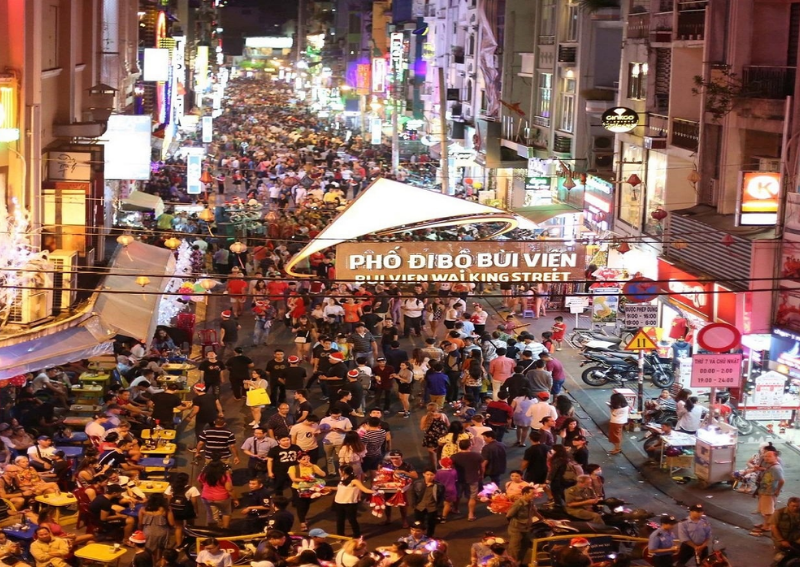
Bui Vien is a street in District 1, about a kilometre and a half west of Ben Thanh Market and roughly a fifteen minute walk or a five minute ride from the main colonial landmarks.
It forms one side of a triangle with Pham Ngu Lao and De Tham, the three streets that together make up what everyone calls the Saigon backpacker district.
How it became this
The area grew as Vietnam opened to independent travel in the 1990s. Cheap guesthouses, travel agencies selling open bus tickets, internet cafes and the kind of restaurant that serves both pho and banana pancakes.
For two decades it was scruffy, functional and genuinely useful. Over the last ten years the guesthouses have become hostels and hotels, the travel agencies have thinned out, and the bars have grown louder and bigger. The current version is less about backpacking than about going out.
What is actually on the street
Bars with open fronts and sound systems pointed at the road. Beer clubs with LED screens. Shisha lounges. Massage shops. A few restaurants. Convenience stores selling cold beer at a fifth of bar prices, which a significant proportion of the crowd is drinking on the kerb outside.
And along the middle of the road, vendors selling snacks, sunglasses, fidget toys and roses.
The streets around Bui Vien
Worth knowing, because they are the escape route. The alleys off Bui Vien and the stretches of Pham Ngu Lao and De Tham hold quieter bars, decent local restaurants and some of the better value accommodation in central Saigon. Fifty metres off the main strip the volume drops by half.
When Bui Vien Walking Street Happens
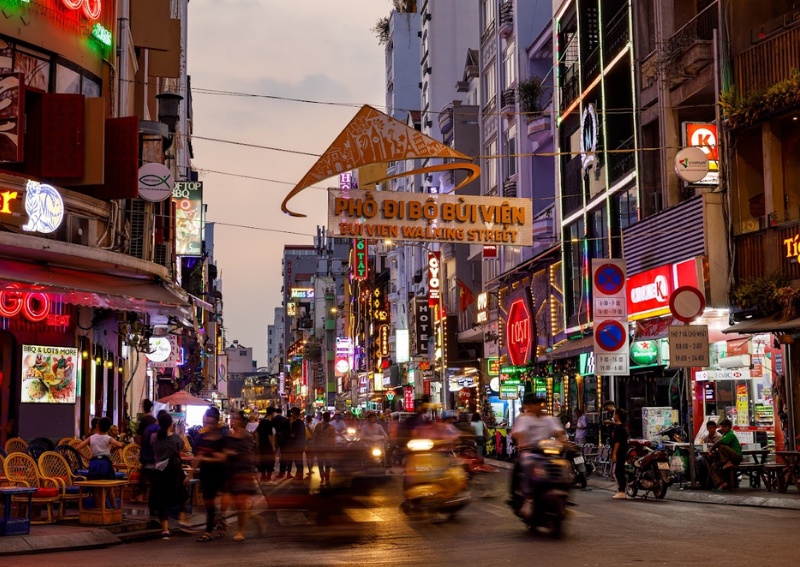
Bui Vien closes to motor vehicles on weekend evenings, which is when it earns the name.
Friday, Saturday and Sunday evenings, from around 7pm until the early hours, barriers go up at each end and the road belongs to pedestrians. Tables spread out from both sides until the walkable channel down the middle is about two metres wide.
On other nights the street stays open to traffic and the bars keep their tables on the pavement. Still busy, still loud, but motorbikes thread through the middle of it, which changes the character considerably.
Hours in practice
Enforcement of the exact start and finish has shifted over the years, and closing time in particular has moved with city policy on late licensing. The street has historically run later than almost anywhere else in District 1.
Check locally for the current position rather than relying on an article, including this one. Your hotel will know this week’s answer.
Which night to go
Saturday is the fullest, loudest and most photographed. If you want the version you have seen online, go then.
Friday is nearly the same with slightly fewer people.
Sunday is calmer and ends earlier.
A weeknight gives you the bars without the pedestrian street, which some people prefer and which is noticeably easier to have a conversation in.
What a Night Looks Like at Bui Vien Street
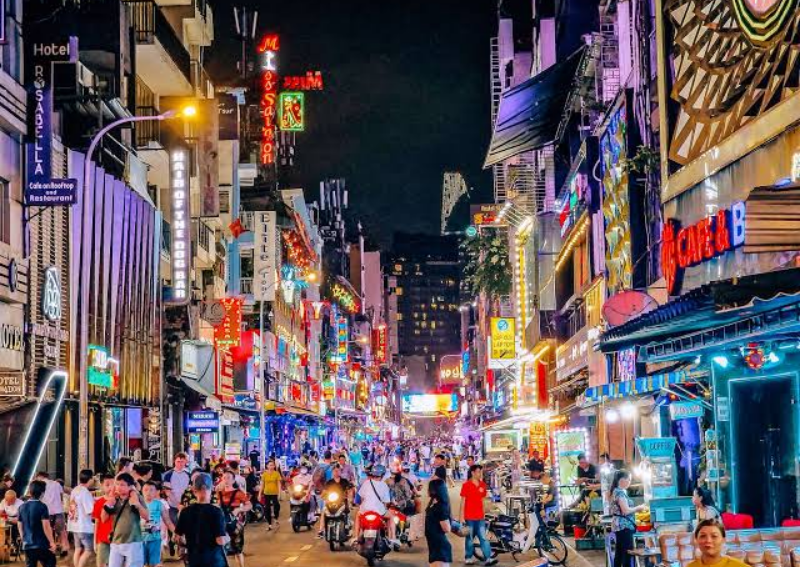
The street changes character completely over about five hours, and which version you meet depends entirely on when you arrive.
| Time | What it is like |
|---|---|
| 6 to 7pm | Quiet. Tables going out, staff eating dinner, a few early drinkers. Pleasant, and almost nobody sees it |
| 7 to 8.30pm | Filling up. Music on but conversational. The best window if you want to sit and talk |
| 8.30 to 10pm | Building. Sound systems competing, crowd thickening, vendors working the tables |
| 10pm to midnight | Peak. Loud enough that conversation happens by shouting. This is the version in every photograph |
| Midnight to 2am | Still going, thinner, messier. The crowd that remains is committed |
| After 2am | Winding down, depending on current licensing, with the late food carts doing their best trade |
The practical reading of that table
If you want to see Bui Vien and are not looking for a long night out, go at about half past seven, have a beer at a table near the quieter end, watch it build for an hour, and leave before ten. You will have seen it.
If you want the full experience, arrive at ten and accept that nothing you say to anyone will be properly heard.
One thing worth doing
Walk the full length of the street once, end to end, before choosing where to sit. The bars vary enormously in volume, crowd and price, and the difference between the two ends is bigger than it looks from a photograph.
What to Drink and Eat in Bui Vien Street
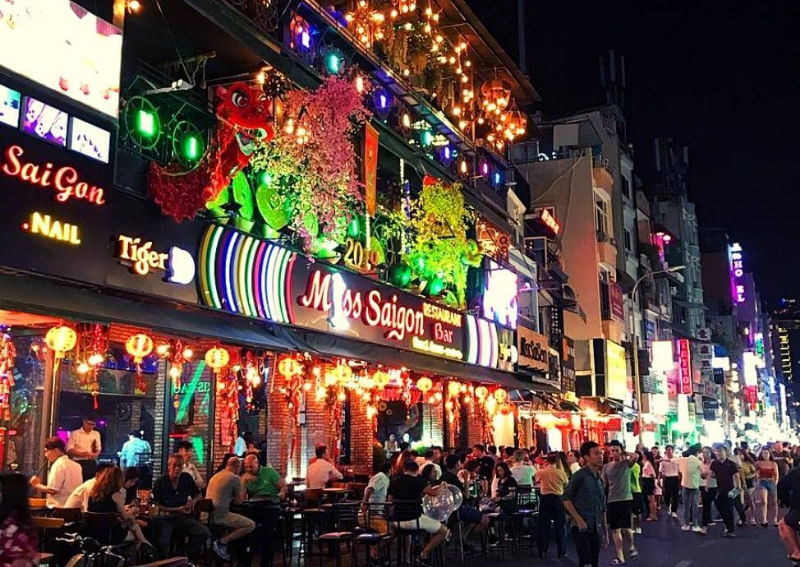
Beer on Bui Vien
The currency of the street. Local bottled beer runs roughly 20,000 to 50,000 VND in a bar, depending on how prominent the bar is, and considerably less from a convenience store.
Many bars run buy one get one offers through the evening, and the stated price on a pavement sign is usually the real one. Cocktails are cheap and correspondingly weak.
The convenience store option
A significant part of the crowd buys beer from the Circle K or the family run shop and drinks it sitting on the kerb. This is normal, nobody minds, and it costs about a fifth of bar prices.
It is also how a lot of people meet each other on this street, since the kerb is more sociable than a table.
Beer clubs
The larger venues with LED walls, bottle service and a DJ. Vietnamese young people go to these in groups and the energy is genuinely good. Prices are higher and the format is table based, so solo visitors may find them harder work.
Food on Bui Vien
The street food on Bui Vien itself is adequate rather than good, aimed at people who have been drinking. Expect grilled skewers, fried rice, banh mi and the occasional pizza.
The better eating is one street back. Pham Ngu Lao and the alleys off it have local restaurants serving proper com tam, banh mi and hu tieu at local prices, and they stay open late.
If you want a better drink
Bui Vien is not the place for a well made cocktail. District 1 has a serious cocktail scene a ten minute walk east, and the rooftop bars around Nguyen Hue are a different proposition entirely.
A reasonable evening is one drink on Bui Vien for the spectacle and the rest somewhere with ice that was made properly.
Bui Vien Compared to the Rest of Saigon Nightlife
Bui Vien is one option among several, and it is the least representative of the city.
| Where | Crowd | Volume | Price | Best for |
|---|---|---|---|---|
| Bui Vien | Young international travellers | Very loud | Cheap | Meeting people, spectacle, a big night |
| Nguyen Hue Walking Street | Vietnamese families and students | Lively but calm | Free | An early evening, people watching, children |
| Rooftop bars, District 1 | Mixed, older, dressier | Moderate | Expensive by local standards | Views, cocktails, a quieter night |
| The Cafe Apartment | Young Vietnamese and visitors | Varies by floor | Moderate | A slow evening, coffee or a drink with a view |
| Thao Dien | Expats and residents | Moderate | Moderate to high | Craft beer, live music, a local feel |
| District 5 and the local beer streets | Almost entirely Vietnamese | Loud but different | Very cheap | Seafood, beer, no English menu |
The useful comparison
Nguyen Hue and Bui Vien are a twenty minute walk apart and could not be less alike. One is where Saigon goes out with its family on a Saturday. The other is where visitors go out with each other.
Seeing both in one evening is the most efficient way to understand the city after dark, and the walk between them takes you past most of the colonial centre lit up.
Is Bui Vien Worth Visiting?
The honest answer is that it depends on what you came to Vietnam for, and most people can predict their own reaction.
You will probably enjoy it if
You are travelling solo or in a small group and want to meet people. You like a loud night out. You are in your twenties, or you are not and do not care. You want cheap beer and no dress code. You enjoy a street where something is happening in every direction.
You will probably not if
You want to hear the person opposite you. You came to Vietnam for the food and the culture and resent time spent away from it. You find aggressive music and constant sales approaches tiring. You are travelling with children. You are sensitive to noise.
The middle position
Most visitors land here: worth seeing once, for an hour, at the right time of evening, as a piece of the city rather than the point of the night.
Go at half past seven. Sit at the quieter end. Have one beer. Watch it fill up. Then walk east into the rest of District 1 and have dinner somewhere you can hear yourself.
That version costs about three dollars and takes an hour, and almost nobody regrets it.
What it is not
It is not representative of Saigon after dark, and a visitor who sees only Bui Vien has not seen the city’s nightlife at all. The local version of a night out happens on beer streets in other districts, over seafood, with no English menu and no sound system. Both are real. Only one of them is in every guidebook.
Safety and Common Problems
Bui Vien is not dangerous. Violent crime against visitors is rare and there is a visible security presence on weekend nights. The problems are the ordinary ones of any busy drinking street, plus two worth naming directly.
Check the bill
The most common complaint. Drinks added that were not ordered, a promotional price not applied, or a round counted twice.
It is usually carelessness in a loud, busy bar rather than a deliberate scam, and it is solved the same way either way: confirm prices when you order, keep a rough count, and look at the bill before paying.
Bag snatching
The real risk, and it happens on the streets around Bui Vien rather than on the pedestrian section itself. Phones taken from hands at the kerb and bags lifted from the back of a chair, usually by someone on a passing motorbike.
Keep your phone away unless you are using it, keep bags in front of you or between your feet, and do not stand at the roadside texting.
Touts and sellers
Constant. Massage offers, souvenirs, shoeshine and roses. A firm no and no eye contact works. Being rude is unnecessary and being endlessly polite extends the conversation.
The shoeshine approach, where someone takes your shoe to clean it and then demands a high price, still occurs. Do not hand over footwear.
Drinks
Stick to bottled beer you see opened, or drinks poured in front of you. Do not leave a glass unattended. This is standard advice for any busy bar anywhere and applies here as it does at home.
If something goes wrong
There is a police presence on the street at weekends. Your hotel is the better first call for anything non urgent, since staff can translate and know the local procedure.
Bui Vien: Practical Tips
A few things worth knowing before you go. For wider trip planning, Vietnam’s national tourism site is the official reference.
Getting there. See our airport to city centre guide if you are arriving the same day. A short ride from anywhere in District 1, or a fifteen to twenty minute walk from Ben Thanh Market. On weekend nights drivers cannot enter the closed section, so you will be dropped at one end.
Getting home. Ride hailing works late. Walk one street away from the barriers before ordering, so your driver can actually reach you. Demand is high at closing time, so expect a wait and higher fares.
Cash. Bars take cards, street vendors and convenience stores do not. Carry small notes and do not flash a full wallet.
What to carry. As little as possible. Phone, a card, enough cash for the evening. Leave the passport in the hotel safe.
What to wear. Anything. There is no dress code on this street and shorts and sandals are the norm.
Noise if you are staying nearby. This is the thing to think about before booking a room in the backpacker district. The street runs until the early hours three nights a week and the sound carries. If you are a light sleeper, stay a few streets away or ask for a room at the back.
Solo travellers. This is one of the easiest places in Vietnam to meet people, which is the main reason it exists in its current form. The kerb outside a convenience store is more sociable than a bar table.
Female travellers. Generally comfortable, with the usual caveats that apply to any crowded drinking street. Approaches from touts and from other visitors are frequent rather than threatening. A clear no works.
Pacing. The combination of cheap beer, heat and a long night catches people out. Drink water, and remember that the Vietnamese heat does not switch off at midnight.
Bui Vien: Frequently Asked Questions
What is Bui Vien Street? The main street of Saigon’s backpacker district in District 1, lined with bars, beer clubs and street vendors. It closes to traffic on weekend evenings and becomes a pedestrian walking street.
When is Bui Vien a walking street? Friday, Saturday and Sunday evenings, from around 7pm until the early hours. On other nights the bars operate but motorbikes still use the road.
What time does Bui Vien close? It has historically run later than anywhere else in District 1, into the early hours. Closing time has shifted with city licensing policy, so check locally for the current position.
Is Bui Vien worth visiting? Worth seeing once if you want a loud, cheap night out or you are travelling solo and want to meet people. Less so if you want conversation, a well made drink or something representative of Saigon.
Is Bui Vien safe? Generally yes. Violent crime against visitors is rare and there is security on weekend nights. The practical risks are bill errors, bag snatching on the surrounding streets and persistent touts.
How much does a beer cost on Bui Vien? Roughly 20,000 to 50,000 VND in a bar, around one to two US dollars, and considerably less from a convenience store.
Where is Bui Vien Street? In District 1, about a kilometre and a half west of Ben Thanh Market, forming a triangle with Pham Ngu Lao and De Tham.
What is the difference between Bui Vien and Nguyen Hue? Nguyen Hue is a wide pedestrian boulevard where Vietnamese families spend the evening, calm and free. Bui Vien is a narrow bar street aimed at young international travellers and is extremely loud. They are twenty minutes apart on foot.
Where to Stay Near Bui Vien
The thing most people get wrong about Bui Vien is treating it as a place to sleep rather than a place to visit. The street runs until the early hours three nights a week, and the noise does not respect a closed window.
The better arrangement is a central base close enough to walk over for an hour and far enough to not hear it afterwards.
La Siesta Premium Saigon Central offers an elegant retreat in the heart of District 1, within easy reach of Ben Thanh Market, Nguyen Hue Walking Street and the Saigon riverfront, with Bui Vien a short ride or a fifteen minute walk west.
For travellers comparing the best hotels in Saigon, that is the practical distance: close enough that a night out needs no planning, far enough that the evening ends in quiet. Recognised among the best boutique hotels in Saigon, it combines Vietnamese inspired design, thoughtful service and a calm atmosphere, which is the opposite of what Bui Vien offers and exactly what you want at one in the morning.
For anyone comparing the best hotels in Saigon District 1, it also puts the rest of the city’s nightlife, from the rooftop bars to the Nguyen Hue walking street, within the same short walk.