



Hanoi Flag Tower 2026: The Monument That Has Flown Vietnam’s Colors for Over Two Centuries
There are landmarks that photograph well, and then there are landmarks that mean something. The Hanoi Flag Tower, known in Vietnamese as Cot Co Ha Noi, one of Hanoi attractions, belongs firmly in the second category. Standing at 41 meters from base to tip of flagpole, this three-tiered stone tower has risen above the western edge of Hanoi’s imperial district since 1812, outlasting dynasties, colonial occupation, two major wars, and the full arc of modern Vietnamese history.
The flag that flies from its peak, a red field with a single gold star, is the same flag hoisted here on October 10, 1954, the day the Democratic Republic of Vietnam officially took control of Hanoi after nine years of resistance against French colonial rule. That moment is considered one of the most significant in the country’s modern history, and the tower has been its physical witness ever since.
For visitors to Hanoi, the Flag Tower is not merely a sightseeing stop. It is a place where the long sweep of Vietnamese history comes into focus against a single, enduring structure.
A Monument Born From Imperial Power – One of Hanoi Cultural Monuments
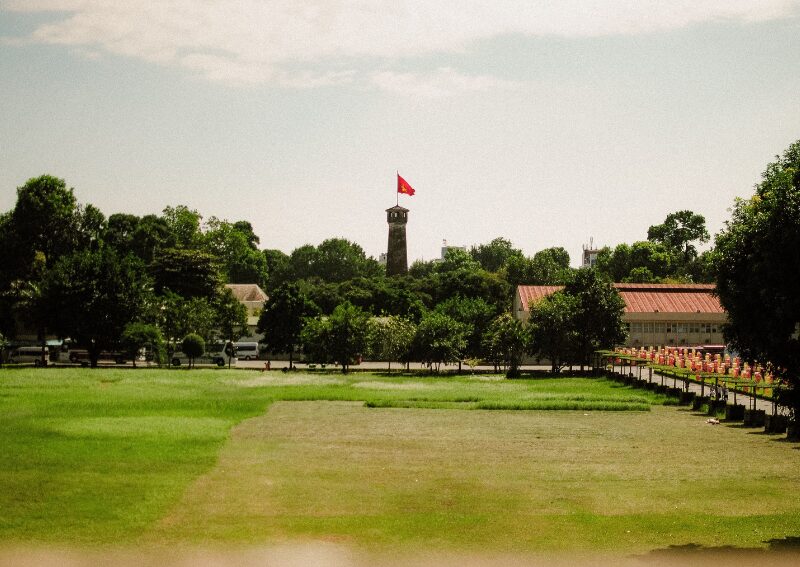
The Hanoi Flag Tower was built between 1805 and 1812 under the order of Emperor Gia Long, the founder of the Nguyen Dynasty who had unified Vietnam under a single ruler for the first time three years earlier. Its construction was part of a broader project to establish Hanoi, then known as Thang Long, as a fortified imperial center, and the tower served a specific military function: an observation post from which sentinels could monitor the surrounding landscape and signal the presence of incoming forces.
The tower was built as part of the Hanoi Citadel complex, the military and administrative heart of the northern capital, which today is recognized as the Imperial Citadel of Thang Long, a UNESCO World Heritage Site. The area has been a seat of Vietnamese power since the 11th century, when Emperor Ly Thai To chose this location for his royal capital in 1010, and the Flag Tower carries that long lineage in its foundations.
The structure survived the French colonial period largely intact, though its function changed dramatically. French authorities used the tower as a military observation post during their administration of Indochina, a usage that mirrors its original imperial purpose but in the service of colonial control rather than imperial sovereignty. When the Viet Minh resistance forces reclaimed Hanoi in 1954, one of the first acts of national reclamation was to raise the gold-starred red flag from the tower’s summit, a moment that was broadcast across the city and witnessed by crowds gathered at Ba Dinh Square nearby.
In 1989, the Hanoi Flag Tower was officially designated a national cultural and historical relic by the Vietnamese government. Its image has appeared on some of the country’s earliest banknotes and in countless official publications as a symbol of national identity and resilience.
The Architecture: Three Tiers, One Story – UNESCO World Heritage Hanoi
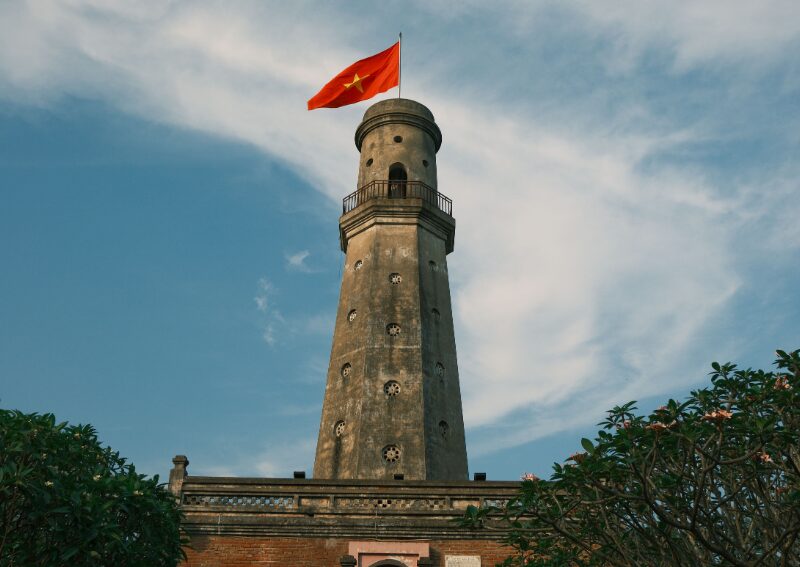
The Flag Tower’s design reflects the architectural conventions of the Nguyen Dynasty period, combining functional military purpose with aesthetic deliberateness. The structure rises in three distinct tiers, each slightly narrower than the one below, before a cylindrical column ascends from the third level to the flagpole at the very top.
The base tier is broad and fortified, built from terracotta brick in the style typical of Nguyen-era military construction, with thick walls designed to withstand bombardment as much as to support the structure above. Each of the four faces of the base tier features a single doorway, each oriented to one of the cardinal compass points, which in traditional Vietnamese cosmology corresponds to a directional deity or guardian.
The doors are named Nghenh Huc (welcoming the sunrise, facing east), Huong Phong (facing the wind, facing west), Hoi Quang (reflecting the light, facing south), and Thu Lam (gathering the mist, facing north). The symbolism of facing all four directions simultaneously gave the tower a ceremonial resonance beyond its practical military use.
The interior contains a spiral staircase of 54 steps leading to the upper observation level, a number that is often noted as corresponding to the 54 ethnic groups recognized in Vietnam, though this correspondence may be coincidental rather than designed.
The staircase is climable by visitors, and the ascent is one of the more rewarding things to do in Hanoi’s Ba Dinh district, not because of dramatic elevation but because of the perspective it offers: standing at the observation level with the Vietnamese flag overhead and the rooflines of the Ba Dinh district spreading out in every direction gives a genuine sense of how this monument has anchored the city’s landscape for more than two centuries.
What You Can See From the Top of One of Hanoi Historical Sites
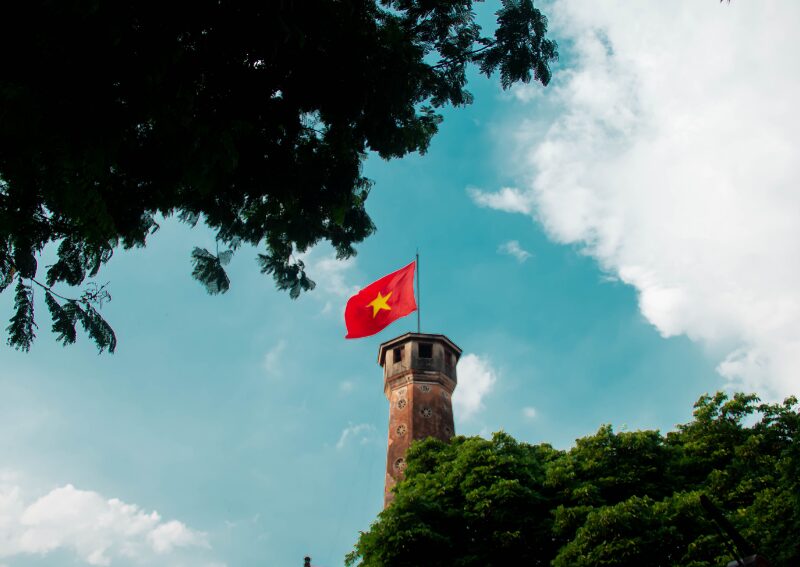
The view from the Flag Tower’s upper level is not panoramic in the way of a rooftop bar or a tall building, but it is historically orienting in a way that those views are not. Looking north from the tower, the walls and excavation areas of the Imperial Citadel of Thang Long are visible, the same citadel grounds that Emperor Ly Thai To established in 1010 and that have been the subject of ongoing archaeological excavation since the early 2000s.
Looking west, the tree canopies of Lenin Park shade the approaches to Ba Dinh Square and the Ho Chi Minh Mausoleum. Looking east, the city stretches toward Hoan Kiem Lake, Hanoi’s spiritual center. This orientation makes the Flag Tower one of the best places in the city to develop a mental map of how Hanoi’s history layers itself spatially, with ancient citadel walls to the north, revolutionary monuments to the west, and the commercial and cultural heart of the old city to the east.
The Vietnam Military History Museum: A Note for Visitors
The Hanoi Flag Tower is historically associated with the grounds of the Vietnam Military History Museum, which was previously located adjacent to the tower at 28A Dien Bien Phu Street in Ba Dinh District. In November 2024, the museum relocated to a new, significantly larger facility in Nam Tu Liem District, approximately 6 kilometers west of the city center.
The new site covers 386,600 square meters, includes a four-floor main building and a 45-meter Victory Tower, and houses over 150,000 artifacts including four designated national treasures: the MiG-21 aircraft serial number 5121 that shot down an American B-52 during the 1972 air campaign, and the T-54B tank serial number 843 that crashed through the gates of the Presidential Palace in Saigon on April 30, 1975.
Visitors planning to combine the Flag Tower with the new Military History Museum should allow for transit time between the two locations. The Flag Tower itself remains at the Ba Dinh District site and is accessible to visitors, while the full museum collection is now at the new Nam Tu Liem location. For the Flag Tower specifically, the grounds at 28A Dien Bien Phu Street remain open to visitors and the tower itself can be climbed during visiting hours.
Practical Visiting Information
- Address: 28A Dien Bien Phu Street, Ba Dinh District, Hanoi. The tower is located within the former Vietnam Military History Museum grounds, near Ba Dinh Square and the Ho Chi Minh Mausoleum complex.
- Opening hours: Tuesday to Sunday, 8:00 AM to 11:30 AM and 1:00 PM to 4:30 PM. The site is closed on Mondays and Fridays. Plan your visit around the midday break to avoid arriving during the closure.
- Ticket price: Approximately 40,000 VND per adult as of 2025. Children under 16, visitors aged 80 and above, and war veterans enter free. Discounts apply for students and senior visitors.
- Getting there:
- By taxi or Grab from the Old Quarter: approximately 15 to 20 minutes depending on traffic, costing around 60,000 to 90,000 VND.
- By bus: routes 9, 18, 41, and 45 stop near the site on Dien Bien Phu Street.
- On foot from the Temple of Literature: approximately 10 minutes, making the two sites a natural pairing for a single morning itinerary.
- By bicycle: the Ba Dinh district is flat and well-suited to cycling, and many Old Quarter hotels and guesthouses offer bicycle hire.
- How much time to allow: The Flag Tower itself takes 30 to 45 minutes to explore properly, including the climb and time spent at the observation level. Combining it with Ba Dinh Square, the Ho Chi Minh Mausoleum, and Uncle Ho’s Stilt House nearby makes for a comfortable half-day itinerary focused on Hanoi’s 20th-century political and revolutionary history.
Tips for Visiting the Hanoi Flag Tower
Go in the morning. The morning session between 8:00 AM and 10:30 AM is typically the quietest time to visit, with better light for photography and cooler temperatures for the staircase climb. The flag is most dramatically lit in the morning when the eastern light catches the red field against the sky.
Combine with the Imperial Citadel of Thang Long. The UNESCO-listed citadel grounds are a short walk from the Flag Tower and provide the deeper historical context for understanding why this location mattered so much to successive Vietnamese rulers over a thousand years. Together, the citadel and the tower tell a layered story of Hanoi as a center of power that no single site covers alone.
Come on a day with a breeze. The national flag at the tower’s summit is most impressive when it is fully extended in the wind. Still days in Hanoi’s hot months can leave the flag hanging close to the pole, which makes less of an impression. The cooler months between October and April tend to offer more consistent wind and therefore more dramatic flag displays.
Dress modestly and follow the site rules. The tower is considered a national cultural monument and the surrounding grounds are maintained accordingly. Visitors are asked not to touch the structure, to avoid smoking on the grounds, and to carry out any food or drink brought in. Photography of the tower exterior and from the observation level is generally permitted.
Plan around the mausoleum’s schedule separately. If you want to combine the Flag Tower visit with a visit to the Ho Chi Minh Mausoleum, note that the mausoleum operates on different hours and is closed on Mondays and Fridays as well as during annual maintenance between September and November.
Checking the mausoleum’s current schedule before planning your day avoids the frustration of arriving on a closed day.
Where to Stay for a Hanoi Historical Itinerary
The Flag Tower, the Imperial Citadel, the Ho Chi Minh complex, and the Temple of Literature all cluster in the Ba Dinh and Dong Da districts west of the Old Quarter. From any base in the Old Quarter, these sites are accessible by a short taxi or Grab ride, typically 15 to 20 minutes and no more than 100,000 VND. The ease of that connection means that where you stay in the Old Quarter matters more for the quality of the rest of your day than for the logistics of reaching the Flag Tower itself.
Hanoi La Siesta Premium Hang Be is a natural choice. Sitting in the heart of the Old Quarter, one of the most well-located positions in Hanoi for reaching both the city’s major historical landmarks and its most compelling neighborhood experiences, the hotel puts you within easy access of the Ba Dinh district’s monuments in the morning and the Old Quarter’s food streets, street life, and lake-side atmosphere in the afternoon and evening, the kind of rhythm that makes a Hanoi historical itinerary feel genuinely satisfying rather than simply efficient.
It has earned consistent recognition as one of the best boutique hotels in Hanoi Old Quarter through a combination of carefully considered design, genuinely warm hospitality, and the kind of calm atmosphere that makes a day of monument visits and staircase climbs feel manageable rather than exhausting. For travelers searching for the best hotels in Hanoi that position them well for both the city’s historical depth and its daily street life, Hanoi La Siesta Premium Hang Be is the kind of base that ties the entire Hanoi experience together into something that feels unhurried and entirely your own.