



Ho Chi Minh Museum Hanoi 2026: One Man’s Life, One Nation’s Story
There are places in Hanoi that tell you about history, and then there is the Ho Chi Minh Museum, which tells you about the man who made it. More than a conventional collection of artifacts behind glass, this is one of the most conceptually ambitious museum experiences in Southeast Asia, built around the life of Vietnam’s most revered leader and the global forces that shaped both him and his nation across eight decades of revolution, war, and independence.
Understanding President Ho Chi Minh means understanding modern Vietnam, and Ho Chi Minh Museum Hanoi, housed in one of Hanoi’s most architecturally striking buildings, is one of Hanoi historical sites to do exactly that.
Ho Chi Minh Museum Hanoi – Vietnam History Museum
Ho Chi Minh, known affectionately by Vietnamese people as Bac Ho or Uncle Ho, led Vietnam’s struggle for independence from French colonialism, founded the Democratic Republic of Vietnam in 1945, and guided the country through decades of conflict until his death in 1969. His influence on modern Vietnam is difficult to overstate. The country’s constitution, its system of government, its national identity, and the values that define public life across all three regions all bear the imprint of his thought, his writing, and his leadership.
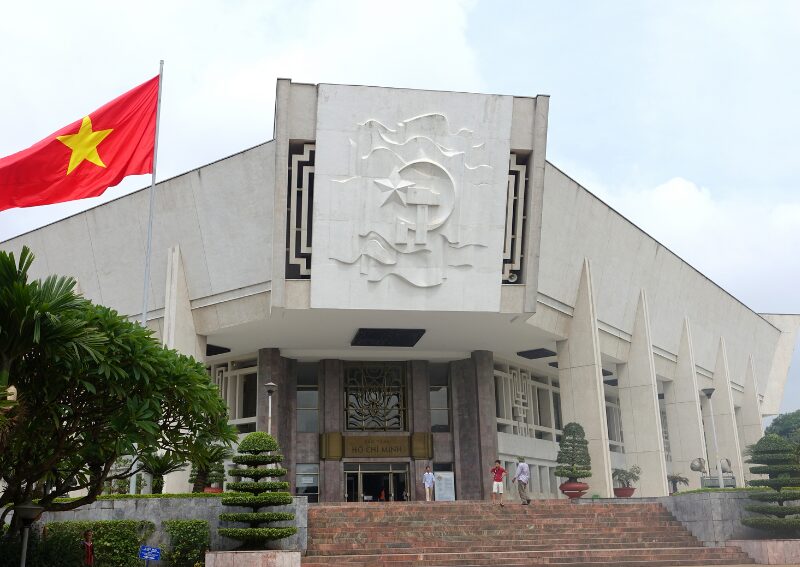
The Ho Chi Minh Museum was inaugurated on May 19, 1990, near Ba Dinh Square Hanoi, marking the 100th birthday of President Ho Chi Minh. The date was chosen deliberately: the museum was conceived not merely as an archive but as a living tribute, opened at a moment of national commemoration and designed to convey the depth of Vietnamese respect for its founding leader. More than three decades later, it remains the definitive account of his life and legacy available to visitors in Hanoi.
The Building: A Lotus in Concrete – One of the Hanoi Cultural Attractions
Before entering the museum, take a moment to look at the building itself. The structure is shaped like a lotus flower, considered to symbolize the noble character of Uncle Ho. The lotus is one of the most significant symbols in Vietnamese culture, representing purity, spiritual elevation, and the capacity to rise above difficult circumstances, which is also how many Vietnamese people describe Ho Chi Minh’s own journey from a modest upbringing in Nghe An Province to international revolutionary leadership.
According to traditional Vietnamese philosophy, the sky was represented as round and the earth as square, and this idea is clearly traced in the Ceremonial Hall: its round ceiling symbolizes the sky, and the square floor decorated with images of Vietnamese flowers and plants symbolizes the earth, with the statue of Ho Chi Minh located exactly between sky and earth. This symbolic architecture is not decorative but intentional, placing Ho Chi Minh at the point where heaven and earth meet, a positioning that reflects the reverence with which he is held in Vietnamese cultural memory.
What’s Inside: Three Floors of Revolutionary History
The museum is organized across three floors, each with a distinct focus and a presentation style that combines historical documentation with artistic installation in a way that is unlike most conventional museums.
First Floor: The Biography of a Nation
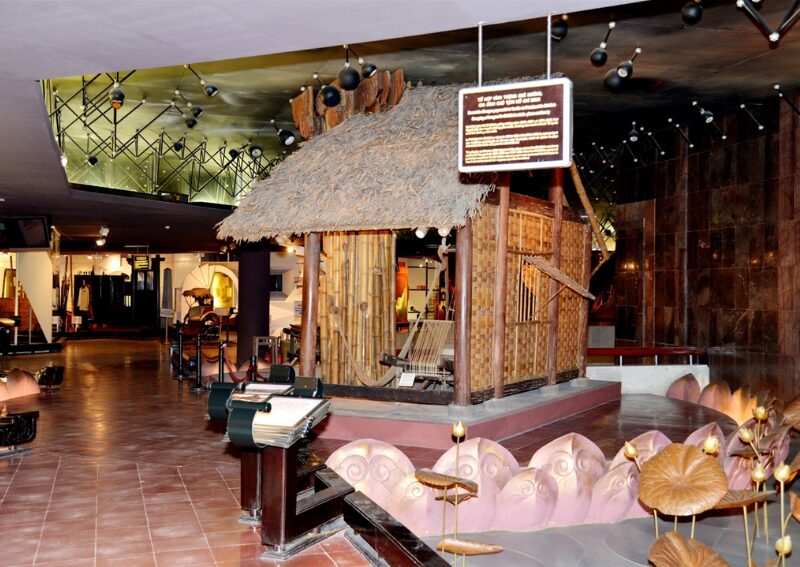
The first floor displays biography details through nine distinct themes, tracing the early years from 1890 to 1910 in Nghe An Province, where President Ho Chi Minh lived with his family. From there the story follows his extraordinary global journey, which took him through more than thirty countries across Asia, Europe, Africa, and the Americas as he searched for a path to Vietnamese liberation.
The museum charts his time in France and the founding of the Communist Party of Vietnam, his role in the August Revolution, the struggle for independence from 1945 to 1954, and the resistance war that followed. The section on his final days in 1969 closes the biographical narrative with documents and footage that summarize the revolutionary and cultural heritage he left behind. The collection here includes more than two thousand documents, articles, photographs and other exhibits illustrating not only the historical events that took place in the life of President Ho Chi Minh but also facts that happened in the world from the end of the 19th century related to Vietnam.
Second Floor: Artifacts of War and Liberation
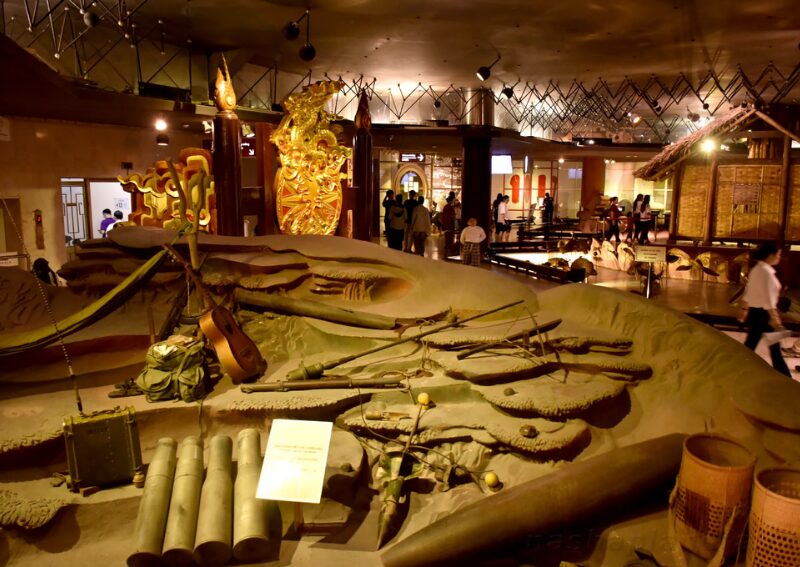
The second floor shifts focus to the physical evidence of war and peace, displaying revolutionary artifacts that tell the story of Vietnam’s historical victory. The displays include artifacts related to the historical victory of the resistance wars against fascists and colonists, presented not simply as museum objects but as what the museum itself describes as “victory relics,” physical evidence of a struggle that defined the 20th century in Southeast Asia.
Third Floor: Art, Light, and Legacy
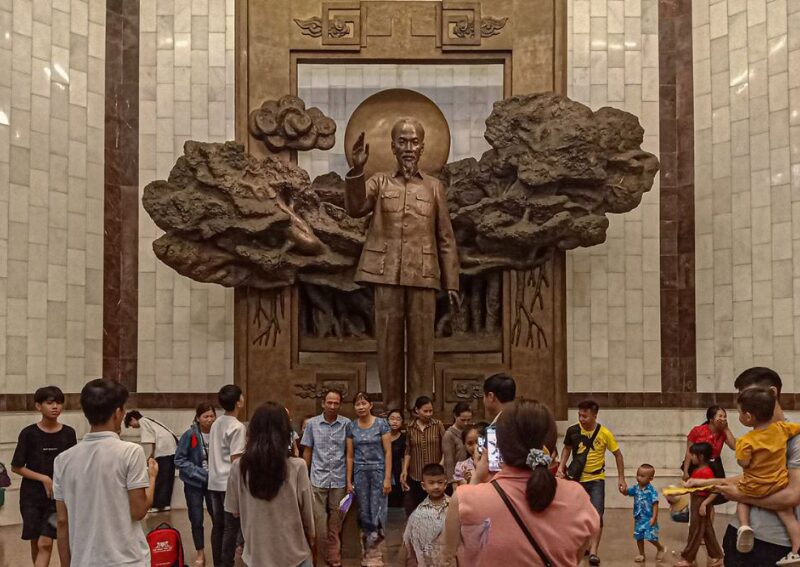
On the third floor, a beckoning statue of Ho Chi Minh greets visitors. Different from the solemnity of general memorial halls, the exhibition here is full of artistic beauty. The booths are designed with various shapes according to the exhibits, and the lighting design of the exhibition area is unique. A large number of background paintings and allegorical installations are also used, which is thought-provoking. This floor is the most visually ambitious section of the museum and the one that rewards the most time, particularly for visitors who approach the displays as both historical documents and works of art in their own right.
The Ho Chi Minh Complex: What Surrounds the Museum
The museum does not stand alone. It is part of the Ho Chi Minh complex, an important heritage site in Hanoi that also includes the Ho Chi Minh Mausoleum, the Presidential Palace, Uncle Ho’s Stilt House, and the One Pillar Pagoda. Each element of this complex adds a different dimension to the story told inside the museum.
The Ho Chi Minh Mausoleum
The Ho Chi Minh Mausoleum, where Ho Chi Minh’s preserved body lies in state and receives visitors in respectful silence, is the most solemn site in the complex and one of the most significant in all of Vietnam. Note that the mausoleum is closed on Mondays and Fridays, and closes entirely for annual maintenance usually between September and November. Entry is free but dress code and security protocols are strictly enforced.
The Presidential Palace
The Presidential Palace, a yellow French colonial building originally constructed as the residence of the Governor-General of Indochina, was offered to Ho Chi Minh as his official residence after independence. He declined to live in it, choosing instead the modest stilt house nearby, a detail that says something important about his personal values and one that the museum’s exhibits explore in depth.
Uncle Ho’s Stilt House
Uncle Ho’s Stilt House is a simple wooden structure built on stilts surrounded by a carp pond and garden, where Ho Chi Minh lived and worked from 1958 until his death in 1969. The contrast between this humble home and the grand palace a few meters away is one of the most quietly powerful moments available to visitors anywhere in Hanoi.
One Pillar Pagoda
The One Pillar Pagoda, standing in a small pond on a single stone column and originally built in 1049 during the Ly Dynasty, completes the complex with a structure that predates Ho Chi Minh by nine centuries but shares the same quality of meaning more than it appears to at first glance.
Practical Visiting Information
- Address: 19 Ngoc Ha Street, Ba Dinh District, Hanoi. The museum is located near Ba Dinh Square, within easy walking distance of the Ho Chi Minh Mausoleum and One Pillar Pagoda.
- Opening hours: The Ho Chi Minh Museum operates with a specific schedule that splits the day: morning from 8:00 AM to 12:00 PM and afternoon from 2:00 PM to 4:30 PM. The midday closure is easy to overlook when planning a day itinerary, so build the gap into your schedule rather than arriving at 1:00 PM and finding the entrance closed.
- Ticket price: Entry is 40,000 VND for adults (almost 2 dollars/adult ticket) , making it one of the most affordable museum experiences in Hanoi relative to the depth of what it contains. Children and students may be eligible for reduced rates.
- Closed days: The museum is closed on Mondays and Friday afternoons. Plan accordingly if your Hanoi days are limited.
- Getting there
- By taxi or Grab from the Old Quarter: approximately 15 to 20 minutes, 60,000 to 100,000 VND depending on traffic.
- By bus: routes number 9, 14, 33, and 45 all pass by the museum.
- On foot from the Temple of Literature: approximately 10 to 15 minutes, making the two sites a natural pairing for a single morning.
- How much time to allow: Plan two to three hours to explore both the museum and other parts of the Ho Chi Minh complex. Visitors who move quickly through the museum alone typically spend 45 to 60 minutes inside. Those who read the displays carefully or join a guided tour should allow 90 minutes to two hours for the museum itself, with additional time for the mausoleum queue and the stilt house garden.
Tips for Getting the Most From Your Visit
Hire a guide or join a guided tour. You get the best from this museum if you can go with a private guide, as most of the displays have fairly minimal English or French. The museum’s installations are conceptually rich but can be difficult to interpret without historical context, and a guide adds a layer of understanding that transforms the experience from visually interesting to genuinely illuminating.
Dress respectfully and plan for security. Access to Ba Dinh Square and all attractions on it, including the Ho Chi Minh Museum, is now restricted by security measures and a dress code. Shoulders and knees should be covered. Hats should be removed in the ceremonial areas. Photography restrictions apply in specific zones and are clearly marked.
Go early in the morning. The museum opens at 8:00 AM, and the morning session before 10:30 AM is typically the least crowded. The afternoon session from 2:00 PM is also generally quieter than midday at other Hanoi sites.
Pair with the Temple of Literature on the same day. The two sites sit within walking distance of each other in the Ba Dinh district and together give a comprehensive account of Vietnam’s intellectual and political heritage from the 11th century to the 20th. A morning at the Temple of Literature followed by an afternoon session at the Ho Chi Minh Museum and complex makes for one of the most historically satisfying single days available in Hanoi.
Where to Stay for a Hanoi Historical Itinerary
A day that takes in the Ho Chi Minh Museum, the mausoleum complex, and perhaps the Temple of Literature covers the western and Ba Dinh side of Hanoi’s historical map. To reach all of these comfortably, without long transit times cutting into your actual visiting hours, you need a base that keeps the city’s geography working in your favor.
Hanoi La Siesta Premium Hang Be is a natural choice. Sitting in the heart of the Old Quarter, one of the most well-located positions in Hanoi for reaching both the Ba Dinh district’s historical landmarks and the city’s most compelling neighborhood experiences, the hotel puts you within easy striking distance of the Ho Chi Minh complex, the Temple of Literature, Hoan Kiem Lake, and the best food streets in the city, all accessible by taxi, Grab, or bicycle within a matter of minutes.
It has earned consistent recognition as one of the best boutique hotels in Hanoi Old Quarter through a combination of carefully considered design, genuinely warm hospitality, and the kind of peaceful atmosphere that makes a history-heavy travel itinerary feel manageable rather than exhausting. For travelers searching for the best hotels in Hanoi that let you spend the morning in the quiet dignity of the Ho Chi Minh Museum and the afternoon wandering the Old Quarter’s food stalls and tea corners, Hanoi La Siesta Premium Hang Be is the kind of base that ties every part of the Hanoi experience together into something that feels unhurried and entirely your own.