



How to Get Around Hanoi 2026: A Complete Transportation Guide for Travelers
To Get around Hanoi is part of the experience itself, but choosing the right way to move through the city can make a real difference to how much of it you actually enjoy. From ride-hailing apps and metered taxis to the growing metro system and simply walking through the Old Quarter, each option comes with its own trade-offs in price, speed, and safety. This Hanoi travel guide breaks down every common way to get around Hanoi city center so you can pick what fits your trip.
Hanoi Transportation Comparison Table – Hanoi Travel Guide
| Mode of Transport | Typical Cost/km | Speed in Traffic | Safety Level | Best For | English-Friendly |
| Ride-hailing apps (Grab, Be, Xanh SM) | Approx. 10,000 to 15,000 VND per km | Moderate | High | Most visitors, door-to-door trips | Yes, in-app |
| Metered taxi (Mai Linh, G7 Taxi, Taxi Group,…) | Approx. 11,000 to 15,000 VND per km | Moderate | High | Groups, luggage, late nights | Limited |
| Hanoi Metro (Line 2A, Line 3) | Flat fare by zone (8,000 to 19,000 VND per ride) | Fast, avoids traffic | High | Fixed routes to Ha Dong or Cau Giay | Yes, bilingual signage |
| Public bus | Flat fare (7,000 to 9,000 VND per ride) | Slow | Moderate | Budget travelers, longer routes | Moderate |
| Xe om (motorbike taxi) | Approx. 10,000 to 15,000 VND per km, negotiate first | Fast, weaves through traffic | Moderate | Short hops, solo travelers | Low |
| Cyclo | Approx. 50,000 to 100,000 VND per 30 minutes | Slow | Moderate | Old Quarter sightseeing | Moderate |
| Walking | Free | N/A | High in Old Quarter, caution needed crossing streets | Old Quarter, Hoan Kiem Lake area | N/A |
How to Get Around Hanoi – Hanoi Traffic
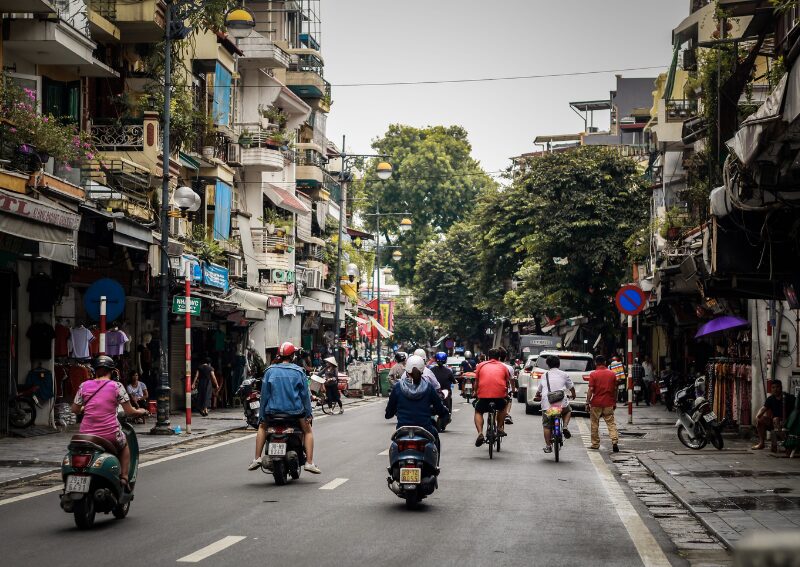
Ride-Hailing Apps: Grab, Be, and Xanh SM
- Upfront pricing shown before you confirm the trip
- Accepts international Visa and Mastercard credit cards
- No language barrier since the destination is set by pin on the map
- Available almost everywhere in the city center within minutes
Ride-hailing apps have become the most practical way to get around Hanoi for most visitors, and Grab alone has operated in Vietnam since 2014. Fares generally run from about 10,000 to 15,000 VND per kilometer, so a short ride within the Old Quarter typically costs under 50,000 VND, while a trip from Noi Bai International Airport to the Hoan Kiem area runs roughly 300,000 to 375,000 VND. Fares are transparent, drivers are rated, and payment can be made by card or cash, which makes this option the safest and most predictable choice for anyone unfamiliar with the city’s traffic patterns.
Metered Taxis
- Reputable companies in Hanoi include Mai Linh, G7 Taxi, and Taxi Group
- Meter based pricing, always confirm it is running before departure
- More seven-seater vehicles available for larger groups than ride-hailing apps typically offer
- Slightly higher waiting time charges than app-based rides
Traditional metered taxis remain a reliable Hanoi transportation option, particularly for families or groups traveling with luggage, or for late-night trips when ride-hailing apps may have longer wait times. Fares generally start around 11,000 to 15,000 VND for the first kilometer and stay fairly consistent for each kilometer after that. Mai Linh, easily identified by its green cars, is one of the most established taxi brands in the country, while G7 Taxi and Taxi Group are both known for transparent, regulated meter rates that do not spike during rain or rush hour.
As long as the meter is running, taxis are considered a safe and consistent way to travel, though street-hailed cabs occasionally overcharge tourists, so pre-booking through an app or hotel front desk is the safer approach.
Hanoi Metro
- Two operational lines: Cat Linh to Ha Dong (Line 2A) and Nhon to Cau Giay (Line 3)
- Fares range from about 8,000 to 19,000 VND per ride depending on distance
- Clean, air-conditioned, and runs from roughly 5:30 AM to 10:00 PM
- Neither line currently stops inside the Old Quarter or directly at Hoan Kiem Lake
The Hanoi Metro is a fast and inexpensive way to avoid road traffic, and it is particularly useful for reaching the Temple of Literature, the Ha Dong district, or the Cau Giay tech corridor. Tickets can be bought at station kiosks or through the official metro app, and stations feature bilingual Vietnamese and English signage, making this one of the easier systems for foreign visitors to navigate independently.
Its main limitation is coverage, since the current lines do not run directly through the Old Quarter, so it usually needs to be paired with a short taxi or ride-hailing trip to bridge the gap.
Public Buses
- Extremely low fares, generally 7,000 to 9,000 VND per ride regardless of distance
- Extensive route network covering most of the city
- Requires some local knowledge or a working map app to identify the correct route
- Can be crowded during peak commuting hours
Public buses are the most budget-friendly way to move around Hanoi, and routes like the airport bus line connect Noi Bai directly to the city center for a fraction of the cost of a taxi. The trade-off is convenience: bus stops are not always clearly marked in English, and schedules can be harder to interpret without a translation app. For travelers comfortable navigating with Google Maps and a bit of patience, buses are a safe and genuinely useful part of Hanoi public transportation.
Xe Om (Motorbike Taxi)
- Fast for short distances since motorbikes can weave through congested streets
- Fares should always be negotiated or confirmed through an app before departure
- Widely available on almost every street corner in the city center
- Limited luggage space and no seatbelt, which affects overall safety
Xe om remains a fast and iconic way to get around Hanoi, especially for short trips through the narrow lanes of the Old Quarter where cars cannot easily pass. It is best suited to solo travelers with minimal luggage, and using the Grab or Be app to book a motorbike taxi rather than flagging one down on the street generally results in fairer pricing and a safer overall experience.
Cyclo
- A slow-paced, pedal-powered tricycle traditionally used for sightseeing rather than fast travel
- Fares are typically negotiated upfront and can range widely depending on route and duration
- Best experienced within the Old Quarter rather than for practical point-to-point travel
- A scenic, low-effort way to see multiple sights without walking long distances
The cyclo is less a transportation method and more a slow, open-air tour of the Old Quarter’s narrow streets. It will not be the fastest way to reach a specific destination, but for travelers interested in Hanoi sightseeing at a relaxed pace, it offers a unique perspective on the city’s architecture and street life that no other option provides.
Walking

- Free and often faster than any vehicle within a one kilometer radius in the Old Quarter
- Best way to experience Hanoi street food, local markets, and daily neighborhood life up close
- Requires caution when crossing streets, since traffic rarely stops fully for pedestrians
- Well suited to the compact area around Hoan Kiem Lake and the Old Quarter
Walking is often the single best way to explore Hanoi’s Old Quarter, since the streets are narrow, the sights are close together, and much of the city’s character lives on the sidewalk itself. Crossing the street takes a bit of practice, since the local approach is to walk at a steady, predictable pace and let motorbikes flow around you, but once travelers get used to it, walking becomes one of the most rewarding ways to experience Hanoi travel on foot.
Where to Stay in Hanoi for Easy Access to Everything

The best way to make the most of all these transportation options is to base yourself in a neighborhood where most of what you want to see is already within walking distance. In Hanoi, that means the Old Quarter, where narrow streets, ride-hailing pickups, and metro connections all converge, and where a short walk often gets you there faster than any vehicle.
Hanoi La Siesta Premium Hang Be, regarded as one of the best hotels in Hanoi Old Quarter, is positioned right in the middle of this convenience. Located on Hang Be Street, within easy reach of Hoan Kiem Lake, the Old Quarter’s main food and shopping streets, and the taxi and ride-hailing pickup points that serve the area, it gives guests a base from which almost every part of the city feels reachable on foot or with a short ride. The hotel’s blend of classic Hanoi architecture and attentive, personal service creates a calm retreat to return to after a day spent navigating the city’s streets, whether on foot, by cyclo, or by app-booked car.
Whether you are heading out early to catch the metro toward the Temple of Literature, hailing a quick ride to West Lake in the afternoon, or simply walking the Old Quarter’s lanes at sunset, Hanoi La Siesta Premium Hang Be offers the kind of stay that keeps every option close at hand. Frequently listed among the best boutique hotels in Hanoi Old Quarter, it is a practical and comfortable starting point for travelers who want to explore the city on their own terms.