



Long Bien Bridge Hanoi 2026: The Rusted Iron Witness to Over a Century of Hanoi History
Few structures in Vietnam carry as much weight, quite literally and figuratively, as Long Bien Bridge Hanoi. Stretching across the Red River on the edge of Hanoi’s Old Quarter, this century old steel bridge has survived colonial rule, two wars, countless floods, and decades of relentless traffic, and it is still standing, still rusted, still very much alive with motorbikes, trains, and street vendors crossing it every single day.
For travelers building a Hanoi travel guide of their own, Long Bien Bridge belongs on the list not just because it looks striking in photos, but because so much of the city’s modern story runs directly through it. This guide will walk you through an overview of the bridge, the real history behind its construction (including a popular myth worth clearing up), what it has meant to the people of Hanoi across more than a hundred years, and a few of the more interesting stories connected to it. At the end, we will also point you toward a place to stay nearby that makes exploring this part of the city far easier.
Long Bien Bridge Hanoi – One of Best Places to Visit in Hanoi
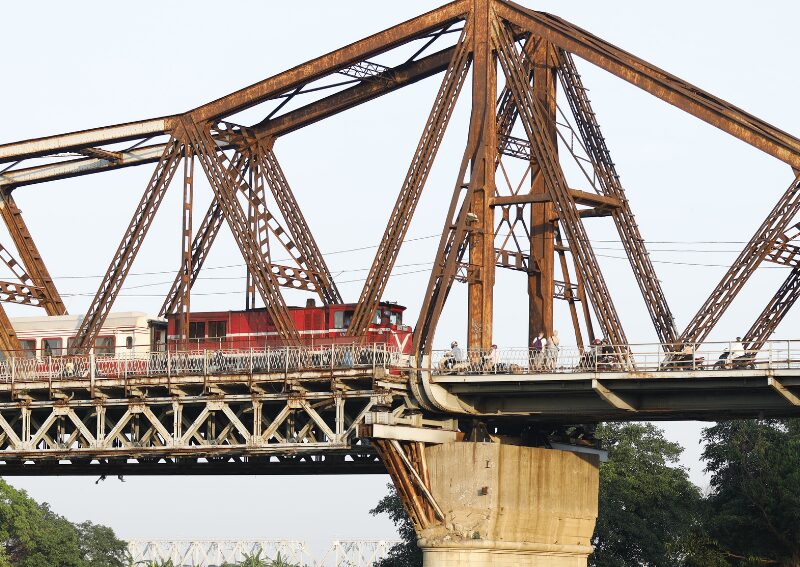
Long Bien Bridge is a steel truss cantilever bridge that crosses the Red River, connecting the central Hoan Kiem side of Hanoi with the Long Bien district on the opposite bank. The bridge stretches 2.4 kilometers across the Red River, featuring a steel truss design that showcases both strength and elegance. At the time it opened, it was once the second longest bridge in the world, just after the Brooklyn Bridge spanning the East River in the United States, and for years it stood as the longest bridge in all of Asia.
The layout is unusual and still very much in use today. A single railway track runs down the center of the bridge, while two side paths handle motorbikes, bicycles, and pedestrians. Interestingly, traffic on the bridge runs on the left side, the opposite direction of standard Vietnamese traffic, a change made decades ago to reduce collisions at the intersection leading onto the bridge. Cars are not permitted, which keeps the experience of walking or cycling across surprisingly calm compared to the rest of the city.
Today, Long Bien Bridge, one of must-visit Hanoi attractions, sits about a kilometer from the heart of the Hanoi Old Quarter, close enough that most travelers staying in the area can walk there in a matter of minutes.
The Real History Behind Its Construction – French colonial architecture
Long Bien Bridge was built during the French colonial period, with construction beginning on September 12, 1898 and the bridge officially opening in February 1902. The total investment came to 5,390,794 French francs, making it the largest construction project in Indochina at the time. It was originally named Paul Doumer Bridge, after the Governor-General of French Indochina who oversaw the project, and it kept that name until 1954, when the French departed Vietnam and the bridge was renamed Long Bien.
Here is a detail many travelers get wrong, and it is worth setting straight: contrary to popular belief, Long Bien Bridge was not designed by Gustave Eiffel, even though it is often nicknamed the horizontal Eiffel Tower because of its lattice steel structure. Documents and the manufacturer plates still attached to the bridge itself show clearly that it was designed and constructed by Daydé et Pillé, a company selected through a competitive bidding process in 1897 in which Eiffel’s own successor company, the Société de construction de Levallois-Perret, actually took part but lost. A metal plate still visible on the older section of the bridge reads “1899-1902, Daydé & Pillé, Paris,” confirming exactly who deserves the credit.
The construction itself was a massive undertaking for its time. More than 3,000 Vietnamese workers, guided by around 40 French supervisors and engineers, used roughly 30,000 cubic meters of stone and metal, including 5,600 tons of rolled steel, to complete the project. Remarkably, the bridge was finished well ahead of schedule. Although the project was originally estimated to take five years, the workers completed it in just three.
For the French colonial government, the bridge served a clear strategic purpose. It connected Hanoi to the port city of Haiphong, allowing raw materials such as rice, tea, rubber, coal, tin, and zinc to be moved out of the country efficiently. It was, in other words, as much a tool of economic control as it was a feat of engineering.
What the Bridge Means to the People of Hanoi
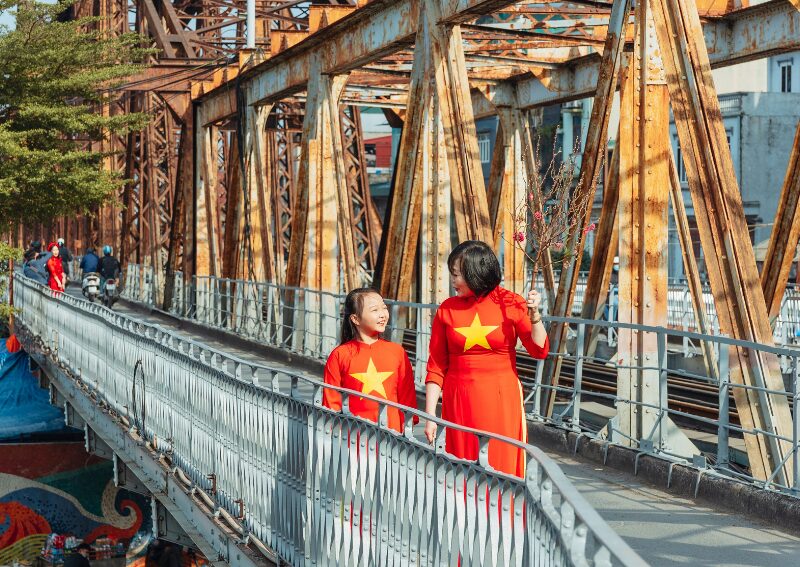
For all its colonial origins, Long Bien Bridge eventually became something far more personal to the Vietnamese people, a living symbol of resilience rather than oppression. On September 2, 1945, when Ho Chi Minh read the Declaration of Independence at Ba Dinh Square, the bridge became the path that led thousands of residents from the suburbs into the city to share in that moment of pride. Years later, in October 1954, as Hanoi celebrated the liberation of the capital with banners and flowers everywhere, the same bridge stood witness to that joy once again, and again two decades later for the reunification of the entire country.
The bridge also became a target during two major conflicts. It was a strategic objective for both sides during the First Indochina War from 1946 to 1954 and during the Vietnam War from 1955 to 1975, and it was bombed several times by both French and American forces, yet it never collapsed completely. During Operation Rolling Thunder, the United States Air Force struck the bridge repeatedly starting in 1967, and it was even the site of one of the first uses of laser-guided bombs in the conflict. Each time it was damaged, Vietnamese workers rebuilt it, reinforcing its status as a symbol of endurance that has stuck with the bridge ever since.
Today, the bridge remains deeply woven into daily life rather than simply preserved as a relic behind glass. Teenagers, expats, and tourists alike enjoy walking across it on weekends, often picking up boiled corn or charcoal grilled sweet potatoes from vendors along the way, and it remains one of the best spots in the city to watch the sunrise or sunset. Brides and grooms frequently choose the bridge as a backdrop for wedding photography, alongside students capturing memories with friends and elderly residents simply taking in the view as traffic continues to move around them.
Interesting Stories Worth Knowing Before You Visit
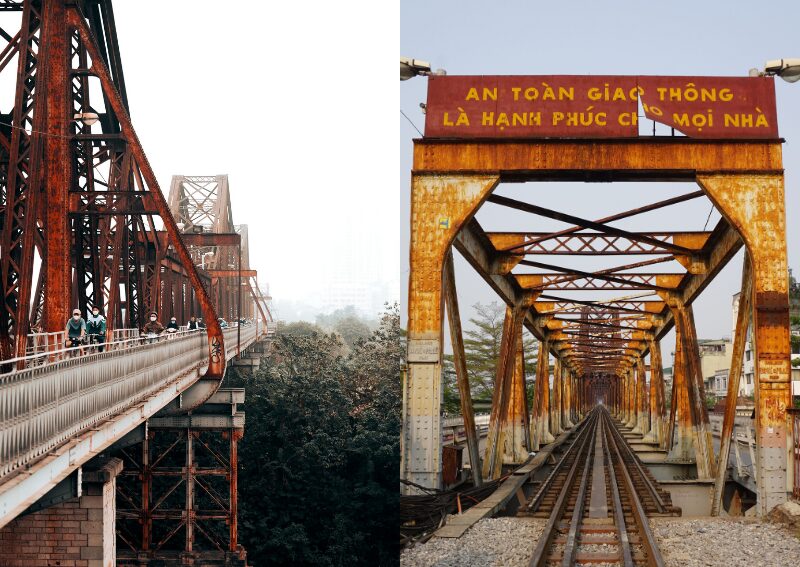
Beyond the major historical milestones, a few smaller details make Long Bien Bridge even more fascinating to explore.
One curious side effect of its construction was its impact on the surrounding neighborhood. The bridge’s construction influenced the development of Hanoi’s famous 36 streets, since it stimulated demand for food and materials and led to the rise of new businesses, with some streets specializing in fruits, vegetables, fish, or meat brought across the river, and others focused on the iron, wood, or stone needed to build and maintain the bridge itself.
Another small but telling detail involves the labor force behind the bridge. The riveting work on the bridge was initially carried out by Chinese laborers before later being handed over to Vietnamese workers, a quiet reflection of how colonial labor systems shifted over the course of the project.
Even the bridge’s near miss with total destruction has its own remarkable footnote. During one of the earliest American airstrikes in 1967, the center span of the bridge collapsed under an attack by 20 United States Air Force fighter bombers, yet CIA reports at the time noted that the bridge did not appear to sustain as much overall damage as had been hoped, a testament to just how solidly Daydé et Pillé had built it decades earlier.
And finally, the bridge’s story is far from over. A long running restoration initiative known as Conservation, Renovation and Development of Long Bien Bridge, championed for more than a decade by French Vietnamese architect Nguyen Nga, was formally introduced in Hanoi in 2019 with support from Vietnamese government officials, suggesting the bridge’s next chapter may be one of careful preservation rather than slow decay.
Tips for Visiting Long Bien Bridge
A few simple suggestions will help you make the most of your visit:
- Go at sunrise or sunset. The light hitting the steel trusses at golden hour is widely considered the best time to photograph the bridge and the Red River below.
- Walk, don’t drive. Cars are not allowed on the bridge, and walking or cycling gives you far more freedom to stop and take in the view.
Try the street snacks. Vendors along the bridge and its approach roads sell grilled corn, sweet potatoes, and other simple snacks that pair perfectly with a slow walk across. - Mind the trains. The center track is still an active railway line, so stay on the designated walking and cycling paths rather than wandering onto the tracks themselves.
- Pair it with nearby spots. The bridge sits close to Dong Xuan Market and the edge of the Old Quarter, making it easy to combine with a half day of exploring on foot.
- Visit on a weekend morning. This is when the small riverside market beneath the bridge tends to be most active, giving you a glimpse of everyday local life beyond the bridge itself.
These kinds of details are exactly what turn a quick photo stop into one of the more memorable things to do in Hanoi, a chance to stand on a structure that has quite literally carried the city through more than a century of change.
Where to Stay for Easy Access to Long Bien Bridge and Beyond
After a morning spent walking across rusted steel trusses and taking in views of the Red River, what you need next is a place to stay that keeps you close to both this landmark and the rest of the city’s most compelling neighborhoods. This is exactly where Hanoi La Siesta Premium Hang Be is a natural choice.
Sitting in the heart of the Old Quarter, one of the most well-located positions in Hanoi for reaching both the city’s transport connections and its most compelling neighborhood experiences, the hotel puts you within easy reach of Long Bien Bridge, Dong Xuan Market, and the winding streets that make the Old Quarter such a rewarding place to explore on foot.
It has earned consistent recognition as one of the best boutique hotels in Hanoi through a combination of carefully considered design, genuinely warm hospitality, and the kind of peaceful atmosphere that makes a busy travel itinerary feel manageable rather than exhausting. For travelers searching for the best hotels in Hanoi Old Quarter, somewhere that lets you spend your mornings tracing more than a century of history across the Red River and your evenings unwinding in real comfort, Hanoi La Siesta Premium Hang Be is the kind of base that ties an entire Hanoi itinerary together.