



One Pillar Pagoda Hanoi 2026: The Complete Travel Guide to Vietnam’s Lotus Shrine
Quick Facts
| Vietnamese Name | Chua Mot Cot (Chùa Một Cột) |
| Official Temple Name | Dien Huu Tu (Pagoda of Eternal Blessing) |
| Also Known As | Lien Hoa Dai (Lotus Terrace) |
| Address | Chua Mot Cot Street, Ngoc Ha, Ba Dinh District, Hanoi |
| Location Context | Within the Ho Chi Minh Mausoleum complex, next to Ho Chi Minh Museum |
| Opening Hours | 7:00 AM to 6:00 PM daily |
| Entrance Fee | Free for Vietnamese citizens / 25,000 VND for foreign visitors |
| Year Originally Built | 1049 AD, Ly Dynasty |
| Distance from Old Quarter | Approximately 2.5 km, 15 to 20 minutes on foot |
| Distance from Hoan Kiem Lake | Approximately 2 km, 10 minutes by Grab |
| Best Time to Visit | 7:00 AM to 9:00 AM or combine with Ho Chi Minh Mausoleum morning visit |
| Time Needed | 30 to 45 minutes for the pagoda / 2 to 3 hours for the full Ba Dinh complex |
One Image That Defines a Nation
There is a moment, somewhere in almost every traveler’s preparation for Hanoi, when they encounter an image that stops them: a small wooden pavilion, shaped like a lotus flower in full bloom, balanced on a single stone pillar rising from a square pond. The proportions seem impossible. The geometry is unlike anything in the European or American architectural tradition. And yet the image is unmistakably ancient, unmistakably deliberate, and unmistakably beautiful.
That image is the One Pillar Pagoda Hanoi, Chua Mot Cot Hanoi in Vietnamese. And the reality, standing before it in Ba Dinh District on a cool Hanoi morning, is even better than the photograph.
The One Pillar Pagoda Vietnam is one of the most famous and iconic Hanoi Buddhist Temple, famous for its unique lotus-shaped design and deep Buddhist symbolism. Built nearly a thousand years ago on a single stone pillar rising from a lotus pond, it has survived dynasties, wars, deliberate destruction, and careful reconstruction to remain one of the most immediately recognizable structures in all of Southeast Asia.
It once appeared on the Vietnamese 5,000-dong coin. It has been called one of Asia’s most architecturally unique monuments. It is, by any measure, one of the essential things to see in Hanoi. This guide gives you everything you need to visit it well.
The Legend Behind the Lotus: A Ly Dynasty Vietnam Pagoda
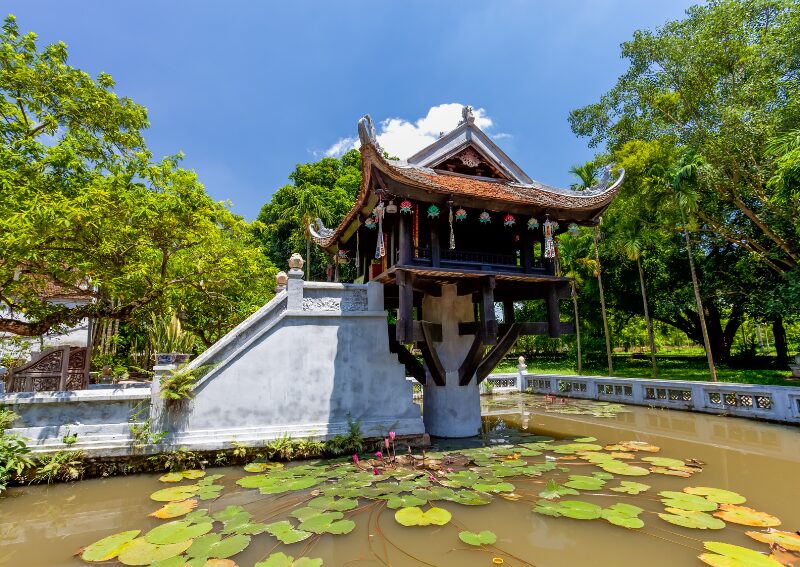
The story of the One Pillar Pagoda begins with a dream.
According to legend, the aging Emperor Ly Thai Tong of the Ly Dynasty, who had no children, used to go to pagodas to pray to Buddha for a son. One night, he dreamt that he was granted a private audience to the Bodhisattva Avalokiteshvara, who was seated on a great lotus flower in a square-shaped lotus pond on the western side of Thang Long Citadel, and gave the King a baby boy.
When the queen gave birth to a son shortly afterward, the emperor understood the dream as divine fulfillment. He commissioned a pagoda to be built in the exact image of his vision: a single-pillared shrine rising from a lotus pond, replicating the seat of the Bodhisattva as he had seen it in sleep. According to the Dai Viet Su Ky Toan Thu (A Complete History of Great Viet), the pagoda was built in the winter of 1049 under the reign of King Ly Thai Tong. When the pagoda was inaugurated, monks went around the pagoda and recited the Buddhist scriptures to pray for longevity of the king.
The pagoda’s formal name, Dien Huu Tu, means “Pagoda of Eternal Blessing” or “Long-Lasting Happiness and Good Luck.” It remains active as a site of worship to this day, and local Hanoians continue to visit to pray to the Goddess of Mercy for children, good health, and fortune, following the tradition of the emperor who built it nearly a millennium ago.
The legend is not merely decorative. It explains the architecture, the symbolism, and the continued emotional resonance of the building for the Vietnamese people who have maintained, damaged, rebuilt, and returned to it across a thousand years of history.
One Pillar Pagoda History of Destruction and Renewal
The One Pillar Pagoda’s history is not one of unbroken preservation. It is a history of repeated loss and equally repeated commitment to restoration. In that pattern lies much of its meaning.
The Ly Dynasty Original: 1049
The origins of the One Pillar Pagoda trace back to 1049 under the reign of King Ly Thai Tong. Following his vision, the pagoda was constructed on a single wooden pillar rising from a lotus pond, symbolizing purity and enlightenment in Buddhism. From then on, it became not only a sacred temple but also a cultural emblem of Hanoi.
The original structure was larger in its overall temple complex than what visitors see today. The full Dien Huu complex included additional buildings, gardens, and facilities for the monks who conducted ceremonies and maintained the site. During the Ly Dynasty, an annual ceremony was held here each spring in which the emperor would personally plant rice, symbolizing his connection to the land and the prosperity of the kingdom.
Centuries of Renovation
The pagoda underwent repeated renovation through the Tran, Le, and Nguyen Dynasties. Each period brought structural updates and stylistic modifications while maintaining the essential form: a single wooden pavilion on a stone pillar above water, oriented toward the Goddess of Mercy. This commitment to continuity of form across changing dynasties reflects how deeply the original image had embedded itself into the Vietnamese national imagination.
The French Colonial Destruction: 1954
The most notable incident occurred in 1954, when retreating French forces planted explosives under the pagoda’s lotus platform as they withdrew from Hanoi.
The deliberate destruction of the One Pillar Pagoda by departing colonial forces was understood by Vietnamese as something more than military vandalism. A structure that had stood for nine centuries, that carried the founding dream of a dynasty and the spiritual meaning of an entire Buddhist tradition, was blown up as a final act of cultural aggression in the final hours of colonial rule.
The Vietnamese government rebuilt the pagoda the following year, using the Nguyen Dynasty’s architectural precedents as the basis for reconstruction. The rebuilt structure is what visitors see today.
The Reconstruction and Its Significance
That the Vietnamese rebuilt the pagoda immediately after 1954 is itself a statement. The reconstruction was understood as an act of national continuity: the physical form of the pagoda was restored because the dream, the legend, and the spiritual meaning it embodied were considered inseparable from the Vietnamese sense of self.
Visitors who know this history experience the pagoda differently from those who do not. What appears as a small, delicate wooden structure becomes something considerably more substantial: a symbol that survived a thousand years and a deliberate attempt at erasure, and that was rebuilt within a year of its destruction.
Architecture: Reading the Lotus
The Single Stone Pillar
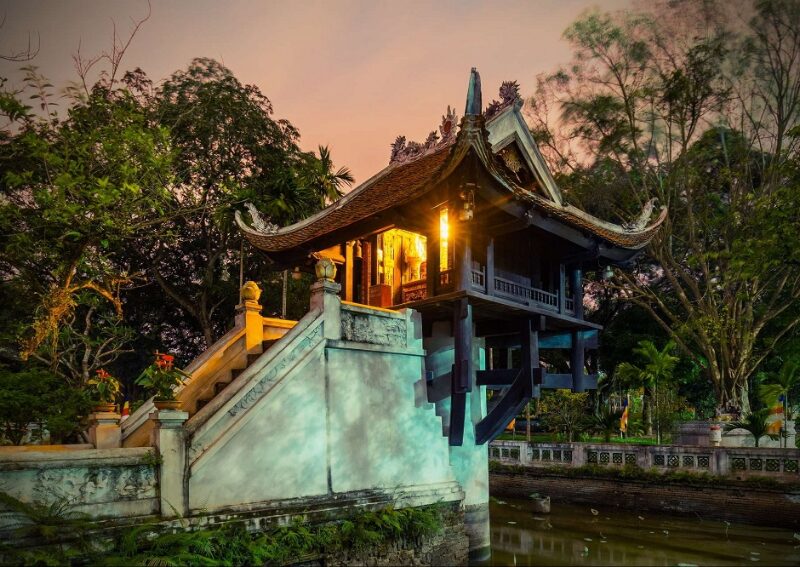
The defining architectural element of the pagoda is the single stone pillar from which the entire structure rises. The 4-meter-high stone pillar symbolizes the flower stalk. This is not a structural compromise or a curiosity. It is the primary meaning of the building. The pillar represents the stem of a lotus plant, rooted in the muddy water below, reaching upward toward purity and light.
In Buddhist symbolism, the lotus is the central metaphor for enlightenment: a flower of extraordinary beauty that grows from mud and murky water, its roots in suffering, its face in the sun. The entire design of the pagoda is an expression of this idea made architectural.
The Pavilion and Its Proportions
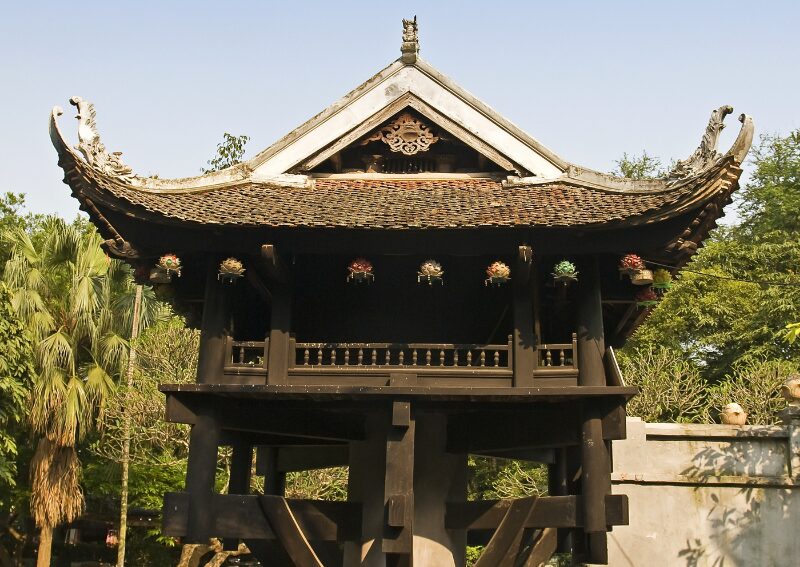
The temple body and the slightly upturned eaves on the four sides form the petals. The wooden pavilion at the top of the pillar is small by the standards of major Vietnamese religious architecture: roughly 3 meters on each side. Its four-sided roof curves upward at each corner in a form characteristic of Ly Dynasty architecture, an elegant upswept line that transforms the simple cubic form into something approaching flight.
Inside the pavilion, which visitors can approach by staircase but cannot fully enter, sits a statue of the Bodhisattva Avalokiteshvara (Quan Am Bo Tat), the Goddess of Mercy, the deity of the original dream.
The Lotus Pond
The square pond from which the pillar rises is itself architecturally intentional. Its shape mirrors the square of the pavilion above. It is planted with lotus flowers in the warmer months, creating the full visual realization of the founding dream: a lotus shrine rising from a lotus pond, the building and the landscape inseparable, the architecture and the symbolism identical.
Surrounding the pond, bonsai trees, flowering plants, and stone lanterns create a contained garden environment that manages to feel peaceful even when visitors are present in numbers.
The Bodhi Tree
Next to the pagoda is a bodhi tree, a gift from Indian President Rajendra Prasad to President Ho Chi Minh on the occasion of his visit to India. The bodhi tree is the species of fig tree under which the Buddha is said to have attained enlightenment. Its presence here connects the One Pillar Pagoda to a global Buddhist tradition and to the diplomatic history of the early Vietnamese state. It is worth pausing at this tree before or after visiting the pagoda itself.
What to Do at the One Pillar Pagoda
Contemplate the Architecture
The pagoda rewards slow looking. Walk around the full perimeter of the pond before ascending the approach stairs. The view from the northwest corner, with the pavilion reflected in the water between lotus leaves, is the classic composition. The view from directly below, looking up at the underside of the curved eaves with the pillar descending into the pond, offers a completely different and equally striking perspective.
Pray and Make an Offering
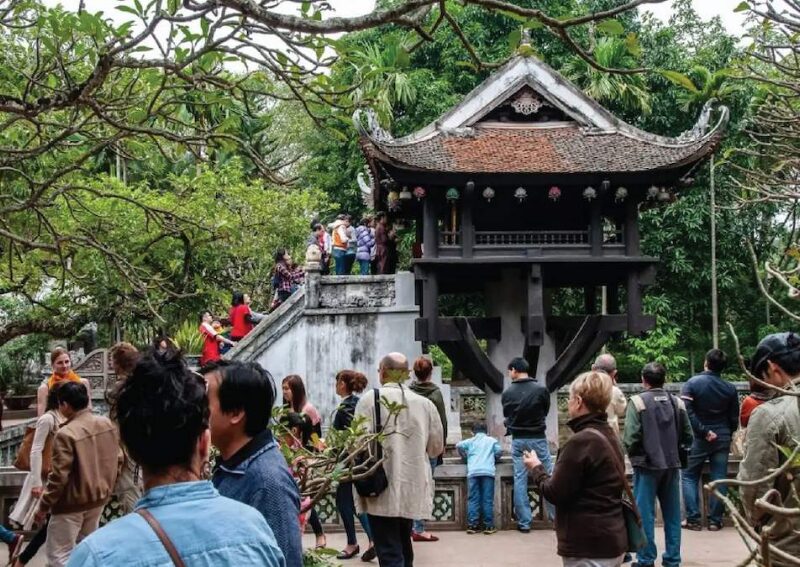
The One Pillar Pagoda is an active place of worship, not only a heritage site. The pagoda is believed to have wish-fulfilling power, and many visitors come to pray and make offerings to the goddess. Many couples who are childless or have difficulties conceiving visit the pagoda to seek the blessing of the goddess, following the example of King Ly Thai Tong.
Incense and offerings are available near the entrance to the pagoda compound. Whether or not you are Buddhist, the act of participating in this practice in a site where it has been performed continuously for a thousand years carries its own weight.
Photography
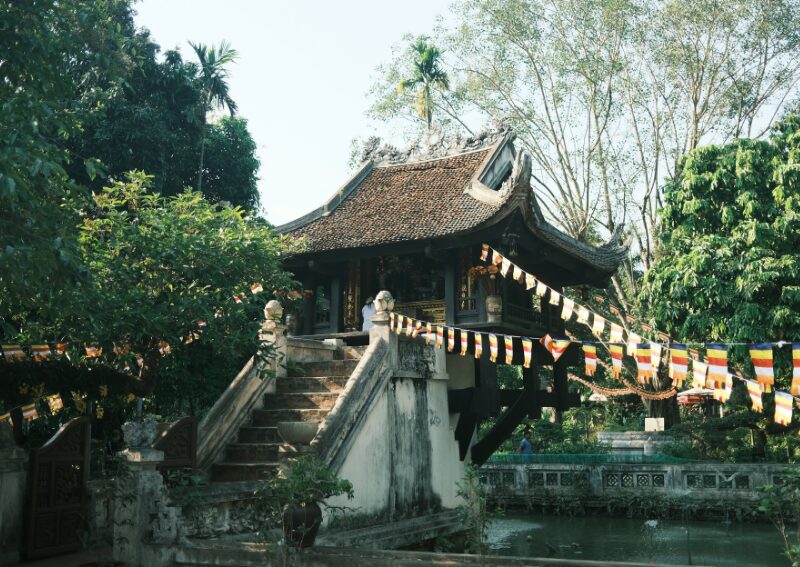
The pagoda is one of the most photographed subjects in Vietnam, and with good reason. Best positions and times:
- 7:00 to 8:30 AM: Morning light falls from the east, illuminating the front of the pavilion and creating reflections in the pond before crowds arrive. This is the clearest and most peaceful time for photography.
- Lotus season (June to August): The pond is at its most beautiful when lotus flowers are in bloom. The combination of the pink and white blooms with the red wooden pavilion above creates the full visual realization of the building’s symbolism.
- Ground-level pond reflection shots: A camera positioned low at the edge of the pond, particularly from the northwest corner, captures the building’s reflection and the surrounding garden in a single frame.
Visit the Surrounding Dien Huu Pagoda Complex
The One Pillar Pagoda sits within the larger Dien Huu Pagoda compound, which includes additional temple buildings, a garden, and a small museum space. These secondary structures provide context for the One Pillar Pagoda’s original setting and are often overlooked by visitors focused only on the main pavilion. Allow an additional 15 to 20 minutes for a thorough exploration of the full compound.
How to Get to the One Pillar Pagoda Hanoi
The One Pillar Pagoda is located on Chua Mot Cot Street, Ba Dinh District, within the Ho Chi Minh Mausoleum complex.
- By Grab (ride-hailing app): The quickest and most convenient option from most central Hanoi locations. A ride from the Old Quarter costs approximately 50,000 to 70,000 VND and takes 10 to 15 minutes depending on traffic. From the French Quarter, expect a similar fare and journey time.
- On foot from the Old Quarter: A 20 to 25-minute walk westward through Ba Dinh District. The route passes interesting residential neighborhoods and gives a sense of the transition from the commercial energy of the Old Quarter to the more ceremonial character of the Ba Dinh civic district.
- By bicycle: Renting a bicycle from your hotel or a local rental shop (30,000 to 50,000 VND per hour) and cycling to Ba Dinh is a popular option for visitors who want to explore the district at their own pace. The flat terrain of central Hanoi makes cycling straightforward.
- By public bus: Routes 09, 22, 33, and 45 stop near the Ba Dinh complex. Bus fare is 7,000 to 15,000 VND. A short walk from the bus stop brings you to the pagoda entrance.
- By taxi: All major Hanoi taxi companies serve the route. Use the meter or confirm pricing via Grab before departure.
Practical Visitor Information
Opening Hours
The pagoda is open every day from 8:00 AM to 5:00 PM, though several sources indicate access from 7:00 AM. Visiting early in the morning is strongly recommended for the best experience and best photography light.
Entrance Fee
For Vietnamese citizens, entry is free. For foreign visitors, the fee is 25,000 VND per person (approximately USD $1 / AUD $1.55 / CAD $1.35 / GBP £0.80). This is among the most affordable entrance fees for any major landmark in Vietnam.
Dress Code
Modest dress is expected as a mark of respect at an active place of worship. Shoulders and knees should be covered. This applies to both the approach to the pagoda and the surrounding Dien Huu compound. Lightweight scarves or shawls are easy to carry and useful for multiple temple visits in a single day.
Ideal Visit Time
The pagoda itself can be experienced thoroughly in 30 to 45 minutes. If combining with a full visit to the Ho Chi Minh Mausoleum complex, the Presidential Palace, Ho Chi Minh’s Stilt House, and the Ho Chi Minh Museum, allow a full 2 to 3 hours for the Ba Dinh district as a whole.
Important Note on Mausoleum Hours: The Ho Chi Minh Mausoleum, which shares the same complex, operates on a restricted schedule: typically open Tuesday to Thursday and Saturday to Sunday, 7:30 to 10:30 AM only. If you plan to combine both sites in one visit, arrive at the mausoleum when it opens and proceed to the pagoda immediately afterward. The pagoda is accessible independently of the mausoleum and does not require the mausoleum ticket.
Where to Stay for the Best One Pillar Pagoda Experience: Hanoi La Siesta Premium Hang Be
Exploring Ba Dinh District and the One Pillar Pagoda requires a base that gives you both the logistics and the quality of experience that a day in this part of Hanoi deserves. The Ba Dinh landmarks are a comfortable Grab or bicycle ride from the Old Quarter, and the right hotel makes that journey feel like the beginning of the day rather than a commute.
Hanoi La Siesta Premium Hang Be is a natural choice. Sitting in the heart of the Old Quarter, one of the most well-located positions in Hanoi for reaching both the city’s transport connections and its most compelling neighborhood experiences, it has earned consistent recognition as one of the best boutique hotels in Hanoi through a combination of carefully considered design, genuinely warm hospitality, and the kind of peaceful atmosphere that makes a busy travel itinerary feel manageable rather than exhausting.
From Hanoi La Siesta Premium Hang Be, reaching the One Pillar Pagoda is a straightforward 10 to 15-minute Grab ride or a leisurely bicycle journey through the transition from Old Quarter energy to Ba Dinh calm. Return after a morning in the Ba Dinh complex and the hotel’s thoughtful design and attentive service provide exactly the right counterweight to a morning spent among a thousand years of Vietnamese history.
For travelers building that kind of itinerary, among all the best hotels in Hanoi Old Quarter, Hanoi La Siesta Premium Hang Be offers the position, the quality, and the genuine warmth that makes coming back feel as good as going out.
Frequently Asked Questions
What is the One Pillar Pagoda in Hanoi?
The One Pillar Pagoda (Chua Mot Cot) is a Buddhist shrine built in 1049 by Emperor Ly Thai Tong of the Ly Dynasty. It stands on a single stone pillar in the center of a small lotus pond in Ba Dinh District, Hanoi, and is one of the most architecturally distinctive and symbolically significant landmarks in Vietnam.
Why is the One Pillar Pagoda famous?
The pagoda is famous for its unique lotus-shaped design, its founding legend connecting it to the Ly Dynasty emperor’s dream of the Goddess of Mercy, and its survival through nearly a thousand years of history including deliberate destruction by French colonial forces in 1954 and immediate reconstruction the following year.
How much does it cost to visit the One Pillar Pagoda?
Entry is free for Vietnamese citizens. Foreign visitors pay 25,000 VND (approximately USD $1 / AUD $1.55 / GBP £0.80). This makes it one of the most affordable major landmarks in Vietnam.
What are the opening hours of the One Pillar Pagoda?
The pagoda is open daily from 7:00 AM to 6:00 PM. Early morning visits between 7:00 and 9:00 AM offer the quietest and most photogenic conditions.
Where exactly is the One Pillar Pagoda?
The pagoda is located on Chua Mot Cot Street in Ba Dinh District, within the Ho Chi Minh Mausoleum complex, adjacent to the Ho Chi Minh Museum. It is approximately 2 to 2.5 kilometers from the Hanoi Old Quarter, a 10 to 15-minute journey by Grab.
Can you go inside the One Pillar Pagoda?
Visitors can ascend the approach steps to the entrance of the pavilion but cannot fully enter the small interior. The statue of the Goddess of Mercy inside can be seen from the entrance. Incense offerings can be made from the approach steps.
When is the best time to visit the One Pillar Pagoda?
Early morning (7:00 to 9:00 AM) offers the quietest experience and best photography light. June to August brings lotus flowers in bloom on the pond, creating the most visually complete expression of the pagoda’s symbolism.
What is near the One Pillar Pagoda?
The Ho Chi Minh Mausoleum, Ba Dinh Square, Ho Chi Minh’s Stilt House, the Presidential Palace, the Ho Chi Minh Museum, the Imperial Citadel of Thang Long, and the Temple of Literature are all within 1.5 kilometers of the pagoda and make natural companions for a Ba Dinh district day.