



St. Joseph’s Cathedral Hanoi 2026: The Complete Travel Guide to the Notre Dame of Vietnam
Quick Facts
| Official Name | St. Joseph’s Cathedral (Nha Tho Lon Ha Noi) |
| Also Known as | The Notre Dame of Hanoi |
| Address | 40 Nha Chung Street, Hoan Kiem District, Hanoi |
| Architectural Style | Gothic Revival (Neo-Gothic) |
| Year Completed | December 1886 |
| Entrance Fee | Free |
| Exterior Viewing | Open 24 hours, 7 days a week |
| Interior Visitor Hours | 8:00 AM to 11:00 AM and 2:00 PM to 5:00 PM daily |
| Mass Schedule (Weekdays) | 5:30 AM and 6:15 PM |
| Mass Schedule (Sunday) | 5:00 AM, 7:00 AM, 9:00 AM, 11:00 AM, 4:00 PM, 6:00 PM, 8:00 PM |
| Distance from Hoan Kiem Lake | 600 meters, approximately 7 minutes on foot |
| Distance from Old Quarter | Within the Old Quarter boundary, 5 to 10 minutes walk from most streets |
Hanoi Cathedral That Stops You in Your Tracks
Hanoi is a city of constant motion. Motorbikes, street vendors, the overlapping noise of a city that never quite goes quiet. And then you turn a corner onto Nha Tho Street and the city stops.
Two neo-Gothic towers rise above the roofline. Grey stone faces you across a small square. The proportions are European, the atmosphere is emphatically Vietnamese, and the effect of encountering this building in the middle of one of Southeast Asia’s most vibrant old quarters is quietly startling.
St. Joseph’s Cathedral Hanoi, known locally as Nha Tho Lon Ha Noi (the Grand Cathedral of Hanoi) and internationally as the Notre Dame of Hanoi, is one of the most distinctive and historically layered landmarks in Vietnam. It is a building that carries multiple histories simultaneously: the story of French colonial architecture transplanted into a Vietnamese city, the story of Catholicism’s deep roots in Vietnamese society, and the story of a neighborhood that has grown up around this cathedral for nearly 140 years.
For international visitors, it is also simply one of the most beautiful and photographically rewarding sites in the city. The square in front of the cathedral, flanked by coffee shops and boutique stores, has become one of Hanoi’s most beloved gathering places. The combination of the cathedral’s soaring facade, the street life of Nha Tho and Nha Chung Streets, and the proximity to Hoan Kiem Lake makes this corner of the Old Quarter unlike anywhere else in Vietnam.
St. Joseph’s Cathedral History
What Stood Here Before: The Bao Thien Pagoda
To understand St. Joseph’s Cathedral fully, you need to know what it replaced.
Before the French arrived, this site was occupied by Bao Thien Pagoda, one of the most significant Buddhist temples in the Vietnamese capital. Built during the Ly Dynasty in the 11th century, Bao Thien was home to the Great Victory Tower (Dai Thang Tu Thap), a pagoda tower of considerable importance in Vietnamese Buddhist culture. It stood here for nearly seven centuries, through the rise and fall of dynasties, through Chinese occupations and Vietnamese resistances.
The destruction of Bao Thien Pagoda and the construction of a Catholic cathedral on its foundations is among the most symbolically charged acts of French colonial urban transformation in Vietnam. The cathedral was constructed on the former site of Bao Thien Pagoda, an important Buddhist temple from the 11th century, reflecting the shifting spiritual landscapes of Hanoi over the centuries. That history is not erased by the cathedral’s beauty — it is part of the full meaning of the site.
Construction and Completion: 1882 to 1886
Construction began in 1884, with the architectural style described as resembling Notre Dame de Paris. The cathedral was designed by French colonial architects and built under the direction of the Diocese of Hanoi. It was one of the first structures built by the French colonial government in Indochina when it was first opened in December 1886 and completed in 1888.
The choice of Gothic Revival style was deliberate. In 19th-century France, Gothic architecture carried associations with national identity, religious authority, and moral permanence. Exporting that aesthetic to the colonial capital was a statement about the intended permanence of French presence in Indochina.
The cathedral’s two square towers, its rose windows, its pointed arches and stone buttresses spoke in a European architectural language that was entirely foreign to the urban fabric of the Vietnamese city around it.
A Name With Meaning: Saint Joseph and Vietnam
In 1678, Pope Innocentinus XI honored Saint Joseph as the Patron Saint of Vietnam and neighboring countries. Therefore, the church was named after him and became the headquarters of the Archdiocese of Vietnam.
The dedication to Saint Joseph is not incidental. Catholicism had been present in Vietnam since the 17th century, brought by French and Portuguese Jesuit missionaries who faced significant periods of persecution before the French colonial period gave the Church formal protection and authority. By the time the cathedral was built, there was already a substantial Catholic community in Hanoi and across the northern provinces.
The cathedral was not only a colonial statement but also a functioning center of a genuine community of faith.
Survival Through War
In spite of the long wars that destroyed major parts of Hanoi, St. Joseph’s Cathedral is still in good condition. This survival is remarkable. Much of central Hanoi was damaged or destroyed during the decades of conflict that defined 20th-century Vietnam. The cathedral’s survival is partly a matter of geography (it was not in the path of the heaviest bombing campaigns), partly a matter of its solid construction, and partly a reflection of the fact that even in periods of intense anti-colonial sentiment, the building and its community maintained a continuous presence in the life of the city.
Today the cathedral serves both as an active place of worship for Hanoi’s Catholic community and as one of the city’s most visited heritage landmarks.
Reading the Building: A French colonial architecture in Hanoi
The Facade and Twin Towers
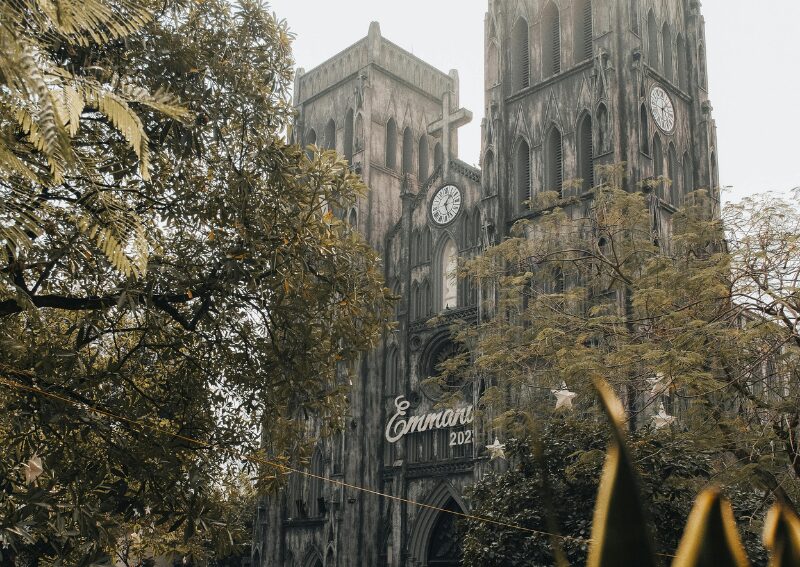
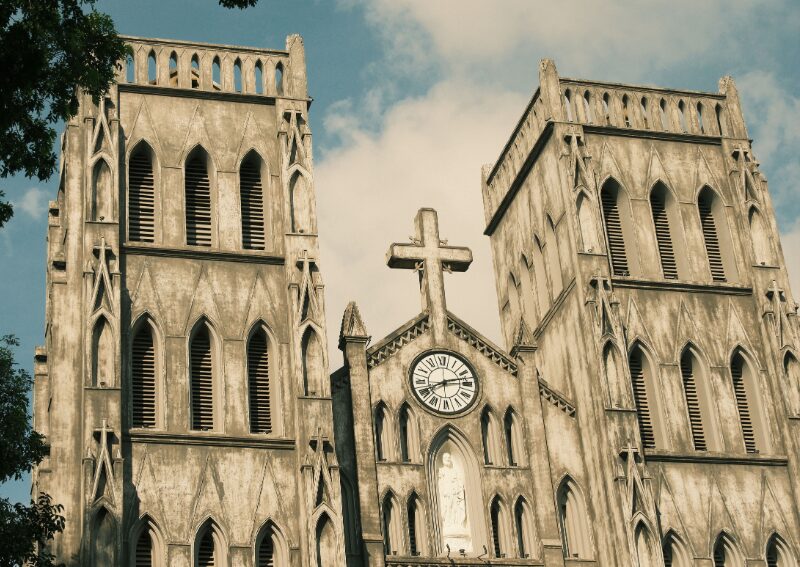
The cathedral’s west-facing main facade is its most immediately recognizable feature. Two square towers, each rising approximately 31 meters, frame a central section dominated by a large rose window and three arched doorways. The facade is built in grey stone, deliberately unadorned by the flamboyant decorative excess of some Gothic Revival buildings, giving it a sober authority that suits the Vietnamese climate and the scale of the surrounding streets.
The twin towers follow a design similar to the towers of Notre Dame de Paris, which is the comparison most visitors make spontaneously upon seeing the building. The resemblance is intentional: the architects were drawing on the most famous Gothic cathedral in France to give their colonial capital building an unmistakable institutional weight.
The Interior: Vietnamese Craft Within European Form
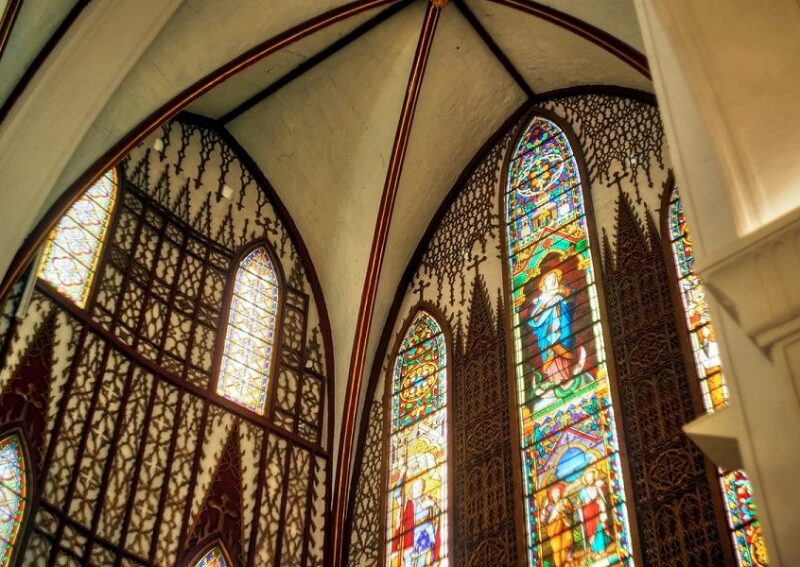
The exterior prepares you for Europe. The interior offers something more interesting: a genuine synthesis.
The most solemn area of the church is the chancel, decorated with traditional folk art and intricately carved patterns. In the primary altar area of the chancel, there is a terracotta statue of Saint Joseph holding Jesus Christ, standing over 2 meters high, with saints on both sides.
The decorative program inside the cathedral incorporates Vietnamese craft traditions into an European architectural framework. The carved woodwork, the use of lacquer, and certain ornamental details reflect local artisan traditions rather than purely imported French workshop production. On the left of the interior space is the statue of Our Lady of La Vang, and on the right is the altar of Saint Teresa. Inside the cathedral is also a grand pipe organ given from Japan on November 23, 2022.
The stained glass windows, the high vaulted ceiling, and the long nave create the sense of upward vertical space that Gothic architecture is designed to produce. The effect, combined with the smell of incense and the murmur of Vietnamese prayers, is an atmosphere genuinely unlike anything else in the city.
The Square and Surrounding Streets
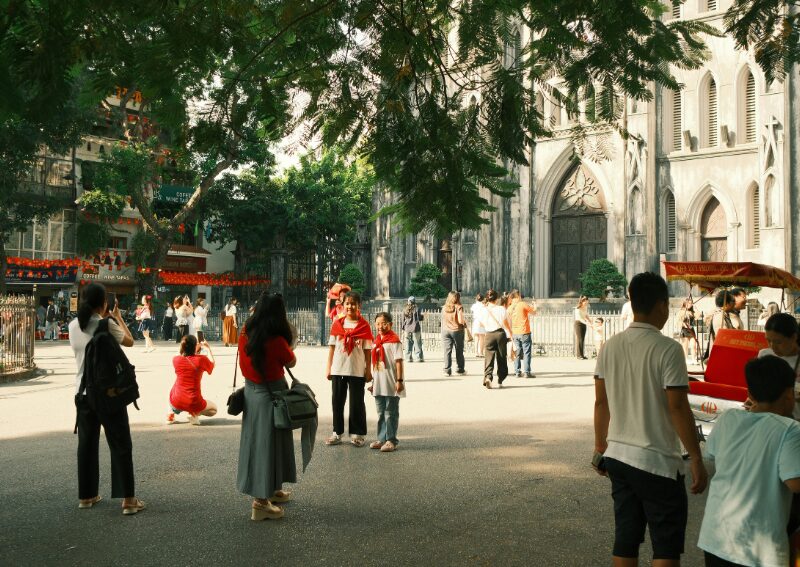
The cathedral does not stand in isolation. The small square in front of its main entrance, flanked by the intersecting streets of Nha Tho, Nha Chung, and Ly Quoc Su, has become one of Hanoi’s most loved urban spaces. Boutique clothing and jewelry stores, specialty coffee shops, and restaurants line the surrounding streets. The character of this neighborhood is different from the more frenetic energy of the deeper Old Quarter: it is calmer, more design-conscious, and feels like the organic result of a beautiful building drawing quality activity around it over 140 years.
The area is lively at virtually any hour. Morning sees locals on their way to daily Mass and neighborhood residents starting their day at street-front coffee shops. Afternoon fills the square with visitors. Evening brings groups of young Hanoians gathering on the cathedral steps and the pavement cafes that make the most of the gothic backdrop.
What to Do at St. Joseph’s Cathedral
Attend Morning Mass
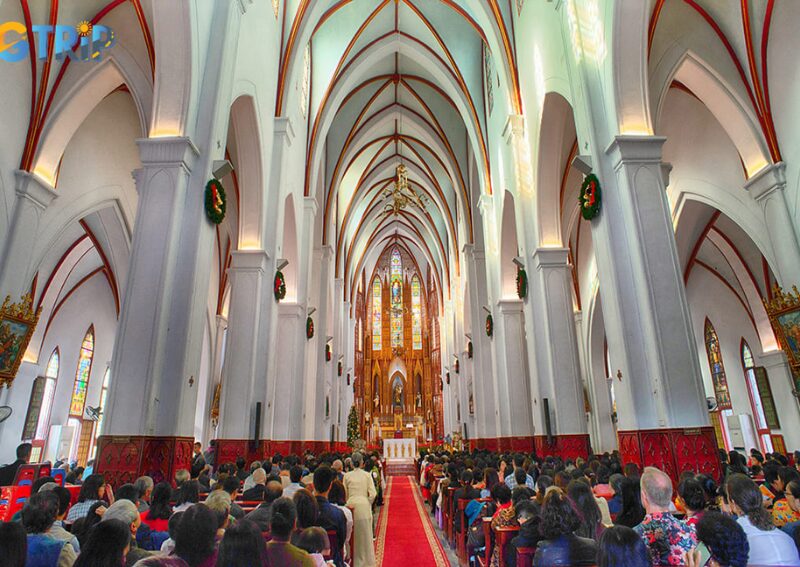
For visitors who are Catholic or curious about Vietnamese Catholic practice, attending an early morning Mass is one of the most quietly memorable experiences available in Hanoi. Weekday Masses are held at 5:30 AM and 6:15 PM. The 5:30 AM Mass draws a congregation of Hanoians starting their day in a centuries-old ritual of community. The cathedral in the early morning, filled with candlelight and the sound of Vietnamese liturgy, is a completely different experience from the tourist landmark it becomes by mid-morning.
Non-Catholic visitors are welcome to enter respectfully and observe. Dress modestly, move quietly, and do not approach the altar area during Mass.
Photography: When and Where
The cathedral is one of Hanoi’s most photographed subjects, and for good reason. The best times and positions:
- Early morning (6:00 to 8:00 AM): The facade faces west, so morning light comes from behind, creating a dramatic silhouette. The square is quiet, the streets are clean, and the cathedral reads clearly against the sky. This is the best time for architectural photography.
- Late afternoon (4:00 to 5:30 PM): The setting sun lights the facade directly, bringing out the texture of the stone and the detail of the towers. The surrounding streets fill with golden light. This is the most flattering time for the surrounding neighborhood.
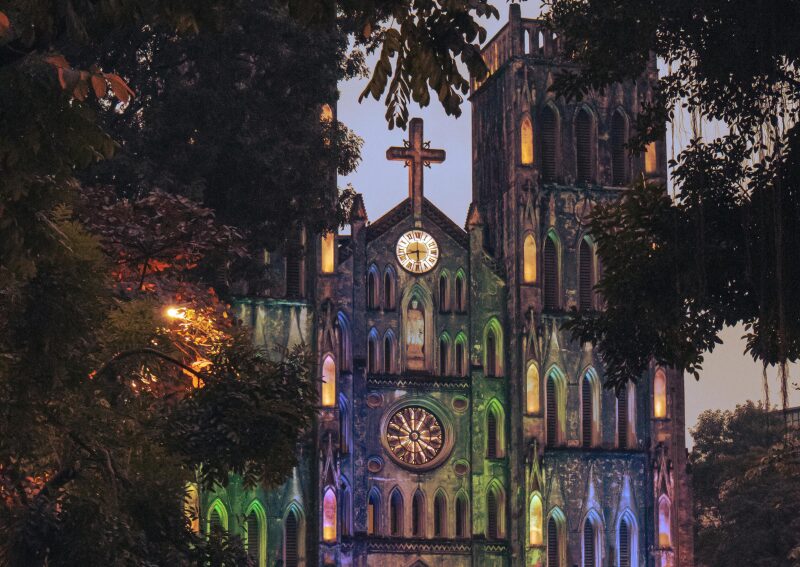
- After dark: The cathedral is lit at night and the illuminated towers above the old street lamps of Nha Tho Street create a particularly atmospheric image. Evening crowds from the nearby street food scene add life and movement.
- Position: Shoot from the far end of Nha Tho Street to include the street-level shops and the cathedral towers in the same frame, which captures the layered character of the location better than a straight-on facade shot.
Sunday Evening Gathering
On Sunday evenings, particularly after the later Masses, the square in front of the cathedral becomes a genuine community gathering point. Young Hanoians meet on the steps. Families linger after services. Street food vendors do brisk business on the nearby corners. The atmosphere is warm, informal, and very distinctly Hanoian. If you are in the city on a Sunday and want to see neighborhood life at its most natural, arriving at the cathedral around 6:30 PM puts you exactly there.
Christmas and Easter at the Cathedral
The cathedral becomes the spiritual and social center of Catholic Hanoi during major religious festivals. Christmas Eve (December 24) draws enormous crowds both inside the cathedral for Midnight Mass and in the surrounding streets, which fill with decorations, food stalls, and Hanoians from across the city who come simply to be part of the atmosphere regardless of religious affiliation. Easter, and particularly the March 19th Feast of Saint Joseph, also bring special ceremonies and heightened activity.
If your Hanoi visit coincides with any of these dates, the cathedral neighborhood is worth a dedicated evening visit.
Enjoy Nha Tho Street Hanoi cafes
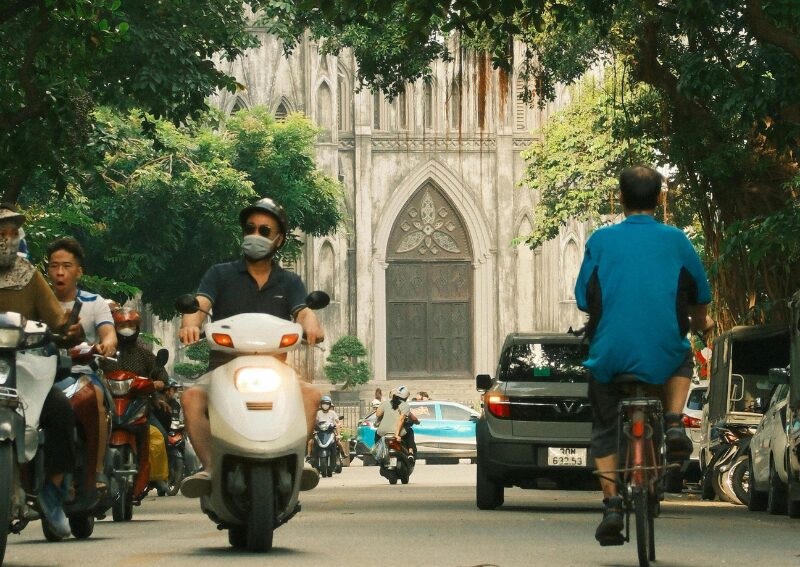
Just steps from the cathedral, Nha Tho Street is one of the most rewarding short walks in the city. Boutique stores selling silk, lacquerware, and handcrafted jewelry line both sides of the narrow lane, but it is the cafes that draw people back again and again. Pavement tables spill out onto the street, nearly every one of them offering a direct view of St. Joseph’s twin towers rising above the roofline.
Order a Vietnamese egg coffee or the notorious Ice Tea – Trà chanh Nhà Thờ, settle in, and let the afternoon pass. The combination of colonial architecture, quiet street energy, and genuinely good coffee makes this corner of the Old Quarter feel like a discovery, even when it is busy.
How to Get to St. Joseph’s Cathedral
St. Joseph’s Cathedral is located at 40 Nha Chung Street, Hoan Kiem District, right in the heart of the city. Its location is particularly special as it sits at the intersection of three bustling streets: Nha Tho, Ly Quoc Su, and Nha Chung.
- On foot:
- from Hoan Kiem Lake: Only about 5 to 7 minutes by foot. Start from the north end of Hoan Kiem Lake, head towards Ly Quoc Su Street, and follow the signs leading to Nha Chung Street, where the cathedral is located. This walk passes through some of the Old Quarter’s most pleasant streets.
- from the Old Quarter: Most hotels in the Old Quarter are within a 10 to 15-minute walk. Head south and west toward Nha Tho Street, following signs or navigation toward Hoan Kiem Lake and then turning onto the cathedral’s streets.
- By Grab: A ride from anywhere in the Old Quarter or French Quarter costs 25,000 to 45,000 VND and takes 5 to 10 minutes depending on traffic.
- By public bus: Bus numbers 01, 02, 09, 14, and 36 have bus stops near St. Joseph’s Cathedral, then walk around 5 to 10 minutes to get to the church.
- By cyclo: A traditional cyclo from the heart of the Old Quarter takes approximately 15 to 20 minutes and offers one of the most atmospheric approaches to the cathedral. Agree on a fare before departing.
- By bicycle: Cycling takes just 5 minutes from Hoan Kiem Lake to the cathedral while enjoying the peaceful rhythm of the city. You can rent a bike from hotels or rental services for around 30,000 to 50,000 VND per hour.
Practical Visitor Information
Entry and Access
The entrance fee is free. The exterior and cathedral square are accessible at all hours. Interior visitor hours are 8:00 AM to 11:00 AM and 2:00 PM to 5:00 PM daily. Outside of these hours, entry to the interior is only during Mass times.
Dress Code
Modest dress is required for interior visits. Shoulders and knees should be covered. If you arrive in shorts or sleeveless clothing, fabric wraps are sometimes available at the entrance, or you can pick up a lightweight scarf from one of the nearby Nha Tho Street boutiques before visiting.
Photography
Photography of the exterior and interior is generally permitted. During Mass, photography should be discreet and respectful. Do not use flash near the altars or during active prayer.
Best Time to Visit
Early mornings (6:00 to 8:30 AM) offer the cathedral at its most peaceful and most beautiful in terms of light and atmosphere. Midday is busy and warm. Late afternoons are excellent for photography. Sunday evenings are ideal for experiencing the community gathering aspect of the site.
Seasonal Considerations
The cathedral is rewarding to visit year-round. The October to April cool and dry season makes lingering in the square and the surrounding streets particularly pleasant. Christmas and Tet (Vietnamese New Year) bring the neighborhood to life with decorations that transform the character of the area entirely.
Where to Stay for the Best St. Joseph’s Cathedral Experience: Hanoi La Siesta Premium Hang Be
A site with the architectural weight and neighborhood character of St. Joseph’s Cathedral deserves a base that matches the quality and depth of the experience around it. The right hotel does not simply provide a bed near a landmark. It places you inside the life of the neighborhood.
Hanoi La Siesta Premium Hang Be is a natural choice. Sitting in the heart of the Old Quarter, one of the most well-located positions in Hanoi for reaching both the city’s transport connections and its most compelling neighborhood experiences, it has earned consistent recognition as one of the best boutique hotels in Hanoi through a combination of carefully considered design, genuinely warm hospitality, and the kind of peaceful atmosphere that makes a busy travel itinerary feel manageable rather than exhausting.
From Hanoi La Siesta Premium Hang Be, St. Joseph’s Cathedral is a short, pleasant walk through the Old Quarter streets that are themselves part of what you came to Hanoi to experience. Hoan Kiem Lake is equally close. Hoa Lo Prison, the Vietnam Museum of Women, and the Hanoi Opera House are all within easy reach on foot or by a brief Grab ride. You are not commuting to the city’s most interesting areas. You are already inside them.
After a morning that moves from the cathedral square to the lake to the Old Quarter, returning to La Siesta Premium Hang Be means returning to attentive service, thoughtfully designed rooms, and the kind of in-house dining that makes the decision to stay in rather than go out for one meal feel completely right.
For any traveler building a serious Hanoi itinerary around the city’s historical and architectural landmarks, among all the best hotels in Hanoi Old Quarter, La Siesta Premium Hang Be offers both the location and the quality that the experience deserves.
Frequently Asked Questions
What is St. Joseph’s Cathedral in Hanoi?
St. Joseph’s Cathedral, known locally as Nha Tho Lon Ha Noi (Grand Cathedral of Hanoi), is a Catholic cathedral built by the French colonial government between 1882 and 1886. Located at 40 Nha Chung Street in the Old Quarter, it is the oldest church in Hanoi, the seat of the Roman Catholic Archdiocese of Hanoi, and one of the city’s most distinctive architectural landmarks.
Why is St. Joseph’s Cathedral called the Notre Dame of Hanoi?
The cathedral’s Neo-Gothic architecture, including its twin square towers and pointed arches, was modeled on Notre Dame de Paris. The visual resemblance is deliberate and immediately apparent to visitors familiar with the Paris cathedral, which is why the nickname has become standard in travel literature.
Is St. Joseph’s Cathedral free to visit?
Yes. Entry to the cathedral exterior and square is free at all hours. Interior visits are free during visitor hours (8:00 AM to 11:00 AM and 2:00 PM to 5:00 PM daily) and during Mass times.
What are the opening hours for St. Joseph’s Cathedral?
The exterior is accessible 24 hours a day. Interior visitor access is 8:00 AM to 11:00 AM and 2:00 PM to 5:00 PM daily. The interior is also open during Mass: weekdays at 5:30 AM and 6:15 PM, Sundays at 5:00 AM, 7:00 AM, 9:00 AM, 11:00 AM, 4:00 PM, 6:00 PM, and 8:00 PM.
How far is St. Joseph’s Cathedral from Hoan Kiem Lake?
The cathedral is approximately 600 meters from Hoan Kiem Lake, a comfortable 5 to 7-minute walk via Ly Quoc Su Street.
What was on the site before the cathedral was built?
The cathedral was built on the site of Bao Thien Pagoda, an 11th-century Buddhist temple of significant importance in the Ly Dynasty capital. The pagoda was demolished to make way for the cathedral, one of the most symbolically charged acts of French colonial urban transformation in Hanoi.
What is the best time to visit St. Joseph’s Cathedral?
Early morning between 6:00 and 8:30 AM offers the most peaceful and beautiful experience. Late afternoon from 4:00 to 5:30 PM is best for photography of the lit facade. Sunday evenings after 6:30 PM are ideal for experiencing the community gathering that forms around the cathedral.
Is there a dress code for entering St. Joseph’s Cathedral?
Yes. Modest dress is required for interior visits. Shoulders and knees should be covered. Respectful, quiet behavior is expected inside the cathedral at all times.