



Bun Cha Hanoi 2026: The Complete Guide to the City’s Most Famous Grilled Pork Noodle
At around eleven in the morning, something changes in the air of Hanoi’s Old Quarter. Thin blue smoke starts curling out of doorways and off the edge of the pavement, carrying the smell of pork fat hitting charcoal. Plastic stools appear. Within half an hour the whole city seems to be sitting down to the same lunch.
That lunch is bun cha Hanoi, and it is the dish this city claims most fiercely as its own. Bun cha Hanoi is grilled pork, cold rice noodles and a warm dipping broth, eaten at a pavement table between eleven and two. While pho travelled the world and became shorthand for Vietnamese food everywhere, bun cha stayed home. It is still largely a Hanoi thing, still mostly eaten between eleven and two, still cooked over real charcoal in the same narrow shophouses where families have been grilling it for three generations.
For visitors, bun cha Hanoi offers something that is increasingly rare: a dish you almost have to eat in the place it comes from. This guide covers what bun cha actually is, where the dish came from, how to eat it the way Hanoians do, and the places around the Old Quarter and French Quarter where the grills have been going longest.
What Is Bun Cha Hanoi? – Hanoi Street Food
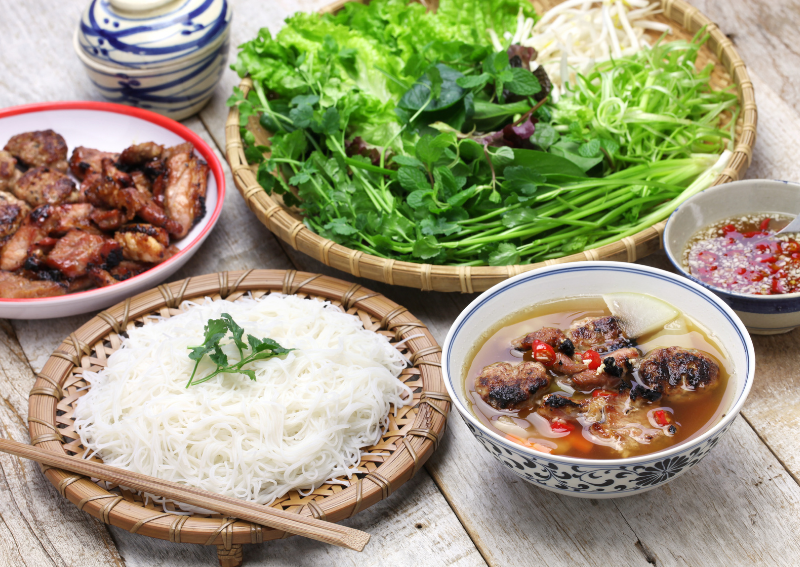
Bun cha Hanoi is a lunch dish made of charcoal grilled pork served in a bowl of warm, lightly sweet and sour dipping broth, eaten with a separate plate of cold rice vermicelli and a basket of fresh herbs. You assemble each mouthful yourself. Nothing arrives pre mixed.
It is not a soup, even though it looks like one. The broth in front of you is a dipping sauce, served in a quantity that invites you to treat it as one.
The four parts of a bun cha Hanoi set
The pork. Two kinds arrive together. Cha mieng are small patties of minced pork, and cha mieng thit are thin slices of pork belly. Both are grilled over charcoal until the edges char and the fat renders. The best places still fan the coals by hand.
The broth. A diluted fish sauce base, balanced with sugar, rice vinegar, garlic and chilli, served warm rather than hot. Floating in it you will usually find pickled green papaya and kohlrabi, which soften the sharpness and add crunch.
The noodles. Bun, or round rice vermicelli, served cold and loose on a separate plate. In Hanoi these often come as small pressed nests rather than a single tangle.
The herbs. Perilla, Vietnamese balm, lettuce, coriander and sometimes banana flower, piled high and meant to be used generously rather than as decoration.
Why bun cha Hanoi stayed in Hanoi
Vietnam has hundreds of regional noodle dishes, and most have spread nationwide. Bun cha has not, at least not in its original form. The dish depends on a specific balance of sweetness and acidity in the broth that northern cooking favours, and on charcoal grilling done to order in front of the customer.
Travel south to Ho Chi Minh City and you will find bun thit nuong, a related grilled pork noodle dish, but it is dry, sweeter and served in a single bowl. The two are often confused by visitors and are genuinely different meals.
The Story Behind the Dish
Bun cha Hanoi has been eaten here for well over a century. Written references to grilled pork sold with vermicelli in the capital go back to the early 1900s, and the Vietnamese writer Vu Bang described the dish in his writing on Hanoi’s food culture as something close to a civic institution.
What made bun cha Hanoi stick was practicality. The charcoal grill sits at the front of the shop, on the pavement, where the smoke pulls people in off the street. The food is cheap, fast and filling. Office workers, students, cyclo drivers and shopkeepers all eat the same bowl at the same hour.
Bun cha Hanoi is a lunchtime dish, not a dinner one
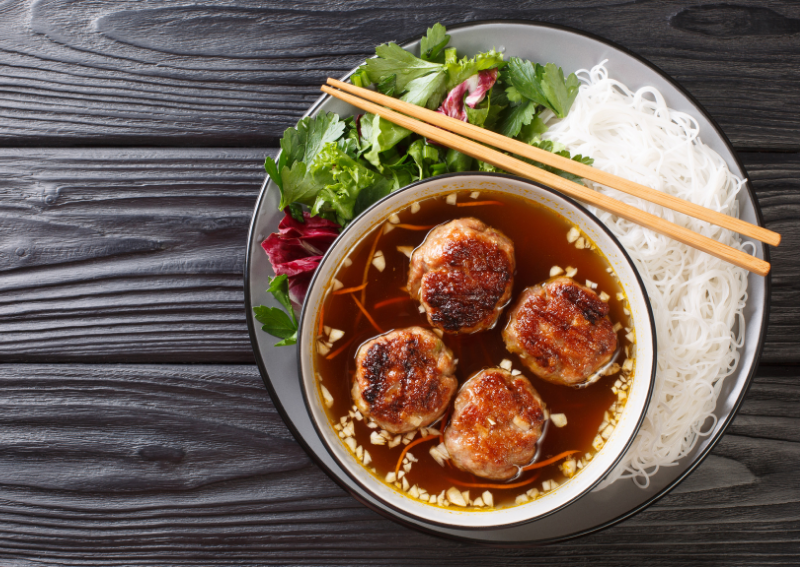
This catches a lot of visitors out. Most traditional bun cha shops open around 10am, hit their peak between 11am and 1pm, and sell out by early afternoon. If you turn up at 7pm looking for bun cha, you will find tourist oriented restaurants serving it, but the famous grills will be closed and swept.
Plan bun cha as lunch. It is the single most useful piece of advice in this guide.
The Obama and Bourdain bun cha Hanoi lunch
In May 2016, during an official visit to Vietnam, President Barack Obama sat down on a low plastic stool at Bun Cha Huong Lien on Le Van Huu Street and shared a meal with Anthony Bourdain for an episode of Parts Unknown. The bill came to around six US dollars, and Bourdain paid.
The episode did two things. It introduced bun cha to a huge Western audience, and it turned one modest shop into a permanent stop on the Hanoi food map. The table they used is now behind glass, and the restaurant sells a set called the Obama combo.
It is worth knowing that most Hanoians do not consider Huong Lien the best bun cha in the city. It is good, it is historic now, and it is genuinely worth visiting for the story. But if you want to understand why locals love this dish, eat at one of the other places in this guide as well.
How to Eat Bun Cha Hanoi Like a Local
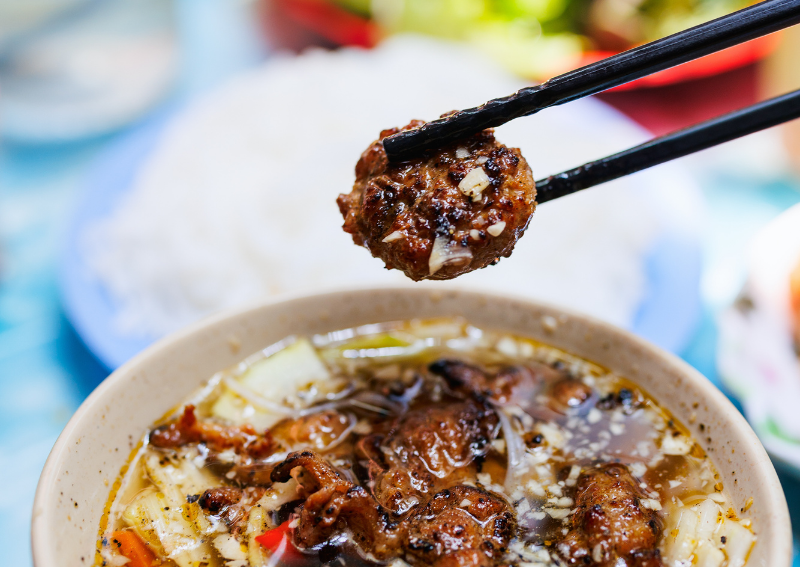
There is no ceremony to eating bun cha Hanoi, but there is a sequence, and getting it right makes the meal considerably better.
- Taste the broth first. Lift the bowl and take a small sip. Every shop balances it differently. This tells you whether you need to adjust anything.
- Adjust if you want to. On the table you will find chilli, garlic in vinegar and sometimes a chilli sauce. Add a little at a time. Hanoians tend to add garlic and chilli, rarely more sugar.
- Add the herbs to the broth. Tear lettuce and perilla and drop them straight into the bowl. They wilt slightly in the warm liquid and pick up the flavour.
- Dip the noodles, do not drown them. Take a small pinch of vermicelli with your chopsticks, dip it into the broth, and lift it out with a piece of pork and some herb. Eat that mouthful whole.
- Work through it in rounds. The plate of noodles is meant to last the whole bowl. Keep the ratio roughly even.
Three bun cha Hanoi mistakes visitors usually make
Pouring the noodles into the broth. This turns a dipping dish into a lukewarm soup and the broth loses its balance within a minute. If you want a noodle soup, order pho.
Ignoring the herbs. The basket is not garnish. Without the perilla and lettuce the dish reads as one note, and a lot of visitors come away wondering what the fuss was about.
Expecting it hot. The broth is warm, not steaming, and the noodles are room temperature. That is correct and intentional.
What to order alongside bun cha Hanoi
Nem cua be. Crab and pork spring rolls, square rather than cylindrical, a northern speciality. Most bun cha shops serve them and they are designed to be dipped in the same broth. If you order one extra thing, order this.
Nem ran. The more common fried pork spring roll, also excellent dipped in the bun cha broth.
Tra da. Iced green tea, usually free or close to it, and the standard drink with this meal. Bia hoi, the local fresh draft beer, is the other classic pairing if you are not working that afternoon.
Where to Eat Bun Cha Hanoi: Best Bun Cha in Hanoi
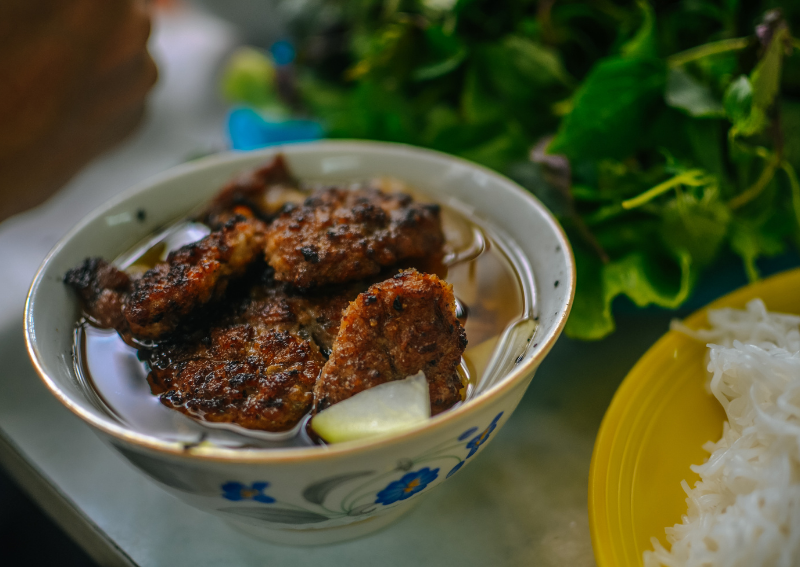
These are the bun cha Hanoi addresses worth planning a lunch around. If you want a second opinion before you choose, the MICHELIN Guide’s Hanoi selection covers a number of the city’s street food kitchens.
All of these sit within the Old Quarter, the French Quarter or a short walk from Hoan Kiem Lake, which means most are reachable on foot from a central hotel.
1. Bun Cha Dac Kim, Hang Manh Street
The most famous address in the Old Quarter and the one most guidebooks send you to. Portions are large, the pork is generous, and the shop has been running since 1965. It is busy, it is touristy, and it is still very good. Go upstairs if the ground floor is full.
2. Bun Cha Huong Lien, Le Van Huu Street
The Obama restaurant, in the French Quarter about ten minutes from Hoan Kiem Lake. Worth going for the story and for a solid, honest bowl. Ask for the Obama combo if you want the full version with a beer and a crab spring roll.
3. Bun Cha Ta, Nguyen Huu Huan Street
A more comfortable, sit down option with air conditioning and an English menu, on a street already known for its coffee shops. A good choice if you are travelling with family, if it is August and you want to escape the heat, or if someone in your group is nervous about street dining.
4. Bun Cha Hang Quat, Hang Quat Street
A tiny, old school shop down one of the Old Quarter’s most atmospheric lanes, surrounded by shops selling religious goods. Very little English, very few tables, and the grilling happens right in the doorway. This is the closest thing on this list to eating bun cha the way it was eaten fifty years ago.
5. Bun Cha Tuyet, Hang Than Street
A neighbourhood favourite slightly north of the Old Quarter, known for a broth that leans more savoury and less sweet than most. Worth the extra ten minute walk if you have already tried one or two others and want to taste the difference.
6. Bun Cha Cua Dong, Cua Dong Street
Popular with office workers rather than visitors, which is usually a good sign. Arrive before noon or expect to wait. Strong nem cua be.
7. Bun Cha Sinh Tu, Nguyen Khuyen Street
A long running shop west of the French Quarter with a loyal local following and a slightly smokier grill character. Further out, so best combined with a visit to the Temple of Literature.
8. Bun Cha 34, Hang Than Street
Another Hang Than option, smaller and quieter, where the patties are hand shaped rather than pressed. Good if the queues elsewhere have put you off.
What you should expect to pay for bun cha Hanoi
| Type of place | Price per person | What you get |
|---|---|---|
| Street level local shop | 40,000 to 60,000 VND (about 1.60 to 2.40 USD) | Bun cha set, tra da |
| Well known Old Quarter shop | 60,000 to 90,000 VND (about 2.40 to 3.60 USD) | Larger portion, spring roll |
| Sit down restaurant with aircon | 90,000 to 150,000 VND (about 3.60 to 6.00 USD) | Full set, drink, English menu |
Prices are a guide for 2026 and move with the season. Carry small notes, because very few of the traditional shops take cards.
Bun Cha Hanoi: Practical Tips Before You Go
A few things worth knowing before you go looking for bun cha Hanoi. For wider travel planning, Vietnam’s national tourism site is a useful general reference.
Eat bun cha Hanoi between 11am and 1pm. Traditional shops sell out. By 2pm the charcoal is usually cold and the shutters are halfway down.
Is it safe to eat? Bun cha Hanoi is one of the safer street dishes in the city, because the pork is grilled to order at high heat in front of you and the broth is kept warm. Busy shops with high turnover are safer than quiet ones. Use the herbs that are visibly fresh and crisp.
Ordering without Vietnamese. Say “mot suat” for one portion and hold up fingers for the number. “Mot suat bun cha” covers it. For a spring roll, add “them nem”. Pointing works everywhere.
Seating. Expect low plastic stools and shared tables. Staff will often seat you next to strangers, which is normal and not rude.
Vegetarian and vegan options. Bun cha Hanoi is not vegetarian, and the broth is fish sauce based, so there is no straightforward adaptation. Vegetarians are better served by bun chay or by one of Hanoi’s dedicated vegetarian restaurants, several of which sit in the Old Quarter.
Gluten free travellers. The noodles are rice based and naturally gluten free, but fish sauce and the dipping broth can contain additives, and spring roll wrappers vary. Ask before ordering if you are highly sensitive.
What to wear. You will be sitting close to a charcoal grill in a narrow space. Your clothes will smell of smoke afterwards. Most people consider this part of the experience, but it is worth knowing before you put on something you plan to wear to dinner.
Bun Cha Hanoi Compared to Vietnam’s Other Noodle Dishes
Visitors often arrive knowing only pho. This is how bun cha sits against the other dishes you will meet in Hanoi.
| Dish | Region | Served | Protein | Broth | Best eaten |
|---|---|---|---|---|---|
| Bun cha | Hanoi | Dipping bowl plus separate noodles | Grilled pork patties and belly | Warm, sweet and sour, fish sauce base | Lunch |
| Pho | Nationwide, Hanoi origin | Single bowl of soup | Beef or chicken | Clear, slow simmered, aromatic | Breakfast |
| Bun bo Hue | Central Vietnam | Single bowl of soup | Beef and pork | Spicy, lemongrass and shrimp paste | Any time |
| Bun rieu cua | Northern Vietnam | Single bowl of soup | Freshwater crab | Tomato and crab, tangy | Lunch |
| Bun thit nuong | Southern Vietnam | Single dry bowl | Grilled pork | Sauce poured over, no dipping bowl | Lunch |
| Bun cha ca | Central coast | Single bowl of soup | Fish cake | Light fish based | Breakfast or lunch |
The short version: if it arrives as two vessels and you build each bite yourself, it is bun cha. If it arrives as one bowl of soup, it is something else.
Bun Cha Hanoi: Frequently Asked Questions
What is bun cha Hanoi made of?
Grilled pork patties and pork belly, served in a warm dipping broth of diluted fish sauce, sugar, vinegar, garlic and chilli, with pickled green papaya, a separate plate of cold rice vermicelli and a basket of fresh herbs.
Is bun cha Hanoi a soup?
No. The bowl of liquid is a dipping sauce, not a broth you drink. You dip noodles and pork into it rather than pouring the noodles in.
Where did Obama eat bun cha in Hanoi?
At Bun Cha Huong Lien on Le Van Huu Street in the French Quarter, in May 2016, with Anthony Bourdain. The restaurant now sells an Obama combo and keeps the original table on display.
How much does bun cha Hanoi cost?
Between 40,000 and 90,000 VND at most local shops, roughly 1.60 to 3.60 US dollars. Sit down restaurants with air conditioning charge up to about 150,000 VND.
What time of day do people eat bun cha?
Lunch. Most traditional shops open around 10am and sell out by early afternoon. Bun cha is not usually a dinner dish in Hanoi.
What is the difference between bun cha and bun thit nuong?
Bun cha is from Hanoi and comes as two vessels, a dipping bowl and a plate of noodles. Bun thit nuong is from southern Vietnam, arrives as a single dry bowl with the sauce poured over, and is noticeably sweeter.
Is bun cha safe for tourists to eat?
Generally yes. The pork is grilled to order over high heat and the broth is kept warm. Choose shops that are busy, since high turnover means fresher ingredients.
Can I find vegetarian bun cha?
Not in its traditional form, because the broth is fish sauce based. Some vegetarian restaurants in Hanoi make a version called bun chay using tofu and mushroom, which is a different dish with a similar structure.
Where to Stay for the Best Bun Cha Hanoi
Bun cha Hanoi is a walking dish. The grills that matter are spread across the Old Quarter and the French Quarter, and almost none are worth a taxi ride, so where you sleep decides how many of them you get to try.
Hanoi La Siesta Premium Lakeside sits a 5 to 10 minute walk from Hoan Kiem Lake, which puts Le Van Huu, Hang Manh, Nguyen Huu Huan and Hang Quat all within easy walking reach. Recognised among the best hotels in Hanoi French Quarter, it is well placed for a dish with a narrow window, since the famous grills serve from late morning until they sell out.
For travellers comparing the best hotels in Hanoi, its central location, Vietnamese inspired interiors and attentive service make it an easy base for working through the city’s grilled pork map one bowl at a time. Among the best boutique hotels in Hanoi, it offers what bun cha itself offers: nothing oversized, everything done carefully and in its proper place.