Who Was Ho Chi Minh? A Brief Portrait for First-Time Visitors
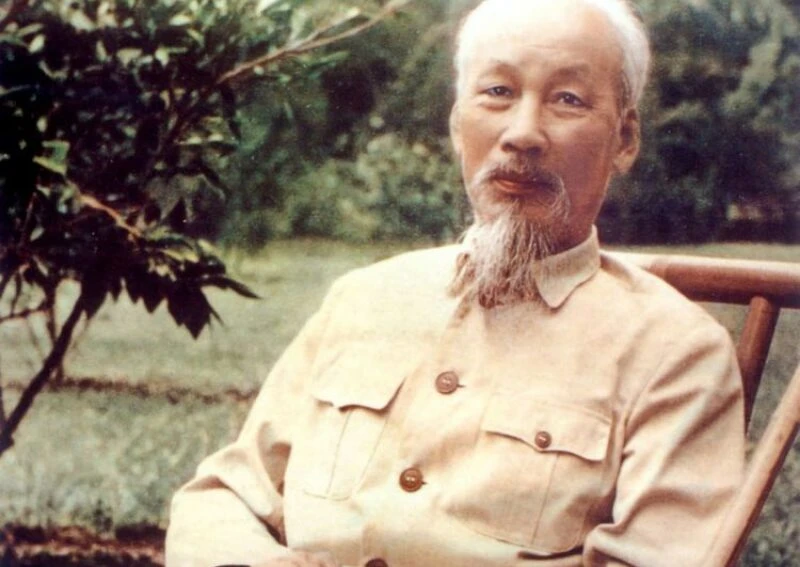
For visitors arriving without a deep background in Vietnamese history, a brief portrait is worth having before you enter.
Ho Chi Minh was born in 1890 in Nghệ An province in central Vietnam, with the given name Nguyễn Sinh Cung. Before returning to lead his country, he spent nearly thirty years traveling the world, living and working in France, the United States, the Soviet Union, and China. Those years abroad shaped everything: the revolutionary ideas he absorbed, the international networks he built, and the political vision he would carry home.
Back in Vietnam, he founded the Việt Minh independence movement and led the resistance first against French colonial rule and then against American military involvement. On September 2, 1945, standing in the very square where his mausoleum now stands, he read Vietnam’s Declaration of Independence to an estimated 400,000 people.
To the Vietnamese people, he is Bác Hồ: Uncle Ho. The title is not merely affectionate. It reflects something specific about how he is remembered: not as a distant authoritarian figure but as a familiar, paternal presence. His personal habits reinforced this image throughout his life. He lived simply, dressed plainly, grew vegetables, and was photographed playing with children. The gap between the grandeur of the Ho Chi Minh mausoleum and the simplicity of the man it honors is one of the most striking things about the entire complex.
Ho Chi Minh Mausoleum: A Building With Its Own History
Ho Chi Minh’s own wishes
In his will, Ho Chi Minh asked to be cremated, with his ashes divided into three portions and scattered across the three regions of Vietnam: the north, the center, and the south. It was a final gesture consistent with his lifelong emphasis on national unity, and with the simplicity that defined his public image.
His wishes were not followed, and it is important to understand why in the spirit in which the decision was actually made. The love of the Vietnamese people for Uncle Ho was, and remains, profound and deeply personal. For millions of Vietnamese who had never seen him in person, the thought of having a place where they could come, stand before him, and pay their respects directly was not a political calculation but an expression of genuine grief and gratitude.
The Party’s decision to preserve and display his body was, at its heart, a response to that love: a way of allowing an entire nation to keep seeing the man they called their father. For the Vietnamese people, the mausoleum is an act of collective care as much as it is a monument.
Ho Chi Minh Mausoleum Construction
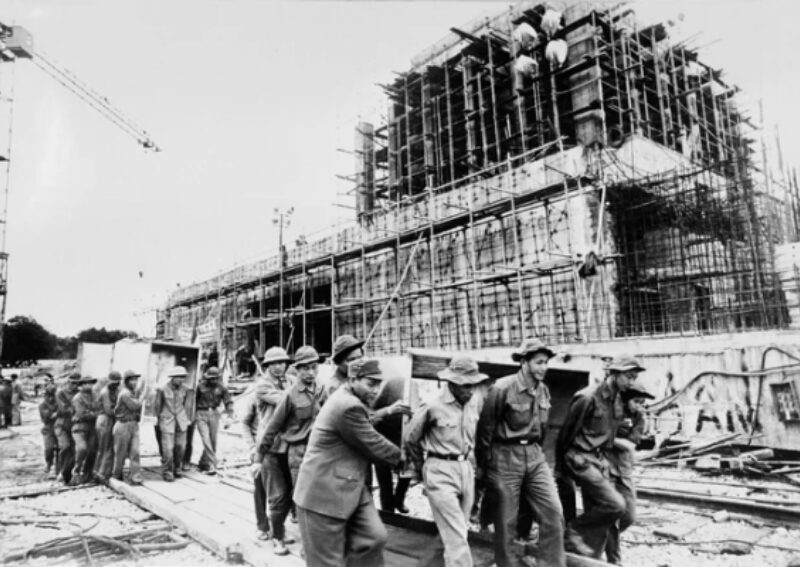
Work on the mausoleum began in 1973, while the war was still ongoing, and the building was completed and inaugurated on August 29, 1975, after reunification. The design was a collaboration between Soviet architect Garold Isakovich and a Vietnamese architectural team, drawing on the model of Lenin’s Mausoleum in Moscow while incorporating elements of traditional Vietnamese architecture.
Materials and symbolism
The granite and marble used in the construction were collected from provinces across the entire country, a deliberate gesture of national unity built into the physical fabric of the building. The structure rises across three levels, traditionally interpreted as representing Vietnam’s three regions. The columns and roofline echo the form of a Vietnamese stilt house, connecting the monumental to the vernacular.
Annual closure
Each year from October through November, the mausoleum closes for two months while Ho Chi Minh’s body is transported to Russia for preservation maintenance, a technical requirement of the embalming process. This catches many visitors off guard. Always check the current schedule before building your Hanoi itinerary around a visit.
Ba Dinh Square: Where Modern Vietnam Was Born
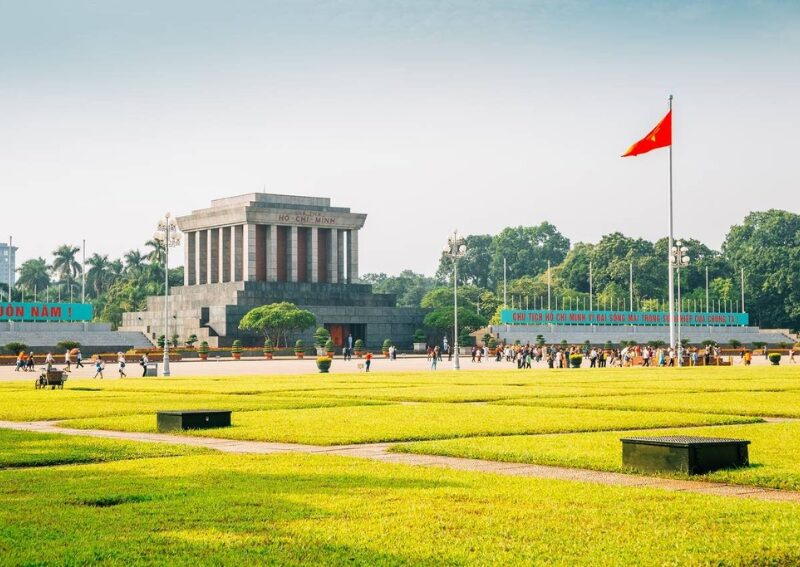
The mausoleum does not stand in isolation. It anchors one end of Ba Dinh Square, which is itself a site of enormous historical significance. On September 2, 1945, this was where Ho Chi Minh addressed 400,000 people and declared Vietnamese independence. The square as it exists today was redesigned and expanded after 1975, covering more than 320,000 square meters, and functions as the ceremonial heart of the Vietnamese state.
Every day, the national flag is raised at 6am and lowered at 9pm in a ceremony conducted by an honor guard in full dress uniform. The raising ceremony in particular, with the flag climbing slowly in the early morning light while the square is still quiet, is one of the most genuinely moving public rituals in Hanoi. It is free to attend, open to anyone, and requires nothing more than arriving a few minutes before six.
The Full Complex: More Than Just the Mausoleum
Most visitors who rush in and out of the mausoleum itself miss the broader complex, which deserves at least two to three hours if you have them.
The Mausoleum is the central structure, free to enter, with visits typically lasting around twenty minutes including queuing time. The experience inside is brief, perhaps two to three minutes walking past the central chamber, but the atmosphere is unlike anything else in the city.
Ho Chi Minh’s Stilt House
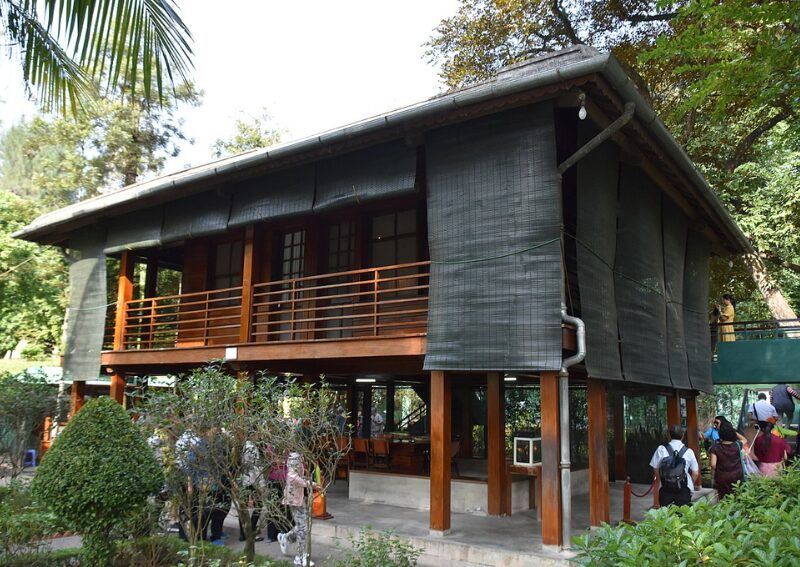
The site is perhaps the most quietly powerful part of the entire complex. This is the simple wooden house on stilts where Ho Chi Minh chose to live and work from 1958 until his death in 1969, despite having access to the grand Presidential Palace next door. The fish pond, the fruit trees, the modest study and bedroom: the contrast between this restrained domestic space and the monumental mausoleum a short walk away says more about the man than any exhibit could.
Ho Chi Minh Museum
The Ho Chi Minh Museum occupies a large modern building adjacent to the mausoleum and documents his life and legacy through photographs, personal belongings, and a series of large-scale artistic installations. It is worth an hour if you want deeper context, and has a separate entrance fee.
One Pillar Pagoda
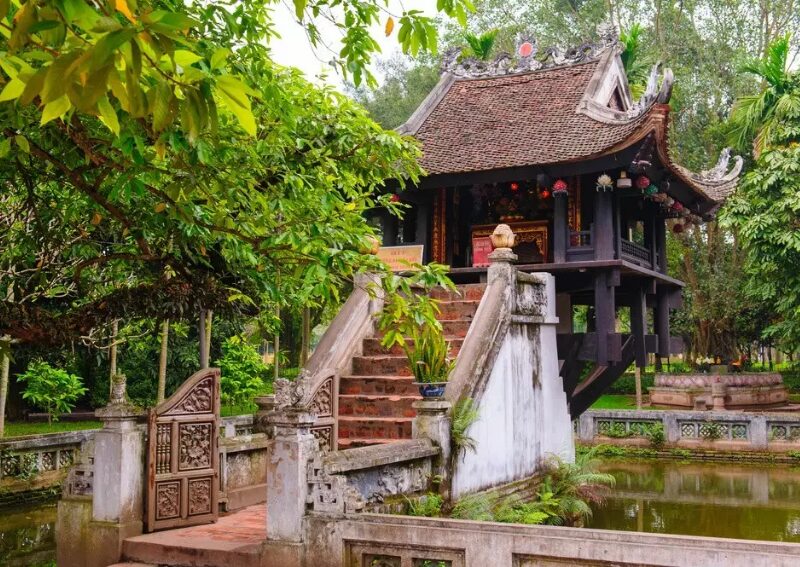
Chùa Một Cột (One Pillar Pagoda) is a five-minute walk from the mausoleum, an 11th-century Buddhist pagoda built on a single stone column rising from a lotus pond. It is one of Vietnam’s most recognizable architectural images and fits naturally into a morning at the complex.
Thang Long Imperial Citadel
Hoàng Thành Thăng Long (Imperial Citadel) is a UNESCO World Heritage Site ten minutes away on foot, covering over a thousand years of Vietnamese royal history. Combined with the mausoleum complex, it makes for a full and rich morning of Hanoi history.
Practical Guide: Everything You Need to Know Before You Go
Opening hours
Tuesday to Thursday: 8:00am to 11:00am
Saturday and Sunday: 8:00am to 11:00am, 2:00pm to 4:00pm
Closed: Monday, Friday, and major public holidays
Closed entirely: October and November each year for preservation maintenance
Entry fees
Mausoleum entry: Free
Stilt House and gardens: 40,000 VND (approximately $1.50 USD)
Ho Chi Minh Museum: 40,000 VND
Dress code
Shoulders and knees must be fully covered, with no exceptions. Lightweight trousers and a shirt or blouse with sleeves are the practical solution for Hanoi’s warm weather. Scarves for covering shoulders are available near the entrance if needed, though bringing your own is more reliable.
Rules inside the Mausoleum
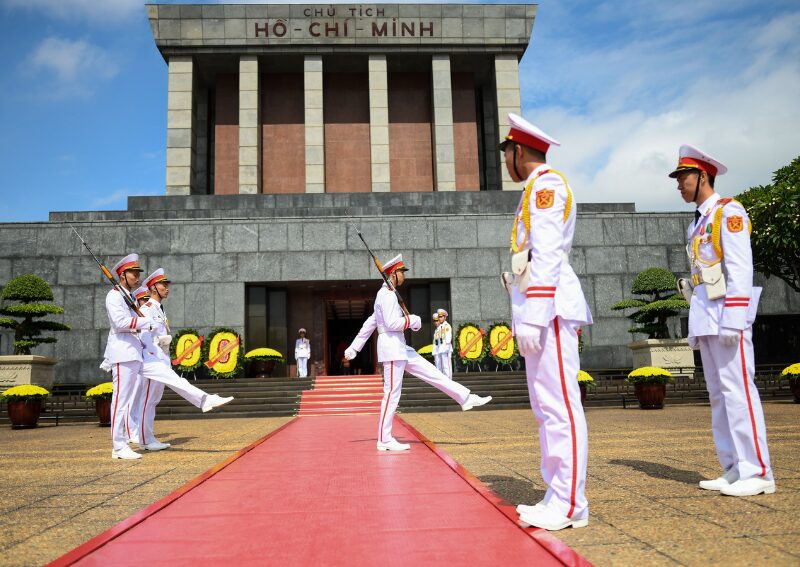
Hats must be removed before entering. Talking, laughing, and using mobile phones are not permitted inside. Photography inside the mausoleum is strictly prohibited, though photographs are welcome in the square and gardens outside. Visitors move in a double line, walking slowly and continuously without stopping. Hands should hang at the sides or be folded in front, not placed in pockets. Cảnh vệ (security guards) will intervene firmly if any of these rules are broken, and visitors have been escorted out for non-compliance.
Getting there
Address: 2 Hùng Vương, Ba Đình, Hanoi
From the Old Quarter by Grab: approximately 10 minutes, 40,000 to 60,000 VND
On foot from the Old Quarter: approximately 25 minutes, walking along Phan Đình Phùng Street, one of Hanoi’s most beautiful tree-lined avenues and worth the walk in its own right
Best time to visit
Arrive before 8 A.M to witness the flag-raising ceremony and join the queue before it lengthens. Weekday mornings are quieter than weekends. Confirm the mausoleum is open before traveling in October or November.
Plan Your Morning: A Half-Day Itinerary
This itinerary covers the mausoleum and its surrounding sites in a single well-paced morning.
5:45am: Depart from your hotel toward Ba Dinh Square
6:00am: Flag-raising ceremony at the square
6:30am: Join the queue for mausoleum entry
8:00am: Enter the mausoleum when it opens
8:30am: Ho Chi Minh’s Stilt House and gardens
9:30am: Ho Chi Minh Museum (optional, 60 minutes)
10:30am: Chùa Một Cột (One Pillar Pagoda)
11:00am: Hoàng Thành Thăng Long or return to the Old Quarter for lunch
The Right Base for Exploring Hanoi’s History
The mausoleum sits in the Ba Dinh district, about twenty-five minutes on foot or ten minutes by car from the Old Quarter. That proximity makes the Old Quarter the natural base for visitors who want to combine a morning at the mausoleum with an afternoon in the historic streets, without crossing the city twice. Among the best hotels in Hanoi Old Quarter, the choice of where you stay shapes the entire rhythm of your visit. A well-located hotel means the mausoleum, the craft streets, the food lanes, and the temple circuits are all reachable before most tour groups have finished breakfast.
For travelers looking for the best boutique hotel in Hanoi, Hanoi La Siesta Classic Mã Mây stands apart. After a long morning of walking Ba Dinh Square, the stilt house gardens, and the citadel, returning to a hotel that genuinely feels like a retreat rather than a transit point makes a real difference. La Siesta Classic Mã Mây captures the traditional atmosphere of the Old Quarter while delivering the comfort and heartfelt hospitality that allow you to recharge properly for the next day.
Its position on Mã Mây Street, one of the most historically layered streets in the quarter, means you are never more than a short walk from Hanoi’s best street food, its most atmospheric temples, and the tailors and fabric shops that line Hàng Gai. It is not simply a place to sleep. It is the kind of base that makes a city feel navigable, personal, and entirely your own.
Quick Reference
| Detail | Information |
| Entry fee | Free (mausoleum), 40,000 VND (stilt house and museum) |
| Open days | Tuesday, Thursday, Saturday, Sunday |
| Morning hours | 8:00am to 11:00am |
| Afternoon hours | 2:00pm to 4:00pm (Saturday and Sunday only) |
| Annual closure | October and November |
| Dress code | Shoulders and knees covered, hats removed inside |
| Photography | Allowed outside, strictly prohibited inside |
| Distance from Old Quarter | 10 minutes by car, 25 minutes on foot |