What Tra Da Via He Hanoi Is – Vietnamese Tea Culture
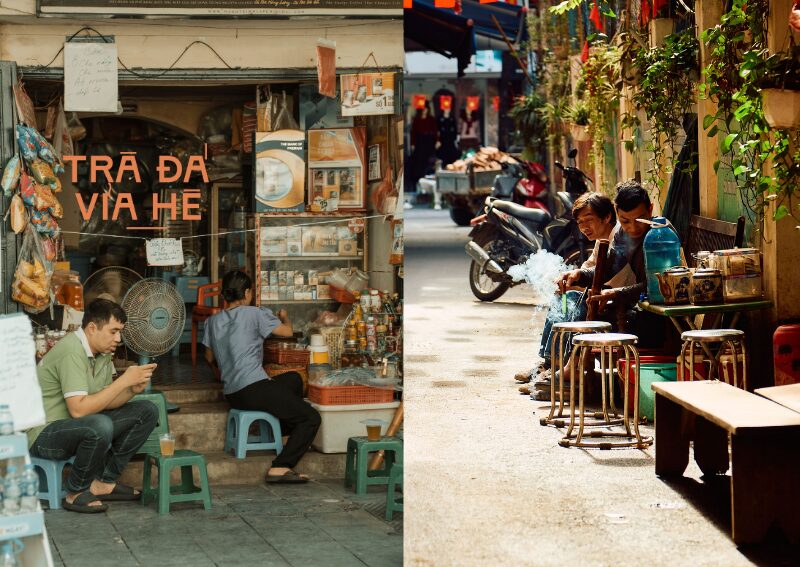
Tra da is brewed green tea, typically made from loose-leaf Vietnamese green tea grown in the northern highlands, steeped briefly in hot water and then poured over ice and served in a small glass. The tea used is not a premium single-origin variety. It is deliberately ordinary, a simple everyday green tea with a light, slightly grassy flavor and almost no bitterness, chosen for how well it drinks in quantity across a long, warm afternoon rather than for complexity or depth.
Vietnamese tea cultivation has deep roots in the country’s northern highlands, particularly in the provinces of Thai Nguyen, Ha Giang, and Son La, where the cooler temperatures and mineral-rich soils produce the green teas that find their way into the massive metal flasks that tra da vendors keep simmering or steeping at the edge of every pavement setup. Thai Nguyen tea, grown in the hills south of Hanoi, is considered the gold standard of Vietnamese everyday green tea and is the variety most commonly used by serious tra da vendors in the capital.
The practice of drinking tea on the street in Hanoi developed gradually through the mid-20th century as the city’s population grew denser and outdoor social life became increasingly important in neighborhoods where indoor space was limited. In Hanoi’s Old Quarter, where the narrow tube houses were built for trade rather than for living rooms, the street itself became the social space, and tra da became the drink that anchored people to it.
By the 1980s and 1990s, tra da culture was so embedded in daily Hanoi life that entire micro-economies had developed around it, with dedicated vendors staking out specific corners and serving a reliable clientele of regulars morning, afternoon, and evening.
How Tra Da Is Made and Served

How Tra Da Is Made and ServedThe preparation is deliberately simple, which is part of why it works so well as a street beverage. A batch of green tea is brewed strong in hot water, allowed to steep for several minutes, and then either cooled and poured over ice or kept hot in a large thermos flask and added to iced glasses at the point of serving. The ratio of tea to water is looser and lighter than what most people would consider a proper brew at home, since tra da is designed to be drunk continuously and in volume rather than sipped slowly from a small cup.
The glasses used are typically small, thick-walled tumblers, inexpensive and nearly indestructible, that hold just enough tea for a few minutes of conversation before they need refilling. Many tra da setups include a shared pitcher or flask from which customers serve themselves, contributing to the communal, informal atmosphere that defines the experience.
Prices are either extremely low or, at many traditional setups, effectively free in the sense that the tea is provided as a courtesy with whatever snack or small purchase is made. At dedicated tra da stalls, a glass typically costs between 2,000 and 5,000 VND, making it one of the cheapest social experiences available in any city in Southeast Asia.
Why Tra Da Became a Hanoi Pavement Culture
Other Vietnamese cities drink green tea too, but tra da culture as a street phenomenon is most strongly associated with Hanoi, and the reasons for that are partly geographic, partly historical, and partly a matter of temperament.
Hanoi’s climate plays a role. The city experiences genuine seasons, including a hot, humid summer that makes cold liquid a practical necessity for anyone spending time outdoors, and a cooler, mistier winter that makes a hot glass of green tea from the same vendor equally appealing. Tra da works year-round because the drink itself is adaptable.
The Old Quarter’s physical structure matters too. The narrow streets, dense housing, and continuous street-level commercial activity create a permanent outdoor living room effect in which sitting on a small stool at the pavement’s edge feels natural rather than makeshift. The street is not an inconvenience to pass through. It is the destination.
But perhaps most importantly, tra da culture reflects something specific about how Hanoi residents relate to time. The city has a different pace from Ho Chi Minh City, more deliberate, less oriented toward transaction and throughput, more comfortable with spending an hour over nothing in particular. Tra da is the physical expression of that temperament. It provides a socially acceptable reason to be exactly where you are, doing precisely what you are doing, for as long as you want.
What Hanoi People Eat and Do while Drinking Tra Da

A tra da session is rarely just about the tea. The street setups that anchor Hanoi’s pavement culture almost always offer a small selection of snacks designed to be eaten slowly, shared casually, and paid for in small increments.
Some Snacks while Drinking
Keo lac (peanut brittle candy)
The most iconic tra da accompaniment, keo lac is a hard, golden candy made from roasted peanuts bound in caramelized sugar and pressed into thin sheets that are broken into irregular pieces. The crunch of keo lac against the cold sweetness of the tea is one of those simple flavor combinations that sounds unremarkable until you’ve experienced it on a warm Hanoi afternoon with the sound of motorbikes moving through a narrow street. It is everywhere at tra da setups and costs almost nothing.
Keo dua (coconut candy)
Chewy, sweet squares of coconut candy often sold alongside keo lac, offering a softer texture contrast to the brittle crunch of the peanut variety.
Hat huong duong (sunflower seeds)
Paper bags of roasted sunflower seeds, cracked one at a time and discarded onto the pavement, providing something for hands and mouths to do during longer conversations. The rhythm of cracking seeds is part of the meditative quality of a long tra da session.
Banh gao (rice crackers)
Light, crisp rice-based crackers with a savory edge that works well against the mild bitterness of green tea. Widely available at pavement setups and eaten in the same casual, unhurried manner as the seeds and candy.
Mia (sugar cane)
At some setups, small pieces of raw sugar cane are provided to chew between glasses, adding a sweet, fibrous element to the session.
Sharing “Teas” while Drinking
As for what people actually do at tra da, the honest answer is: talk, watch, and exist in proximity to other people without any particular agenda. Tra da is where news travels in the Old Quarter, where neighbors catch up on the previous evening’s events, where older residents hold court on questions of local history and current gossip in equal measure. Mobile phones have integrated themselves into the culture without displacing it. People scroll and talk simultaneously, look up to comment on something passing in the street, and return to their screens without breaking the general flow of the session.
It is also one of the few social spaces in Hanoi that is genuinely classless. Street vendors, office workers on their lunch break, retired teachers, young couples, and visiting travelers all share the same plastic stools and the same cheap glasses of tea, separated from each other by nothing more than the width of the pavement.
How to Experience Tra Da Like a Local
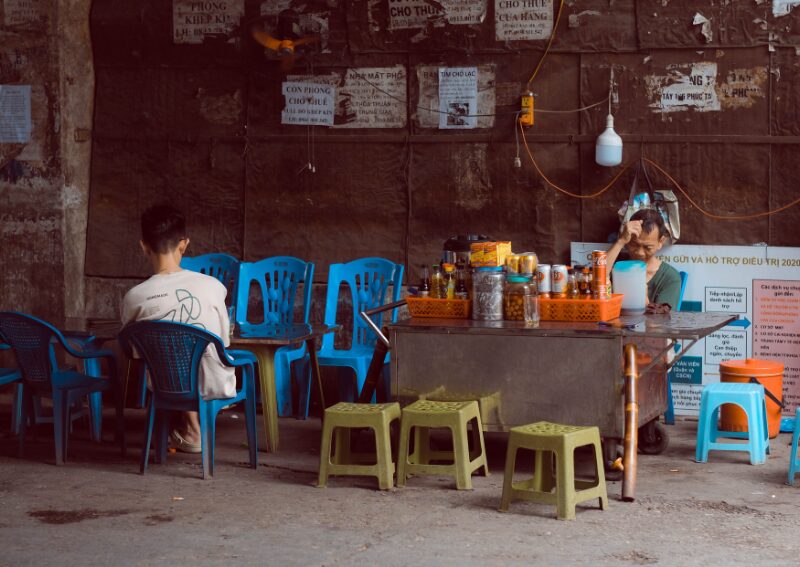
Finding a tra da setup in Hanoi’s Old Quarter requires almost no effort. They are on almost every corner, identifiable by the cluster of low plastic stools, the large metal flask or pitcher of tea, and the small tray of wrapped candies arranged within arm’s reach.
Sit down without overthinking it. A vendor will fill a glass almost immediately. There is no menu to consult and no decision to make beyond whether to take keo lac or sunflower seeds alongside. Pay when you leave rather than after each glass, since the arrangement is understood to be ongoing until you stand up.
The best times for tra da are early morning between 6:00 AM and 8:00 AM, when the Old Quarter streets are cool and the first conversations of the day are getting started, and late afternoon between 4:00 PM and 6:00 PM, when the heat has begun to ease and the pavement fills back up after the quieter midday hours. Both windows give the most authentic sense of how tra da functions as a daily social rhythm rather than a tourist attraction.
Do not rush. The entire point of tra da is to not be somewhere else.
Some Tra Da Location You Should Try
Tea stall near Chan Tien Pagoda
Address: 151 Bà Triệu Street, Hai Bà Trưng District
Bà Liên’s tea stall – over 40 years old, iconic old iron window and faded yellow wall.
Address: No. 8 Hàng Bún Street, Hoàn Kiếm District
Châu Long tea stall – old-villa vibe with wooden windows, near Trúc Bạch.
Address: 139 Châu Long Street (corner with Trúc Bạch Street), Ba Đình District
Quang Trung tea stall – small stall where locals read newspapers over tea.
Address: No. 30 Quang Trung Street, Hoàn Kiếm District
Bùi Thị Xuân tea stall – vintage Hanoi photo-spot, quiet in early afternoon.
Address: 102 Bùi Thị Xuân Street, Hai Bà Trưng District
Hàng Bài tea corner – classic sidewalk scene near shopping street.
Address: 47 Hàng Bài Street, Hoàn Kiếm District
Tạ Hiện Street tea/beer corner – busy day and night, mix of tea stalls and “bia hơi” spots, popular with tourists.
Address: Tạ Hiện Street, Hoàn Kiếm District (Old Quarter)
Hàng Đường tea stalls – right in the heart of the Old Quarter, near Đồng Xuân Market.
Address: Hàng Đường Street, Hoàn Kiếm District
Hàng Buồm – Hàng Gai area tea stalls – busy commercial streets with several sidewalk tea vendors.
Address: Hàng Buồm Street / Hàng Gai Street, Hoàn Kiếm District
Hoàn Kiếm Lake shore tea stalls – informal stalls along the lake, great for people-watching.
Address: Around Hồ Hoàn Kiếm (Hoàn Kiếm Lake), Hoàn Kiếm District
Where to Stay to Live the Tra Da Experience
The best way to understand tra da culture is to walk out of your accommodation and find it on the nearest corner. That requires being in the right neighborhood, which in Hanoi means the Old Quarter, where the street setups are densest, the streets are narrowest, and the pavement life is most continuous from morning to evening.
Hanoi La Siesta Classic Ma May, one of the best hotels in Hanoi Old Quarter, sits at the center of all of this. Located on Ma May Street, one of the Old Quarter’s most historically layered corridors and within easy walking distance of the neighborhood’s most atmospheric tra da corners, morning sugar cane vendors, and keo lac sellers, it offers the kind of stay that makes the city feel like it belongs to you rather than the other way around.
Whether you are stepping out at dawn to catch the first tra da session of the day on a still-quiet Old Quarter street, or returning in the late afternoon to find a corner setup in full social flow, Hanoi La Siesta Classic Ma May is the kind of base that makes every part of the Hanoi street experience feel unhurried and entirely your own. Consistently celebrated as one of the best boutique hotels in Hanoi Old Quarter, it is the right starting point for anyone who wants to understand the city not just as a collection of sights but as a place where people actually live.