



Notre Dame Cathedral Saigon 2026: The Complete Travel Guide to Saigon’s Most Beloved Landmark
The Pink Cathedral – One of the Most Iconic Saigon Attractions
At the end of Dong Khoi Street, where the pace of modern Saigon slows for just a moment, two soaring bell towers rise above the rooftops of District 1. The Notre Dame Cathedral Basilica of Saigon, known in Vietnamese as Nha Tho Duc Ba, has anchored the city’s skyline for over 140 years. To stand in the square in front of it is to feel the long arc of Saigon’s history beneath your feet: French colonial ambition, wartime upheaval, religious devotion, and the enduring spirit of a city that has always found a way to renew itself.
For travelers visiting Ho Chi Minh City, the cathedral is far more than a photo opportunity. It is a living monument, still holding weekly Mass, still drawing pilgrims and tourists in equal measure, and currently undergoing a meticulous restoration that will return it to its original splendor. This guide covers everything you need to know before you go.
What Is the Notre Dame Cathedral Saigon?
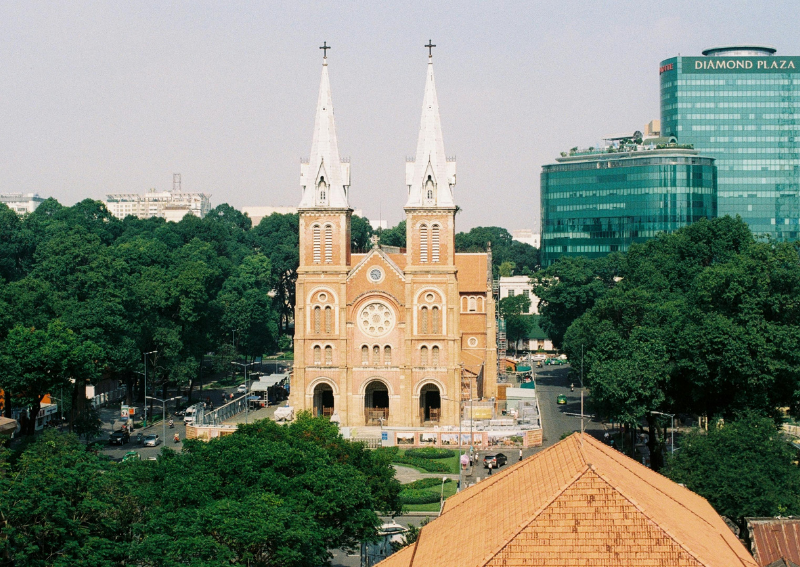 Address: No. 1 Cong Xa Paris Street (Paris Square), Ben Nghe Ward, HCMc
The Notre Dame Cathedral Basilica of Saigon, officially named the Cathedral Basilica of Our Lady of the Immaculate Conception, is one of only four basilicas in Vietnam, a title conferred by the Vatican to churches of exceptional religious and architectural significance.
Built entirely from materials shipped from France in the late 19th century, the cathedral stands as the most recognizable symbol of French colonial influence on Vietnamese urban architecture. Its twin bell towers, rising 58 meters above street level, can be seen from multiple points across central Saigon and have become one of the defining images of Ho Chi Minh City.
In 2023, the South China Morning Post named it among Asia’s ten most magnificent churches, a recognition that speaks to its enduring power as both a religious space and an architectural achievement.
Saigon Cathedral History
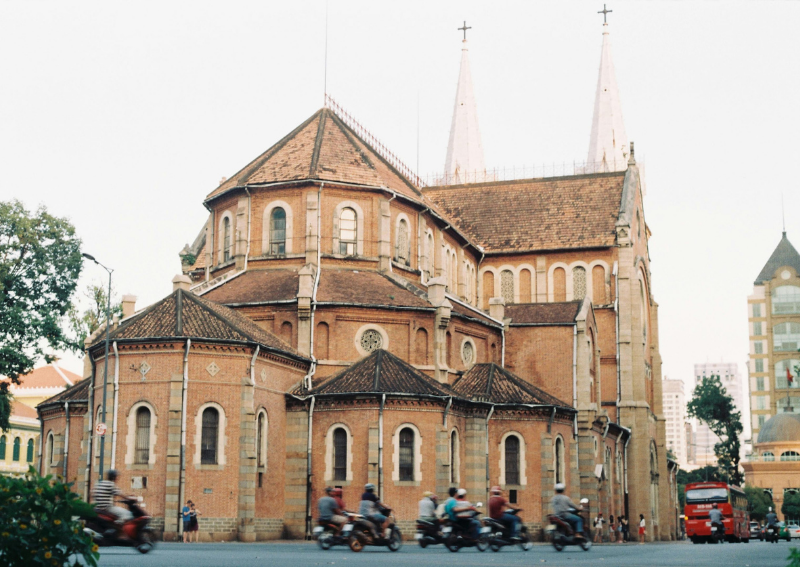 From a Makeshift Chapel to a Grand Basilica
The history of the Saigon Notre Dame Cathedral begins shortly after the French seized Saigon in 1859. The colonial administration initially built a small wooden church on Ngo Duc Ke Street to serve the religious needs of French military and administrative personnel. As Saigon grew in importance and the Catholic community expanded, a second, larger wooden church was constructed along the Charner Canal and completed in 1865, named Saigon Church. But this too proved inadequate.
French Admiral Bonard and subsequent colonial authorities recognized the need for a permanent, grand cathedral befitting a city they intended to develop into the capital of French Indochina. A formal design competition was held, and the commission went to French architect Jules Bourard.
Construction: A Cathedral Built Across Two Oceans
Construction began in 1877 and was completed remarkably quickly for a project of such scale. The cathedral was inaugurated on April 11, 1880, just three years after the first stone was laid. Every material used in construction was shipped directly from France. The distinctive red bricks came from Marseille, fired with a formula designed to resist moss growth in tropical climates. After more than 140 years in Saigon’s heat and humidity, those Marseille bricks retain much of their original color, a testament to the care taken in their manufacture.
The interior features 56 stained glass windows crafted in Chartres, France. The cathedral measures 91 meters in length, 35.5 meters in width, and the main roof vault reaches a height of 21 meters. By any measure, it was the most ambitious construction project undertaken in Saigon during the French colonial era.
In 1895, pointed roofs were added to the two bell towers, completing the silhouette that defines the cathedral today. The six bronze bells housed in the towers were cast in France and shipped to Saigon in 1879. Together they weigh 30 metric tons. On special occasions such as Christmas Eve, all six bells ring simultaneously, a sound audible from up to 10 kilometers away. Between the twin towers hangs a clock manufactured in Switzerland in 1887. Over 135 years later, it continues to keep accurate time, making it the oldest functioning clock in Ho Chi Minh City.
Elevation to a Basilica
In 1960, Pope John XXIII reorganized the Roman Catholic dioceses across Vietnam. The cathedral was designated the Saigon Chief Cathedral. Two years later, in 1962, Pope John XXIII elevated it to the status of a basilica, granting it the official title it carries today: Notre Dame Cathedral Basilica of Saigon.
The Virgin Mary Statue and a Miracle That Made Headlines
In front of the cathedral stands a 4.6-meter statue of the Virgin Mary, carved from Italian white Carrara granite by sculptor G. Ciocchetti and installed in 1959. The statue, which depicts Our Lady of Peace, has become a site of pilgrimage. In October 2005, thousands of devotees gathered after reports emerged that the statue’s eyes had shed tears. The event attracted enormous attention across Vietnam and among Catholic communities worldwide.
Whether interpreted as a miracle or a phenomenon, the episode cemented the statue’s place in the spiritual life of the city and drew international coverage that brought Notre Dame Cathedral Saigon to global attention.
Wartime and Continuity
During the Vietnam War, the cathedral became a gathering place for Saigon residents seeking spiritual solace amid the conflict. It sustained only minor damage and continued to hold services throughout the war years. When Saigon fell on April 30, 1975, the cathedral remained intact. Under the reunified Vietnamese government, it was permitted to continue religious operations, and it has held Mass without interruption ever since.
Architecture: A French Colonial Architecture in Vietnam
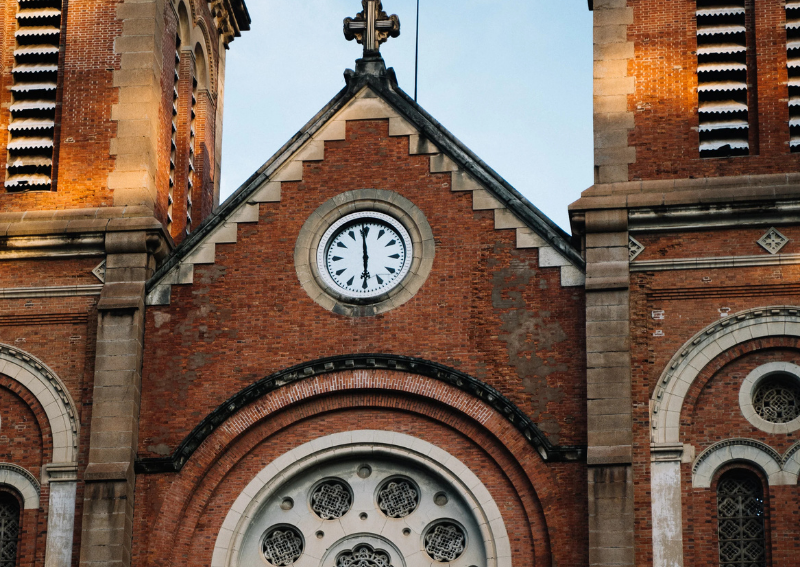 The Notre Dame Cathedral Saigon is a masterwork of Neo-Romanesque architecture with Gothic influences, a style that was fashionable across French colonial projects in the late 19th century but rarely executed with such fidelity to the original tradition.
- The Twin Bell Towers rise 58 meters above street level and frame the cathedral’s main facade. Each tower houses three of the six bronze bells. The pointed roofs added in 1895 give the towers their characteristic silhouette, distinct from the flat-topped profile of the original design.
- The Facade and Brick Exterior features those remarkable Marseille bricks, which give the building its warm reddish-pink hue. Their resistance to moss and tropical weathering was intentional and has proved extraordinarily effective.
- The Stained Glass Windows number 56 in total, each crafted in Chartres. Many were damaged during the wartime years but have been carefully repaired and continue to cast their colored light across the interior.
- The Cross-Shaped Roofline, visible from above, is a deliberate architectural reference to Christian symbolism. From ground level, the length and proportions of the nave create a sense of solemn grandeur that strikes even secular visitors.
- The Square and Garden in front of the cathedral are as much a part of the experience as the building itself. The formal garden, laid out with four pathways arranged in the shape of a cross, leads to the statue of Our Lady of Peace at its center. The square is one of the most popular gathering places in District 1, particularly in the evenings.
Visiting the Notre Dame Cathedral Ho Chi Minh City: What to Know in 2025
Notre Dame Cathedral Renovation 2025
The cathedral has been undergoing a comprehensive restoration since August 2017. The project, which covers the roof tiles, drainage systems, bell towers, interior and exterior structures, and the bells themselves, has been more extensive and technically complex than originally anticipated. Completion is now expected around 2027.
Despite the ongoing work, the cathedral square, the garden, and the exterior remain fully accessible to visitors at all times. A significant milestone was reached in March 2026, when two newly crafted gold-plated crosses, each weighing over 400 kilograms and manufactured by Belgium’s Monument Group in the style of the original 128-year-old crosses, were installed atop the twin towers at a height of 60 meters. The restoration, far from diminishing the cathedral’s appeal, has made the visit a chance to witness a piece of living heritage being actively preserved.
Visitors who wish to experience the cathedral in its fully restored state may wish to plan a return visit after 2027, when the scaffolding will finally come down and the building will be revealed in renewed splendor.
Opening Hours and Access
The cathedral square and exterior grounds are accessible to visitors throughout the day. Interior access for tourists may vary depending on restoration progress and scheduled services. The Sunday 9:30 AM Mass is conducted in both Vietnamese and English and remains open to worshippers and respectful visitors.
For the most current access information, it is advisable to check local tourism sources or ask at your hotel before visiting.
Mass Schedule
- Weekdays: 5:30 AM and 5:00 PM
- Sundays: 5:30 AM, 6:45 AM, 8:00 AM, 9:30 AM (often bilingual in Vietnamese and English), 4:00 PM, and 5:30 PM
Admission
Entry to the cathedral grounds and exterior is free. There is no admission fee to visit the square, garden, or to attend Mass.
Best Time to Visit Notre Dame Cathedral Saigon
The best time to visit Notre Dame Cathedral Saigon is in the early morning, between 7:00 AM and 9:00 AM. At this hour, the soft light falls directly on the warm pink brickwork of the facade, crowds are thinner, and the square has a calm, contemplative quality before the midday heat and tourist groups arrive. Late afternoon, as the sun drops toward the west, also offers beautiful light on the towers.
Avoid the midday hours between 11:00 AM and 2:00 PM, when temperatures in Ho Chi Minh City regularly exceed 35 degrees Celsius and the square offers little shade.
Photography Tips
The cathedral’s facade photographs best in the morning when the light falls on the front of the building. The statue of Our Lady of Peace in the garden is a popular subject at all hours. For a wider architectural shot that includes both towers and the full garden, position yourself at the far end of the square near the junction with Dong Khoi Street.
How to Get to Notre Dame Cathedral Saigon
The cathedral sits at one of the most central and walkable points in the entire city.
- On Foot: From the Nguyen Hue Walking Street, the Saigon Opera House, or most hotels in central District 1, the cathedral is a 5 to 15 minute walk. The route along Dong Khoi Street, one of Saigon’s most elegant boulevards, is a pleasure in its own right.
- By Grab: Vietnam’s dominant rideshare app makes getting to the cathedral straightforward from any district. A ride from most District 1 hotels costs between 25,000 and 55,000 VND.
- By Taxi: Metered taxis from reputable companies such as Vinasun or Mai Linh are widely available. Always confirm the meter is running before departure.
- By Motorbike Taxi: Xe om drivers are available near all major tourist areas. Agree on the fare in advance.
- Parking: Street parking on surrounding roads is available for motorbikes. For those arriving by car, parking in the nearby Vincom Center or along Ham Nghi Street is the most practical option.
What to Do Near Notre Dame Cathedral Saigon
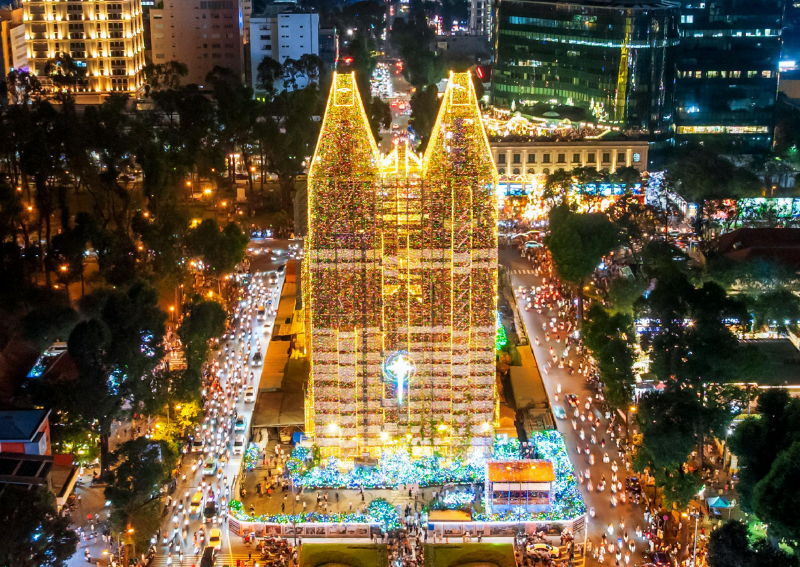 The cathedral anchors a rich cluster of Saigon attractions in central District 1, all within easy walking distance. A well-planned morning can cover several of the city’s most significant landmarks in a single outing.
- Saigon Central Post Office (50 meters): Directly across the square from the cathedral stands the Saigon Central Post Office, one of the finest surviving examples of French colonial architecture in Southeast Asia. Designed by the firm of Gustave Eiffel and completed in 1891, it still functions as a working post office. The barrel-vaulted interior, original wooden telephone booths, and large wall maps of colonial-era Saigon create an atmosphere unlike anything else in the city.
- Independence Palace / Reunification Palace (700 meters): A short walk south brings you to the Independence Palace, the former seat of the South Vietnamese government and site of the dramatic conclusion of the Vietnam War on April 30, 1975. Its preserved 1960s interiors, underground bunker, and rooftop helipad make it one of the most compelling historical sites in Southeast Asia.
- War Remnants Museum (1.1 kilometers): The most visited museum in Ho Chi Minh City, the War Remnants Museum presents a powerful and unflinching account of the Vietnam War from the Vietnamese perspective. Paired with the Independence Palace, the two sites offer the most complete portrait of the conflict available in a single afternoon.
- Dong Khoi Street (adjacent): The street running from the cathedral toward the Saigon River is lined with French colonial buildings, boutique shops, art galleries, and some of the city’s finest cafes. A walk down Dong Khoi connects the cathedral square to the riverfront in about 15 minutes.
Ben Thanh Market (1.3 kilometers): The city’s most iconic covered market, a short Grab ride or brisk walk from the cathedral, offers an immersive contrast of local street food, fresh produce, and crafts.
Where to Stay for a Complete Saigon Experience – La Siesta Premium Saigon
After a morning at the Notre Dame Cathedral, the Central Post Office, and the surrounding Saigon attractions of District 1, returning to the right hotel transforms a good trip into an exceptional one.
La Siesta Premium Saigon stands out among the Best hotels in Saigon, offering a calm and elegant retreat right in the city center. Its Indochine-inspired design reflects the same layered cultural history you encounter at the cathedral itself, while its attentive service provides genuine rest after a day of exploration.
Recognized as one of the Best boutique hotels in Saigon, La Siesta Premium Saigon is especially well suited to travelers who want both refined comfort and convenient access to the city’s most significant Saigon attractions.
The cathedral, the Central Post Office, the Independence Palace, and the Nguyen Hue Walking Street are all within easy reach. For visitors arriving from Europe, North America, or Australia who want accommodation that reflects the character and depth of the city they have come to discover, La Siesta Premium Saigon offers exactly that kind of thoughtful, place-rooted experience.