Vietnam’s Own Little Piece of Europe, at 1,500 Meters Above the World
Picture a city where pine forests spill down misty hillsides, where the air turns cool and fragrant by late afternoon, where French colonial villas sit behind gardens full of hydrangeas and roses, and where a steaming cup of locally grown coffee tastes like the best version of itself. That city is Dalat, and it sits just 300 kilometers from the tropical heat of Ho Chi Minh City, yet feels worlds away.
Known affectionately as the City of Eternal Spring, the City of a Thousand Flowers, and, with good reason, the Little Paris of Vietnam, Dalat Vietnam has been drawing those in search of cool air and quiet beauty since French colonial planners decided to build their own alpine retreat in the Vietnamese highlands more than a century ago. The result is one of Southeast Asia’s most unexpectedly enchanting cities: part Provence, part Swiss lakeside town, entirely Vietnamese.
For international travelers from Europe, North America, and Australia, Dalat tends to come as a pleasant surprise. You expect a Vietnamese city. You find something that looks like it might belong in the Auvergne or the Austrian Tyrol, except that the food is extraordinary, the coffee is excellent, the landscapes are covered in flower farms rather than vineyards, and the locals are among the warmest you will meet anywhere in the country.
This guide covers everything you need to know to plan a visit: what to see and do, when to go, what to eat, where to find it, and how to get there.
Why Dalat Feels So Different From the Rest of Vietnam

Dalat sits on the Lang Biang Plateau in the Central Highlands of Lam Dong Province, at an altitude of approximately 1,500 meters (4,900 feet) above sea level. That elevation changes everything.
The average annual temperature in Dalat hovers between 15 and 24 degrees Celsius, compared to 30 to 38 degrees in Ho Chi Minh City. There is no need for air conditioning. Evenings call for a light jacket. Mornings often bring mist that drifts through pine forests and settles over the surface of the lake at the heart of the city. It is the only place in southern Vietnam where you can sit outside in a café in the middle of the day in genuine comfort, sipping coffee grown in the hills visible from your table.
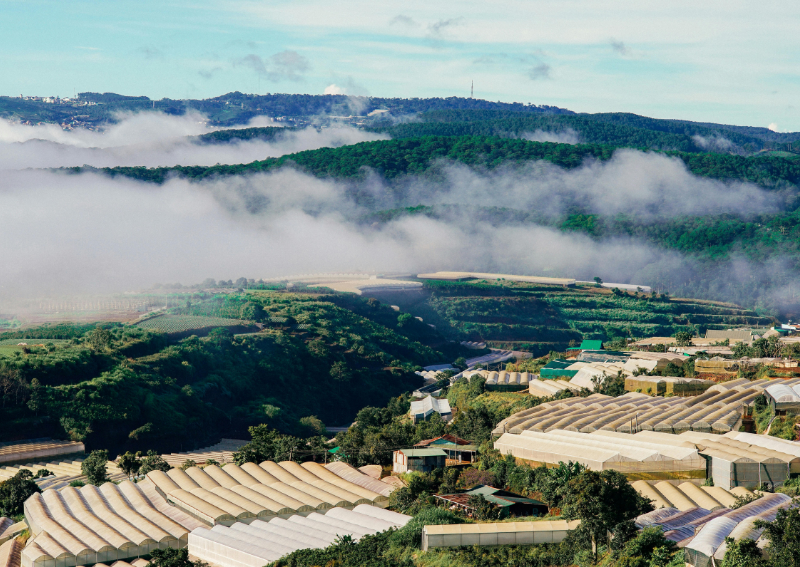
The city’s landscape is equally distinctive. Pine forests cover the hills. Flower farms terraced across the hillsides produce roses, hydrangeas, chrysanthemums, and carnations for markets across Vietnam. Strawberry fields, artichoke gardens, and vegetable plots give the outskirts of the city the texture of a working European countryside. French colonial villas, many of them more than 80 years old and still beautifully maintained, line the streets of the city center.
It is this combination, alpine climate, European architectural legacy, spectacular highland scenery, and distinctively Vietnamese warmth and culinary character, that makes Dalat one of Vietnam’s most singular destinations.
The Best Time to Visit Dalat – Dalat Climate and Weather
Dalat can be visited year-round, but the two seasons create meaningfully different experiences.
Dry Season (November to April)
This is the optimal window for most international travelers. Skies clear reliably, temperatures are at their most comfortable, and outdoor activities including trekking, canyoning, and cycling are fully accessible.
December through February is the coolest period, with overnight temperatures occasionally dropping below 10 degrees Celsius. Pack a light jacket or sweater. This is also peak domestic travel season, so popular sites can be busy on weekends and around Vietnamese public holidays. Book accommodation in advance for December and January visits.
The Flower Festival: Dalat hosts its Flower Festival every two years, typically in December. The city transforms into an open-air garden, with elaborate floral installations, cultural performances, and exhibitions throughout the center. If your visit coincides with a Festival year, it is an extraordinary time to be there.
Rainy Season (May to October)
Afternoon and evening showers are common but rarely last all day. The landscape is at its greenest and most lush, flower farms are vibrant, and prices are lower with fewer crowds. Many experienced travelers actually prefer Dalat in the rainy season for its moody atmosphere: the mist thickens, the pine forests deepen in color, and the city has a quiet, contemplative quality that suits slow exploration.
Early Mornings, Any Season: Whatever time of year you visit, make a point of being out before 8:00 AM at least once. The mist on Xuan Huong Lake, the empty streets, the cool air, and the quality of light in the early morning are among Dalat’s most memorable experiences.
Dalat Attractions – What to See in Dalat
Xuan Huong Lake

Address: Dalat city center
The geographic and social heart of the city, Xuan Huong Lake is an artificial reservoir created in 1919. The walking path that circles its 7-kilometer shore is the city’s most pleasant promenade, offering continuous views of the surrounding pine-covered hills, colonial buildings, the Dalat Market on the northern bank, and flower gardens that change color with the seasons. Walking the full circuit takes approximately 90 minutes. Paddle boats are available for rent.
The lake is especially beautiful at dusk and in the misty early morning, when the water acts as a mirror for the surrounding landscape.
Lang Biang Mountain

Address: Lang Biang Plateau, Lac Duong District, Lam Dong Province (approximately 12 km north of Dalat city center)
The highest peak in the Dalat area at 2,167 meters above sea level, Lang Biang Mountain is the spiritual heart of the K’Ho indigenous people and the origin of some of the region’s most deeply rooted legends. Hiking to the summit takes two to three hours from the trailhead and rewards the effort with sweeping panoramic views across the plateau and, on clear days, all the way to the coast.
A jeep service carries visitors to the first peak for those who prefer a shorter walk. Lang Biang is about 12 kilometers north of the city center.
Crazy House (Hang Nga Guesthouse)

One of the most architecturally remarkable buildings in Vietnam, Crazy House is the ongoing project of Vietnamese architect Dang Viet Nga. The structure, which functions as a working guesthouse, is a fantastical composition of organic curves, cave-like rooms, sculpted staircases, and surrealist details that seems to have grown from the hillside rather than been designed and built.
International architecture publications have compared it to the work of Antoni Gaudi. Walking through it at any hour feels like entering a dream.
Bao Dai’s Summer Palace
The last emperor of Vietnam used Dalat as his highland retreat and built several palaces on the city’s forested hillsides. Palace III (Dinh III), the most accessible, has been preserved with its original furnishings, personal effects, and decor intact. The palace offers a fascinating window into the life of Vietnam’s final imperial family and the world they inhabited at the intersection of Vietnamese tradition and French modernity.
Dalat Railway Station

Built in the 1930s in a graceful fusion of French colonial and Art Deco styles, the Dalat Railway Station is one of the most beautiful historic buildings in the city. A short heritage rail section, recently restored, runs from the station through pine forests to the nearby village of Trai Mat, making it one of the most charming short train rides in Vietnam. The journey passes through highland scenery and ends near Linh Phuoc Pagoda.
Linh Phuoc Pagoda
Reached most atmospherically by the heritage train from Dalat Railway Station, Linh Phuoc Pagoda in the village of Trai Mat is one of the most elaborately decorated religious sites in southern Vietnam. Every surface is covered in intricate mosaic work made from thousands of fragments of ceramic, glass, and porcelain. The pagoda houses a dragon made from over 12,000 beer bottles and a 27-meter-high tower.
The effect is somewhere between devotional art and baroque fantasy.
Truc Lam Zen Monastery
Perched above Tuyen Lam Lake in a forested valley south of the city, Truc Lam Zen Monastery is one of Vietnam’s most significant centers of Zen Buddhism. The monastery grounds, with their pine trees, prayer halls, and gardens overlooking the lake, have a stillness that offers a genuinely meditative contrast to the bustle of the city center. A cable car from the city provides access for those who prefer not to drive.
Valley of Love and Flower Parks

Several of Dalat’s parks and gardens, including the Valley of Love and the Dalat Flower Garden near Xuan Huong Lake, showcase the extraordinary range of flowers grown in the region. These are particularly popular with Vietnamese domestic visitors and are genuinely beautiful in the morning light. The flower varieties on display change with the season.
Adventure Activities: Canyoning and More
Dalat has established itself as one of Southeast Asia’s premier adventure destinations. Canyoning is the signature activity: guides lead groups through forested gorges, abseiling from waterfalls, sliding down natural rock chutes, jumping into clear highland pools, and floating through river sections. The experience is suitable for reasonably fit travelers with no prior experience and is routinely described as a highlight of entire Vietnam trips.
White water rafting, mountain biking, rock climbing, and multi-day motorbike tours through the surrounding highlands are also widely available. For travelers who want to get off the beaten path and into the genuine landscape of the Central Highlands, a guided jeep or motorbike tour through coffee plantations, ethnic minority villages, and mountain passes offers an unforgettable half-day or full-day experience.
Dalat Food Guide – What to Eat in Dalat
Dalat’s cool climate and exceptionally fertile soil produce ingredients unavailable elsewhere in Vietnam at the same freshness and quality. The food here is genuinely different from what you find in Saigon or Hanoi, and eating your way through the city’s street stalls, market corners, and small restaurants is one of the most enjoyable parts of any visit.
Banh Trang Nuong Dalat: Vietnamese Pizza Dalat

Banh Trang Nuong Dalat: Vietnamese Pizza DalatIf there is one dish that defines Dalat’s street food identity, it is banh trang nuong, known affectionately among travelers as Vietnamese pizza. A sheet of thin rice paper is placed over a charcoal grill and topped with layers of egg, dried shrimp, pork pate, green onion, quail egg, cheese, dried beef, and mayonnaise, then folded and sliced. The result is impossibly crispy on the outside, rich and savory within, and perfectly suited to Dalat’s cool evening air.
You will find banh trang nuong on nearly every street corner in the city, but not all versions are created equal. One of the most beloved addresses is Banh Trang Nuong Ba Dinh, a long-established local institution known for the generosity of its toppings, the quality of its charcoal grilling, and the distinctively rich flavor of its dried beef layer. The stall is typically open from late afternoon into the evening and draws a constant line of locals and in-the-know visitors. Arrive early or be prepared to wait, which is itself part of the experience.
Other well-regarded addresses for banh trang nuong include Banh Trang Nuong Di Dinh at the corner of Hoang Dieu and Tran Nhat Duat Streets, a compact spot that is perpetually busy on weekends and holidays, and various stalls around the Dalat Night Market area on Quang Trung Street.
Sua Dau Nanh Bo: Hot Soy Milk on a Cold Evening
One of Dalat’s most cherished evening rituals is sitting at a street-side stall with a cup of hot sua dau nanh bo, a rich, creamy soy milk served warm and sometimes paired with grilled rice cakes or sweet potato. In the cool highland air, there are few things more comforting. The drink is nutritious, affordable (typically under 15,000 VND per cup), and available at small stalls throughout the city center. Look for the clusters of low plastic stools and steaming pots near the night market area in the evenings, and you will have found the right place.
Banh Can: Dalat’s Beloved Mini Rice Cakes

Banh can are small rice flour cakes cooked in heated ceramic molds and filled with quail eggs, beef, or seafood. The outside is delicately crispy while the inside remains soft and yielding. They are served with a sweet and sour dipping sauce made with fish sauce, fresh chili, and herbs. Banh can is a breakfast and evening snack staple found throughout the city.
Banh Mi Xiu Mai: The Perfect Highland Breakfast
A distinctly Dalat take on the classic Vietnamese banh mi, banh mi xiu mai pairs a crusty baguette with a bowl of steaming pork meatballs in a savory, slightly sweet tomato broth. Tear the bread into pieces, dip, eat, repeat. It is one of the most satisfying breakfast dishes you will find anywhere in Vietnam and particularly welcome on a cool Dalat morning.
Strawberries, Avocados, and Local Produce
No visit to Dalat is complete without stopping at one of the fresh produce stalls or farm shops in the city market area. Dalat strawberries, grown in the highlands and sold fresh or as jam, wine, and dried fruit, are famous across Vietnam for their sweetness and quality. Avocados, artichokes, and highland vegetables unavailable elsewhere in the south are piled high at every market stall. The Dalat Central Market on Nguyen Thi Minh Khai Street is the best single destination for exploring the full range of local produce.
Dalat Coffee and Wine

The highlands surrounding Dalat grow some of Vietnam’s finest coffee, and the city’s café culture reflects this. From rustic roadside drip coffee stalls to architecturally ambitious specialty cafes with lake views, Dalat is one of the best places in Vietnam to drink coffee. Dalat wine, produced from local grapes, is modest in ambition but widely available and worth trying for the novelty of drinking highland Vietnamese wine in a pine forest.
Artichoke Tea
A Dalat specialty with no equivalent elsewhere in Vietnam, artichoke tea (tra atiso) is brewed from local artichoke leaves and flowers and served warm. It has a mild, slightly earthy, subtly sweet flavor and is valued locally for its health properties. Available at cafes and market stalls throughout the city.
How to Get to Dalat from Ho Chi Minh city
Dalat is approximately 300 kilometers from Ho Chi Minh City by road and accessible by several means of transport.
By Flight: The fastest option. Vietnam Airlines, Vietjet Air, and Bamboo Airways operate daily flights from Tan Son Nhat International Airport in Ho Chi Minh City to Lien Khuong Airport (Dalat airport code: DLI). The flight takes approximately 50 minutes to one hour. Fares range from approximately USD 30 to USD 110 depending on the operator and booking lead time. Lien Khuong Airport is located 30 kilometers south of the city center; taxi and Grab rides to the center take around 45 minutes. (CLOSED UNTIL SEPTEMBER 1ST)
By Sleeper Bus: The most economical and widely used option for budget-conscious travelers. Direct sleeper buses depart regularly from Ho Chi Minh City, with reputable operators including Thanh Buoi and Phuong Trang (FUTA). Journey time is approximately 7 to 8 hours. Fares range from USD 8 to USD 23. Sleeper buses are equipped with reclining berths, air conditioning, and WiFi, making an overnight bus a practical way to combine travel and rest.
By Private Car or Limousine Van: The most comfortable overland option. Door-to-door service from central Ho Chi Minh City hotels to Dalat
accommodation takes approximately 5 to 6 hours via Highway 20, passing through the scenic Di Linh Plateau. Private car costs start from around USD 50 to USD 95 for a full vehicle.
accommodation takes approximately 5 to 6 hours via Highway 20, passing through the scenic Di Linh Plateau. Private car costs start from around USD 50 to USD 95 for a full vehicle.
By Motorbike: A favorite of adventure travelers who want to experience the highland landscape at their own pace. The route via Highway 20 through Bao Loc and its tea plantations is consistently described as one of Vietnam’s most beautiful mountain drives. Allow two full days for a comfortable journey with stops.
Getting Around Dalat
Grab: The most convenient option for getting between specific attractions. The app operates reliably in Dalat and prices are reasonable.
Motorbike Rental: Renting a motorbike gives maximum flexibility for exploring the city and the surrounding countryside, including waterfalls, coffee farms, and highland villages. Daily rentals typically cost between 100,000 and 200,000 VND. Carry a valid home country license and an International Driving Permit (1968 Vienna Convention) to ride legally.
Open-Top Jeep Tours: Military-style open jeeps operated by local guides are an atmospheric and popular way to visit the surrounding waterfalls, farms, and villages. Group and private options are available through most hotels and tour operators.
On Foot: The area around Xuan Huong Lake and the city center market district is pleasant and rewarding on foot, particularly in the cool morning or late afternoon hours.
How Long to Spend in Dalat
Two nights and two full days is the comfortable minimum for experiencing the city’s main highlights. Three to four nights is ideal for travelers who want to combine sightseeing with adventure activities, day trips to outlying waterfalls and monasteries, and genuine relaxation. Those pursuing multi-day canyoning or motorbike touring routes through the highlands often extend to five nights or more.
Where to Stay for a Complete Dalat and Southern Vietnam Experience
Dalat is most naturally accessed via Ho Chi Minh City, where the majority of international flights arrive and where most Vietnam itineraries begin or end. Choosing the right base in Saigon makes the entire journey smoother, whether you are departing on an early flight to Lien Khuong or returning after several days in the cool highlands.
La Siesta Premium Saigon stands out among the Best hotels in Saigon, offering a calm and elegant retreat in the heart of the city. Its Indochine-inspired design, warm in tone and thoughtful in detail, echoes the same layered French and Vietnamese aesthetic sensibility that gives Dalat so much of its charm, creating a natural continuity between your Saigon base and your highland escape.
Recognized as one of the Best boutique hotels in Saigon, La Siesta Premium Saigon is particularly well suited to international travelers who want genuine comfort alongside convenient access to the city’s transport connections. Whether you are heading up to Dalat’s cool air and misty mornings or returning from the highlands to catch an international connection, the hotel’s central District 1 location, attentive service, and refined atmosphere make it the ideal anchor for your southern Vietnam journey.
