



Saigon Central Post Office 2026: Inside Ho Chi Minh City’s Most Magnificent Colonial Landmark
The Golden Building That Stops Every Visitor in Their Tracks
Step off Dong Khoi Street into Paris Square and you will see it immediately: a sweeping yellow facade framed by grand arched windows, an oversized clock keeping faithful time above the central entrance, and the unmistakable silhouette of a building that has presided over the heart of Saigon for more than 130 years.
The Saigon Central Post Office is one of those rare landmarks that genuinely deserves its reputation. Unlike many tourist attractions that promise grandeur and deliver modest reality, this building exceeds expectations at every turn.
The exterior is magnificent. The interior is more magnificent still. And unlike a museum, this is a building you are invited to use: to buy a stamp, to send a postcard, to snap a photo at its newly launched Stamp Booth, to sit quietly in one of the world’s most beautiful working post offices and feel, for a moment, the particular kind of time that only old buildings can hold.
This guide covers everything a traveler needs to know before visiting one of the most iconic Ho Chi Minh City attractions.
Where is Saigon Central Post Office?
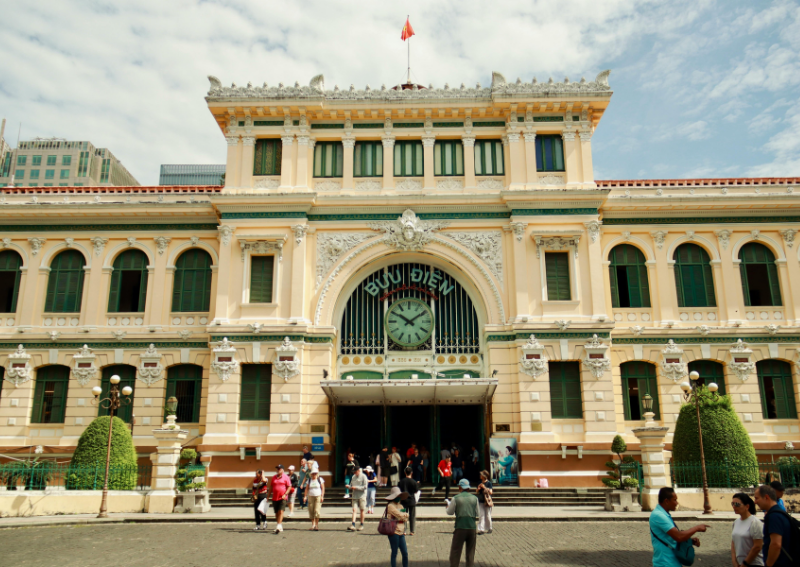
- Address: 2 Cong Xa Paris (Paris Square), Ben Nghe Ward, Ho Chi Minh City
- Opening Hours: 8:00 AM to 5:00 PM daily, including weekends
- Entrance Fee: Free. No ticket is required to enter or explore the building.
- Best Time to Visit: Early morning on weekdays, between 8:00 AM and 10:00 AM, for the best natural light on the facade and thinner crowds inside the hall.
- How Long to Spend: 30 to 45 minutes for a relaxed visit. Budget up to an hour if you plan to write and send a postcard, browse the souvenir stalls, and try the Stamp Booth.
A History Written in Yellow Bricks and Iron Arches
The First Communication Hub of French Saigon
The French seized Saigon in 1859 and within a few years had begun constructing the administrative infrastructure of their new colonial capital. Among the earliest priorities was establishing a working communication network across French Indochina. On January 13, 1863, a telegram and postal facility known as the Saigon Telegraph-wire Department was inaugurated on this site, connecting Saigon with Cambodia, Laos, and eventually with France itself through the expanding global telegraph network.
For the better part of two decades, this original facility served as the nerve center of colonial communication in southern Vietnam. But Saigon was growing fast, and the demands placed on the department had long outpaced its capacity.
Building the Grand Post Office – An icon of French Colonial Architecture in Saigon: 1886 to 1891
In 1886, the French colonial administration commissioned a replacement building worthy of a city they were actively developing into one of Asia’s great colonial capitals. The project was led by architect Alfred Foulhoux, a collaborator of the firm associated with Gustave Eiffel. Though the building is often popularly attributed to Eiffel himself, the architectural vision was in fact shaped by Foulhoux and his associate Villedieu, who applied the structural engineering innovations of their era, particularly the use of iron framework construction, to create the soaring vaulted interior that defines the building today.
Construction took five years. When the new Saigon Central Post Office was inaugurated in 1891, it was immediately recognized as one of the finest buildings in French Indochina. The design fused multiple European traditions: the civic grandeur of French Neo-classical architecture, the pointed arched windows of Gothic influence, and Renaissance decorative detailing, brought together with subtle Asian elements in the color scheme and ornamental relief work. The warm yellow exterior, the large clock above the entrance, the symmetrical arched windows marching along both sides of the facade, all of it was conceived as a statement of permanence and institutional authority.
Inside, the main hall was fitted with cast-iron pillars supporting a barrel-vaulted ceiling painted in green and cream. Long wooden counters ran the length of the hall on both sides. And on the interior walls above the counters, two extraordinary features were installed: large, meticulously hand-painted maps depicting colonial Saigon and the wider telegraph network connecting French Indochina, and along the upper walls, the names of the great scientists and inventors who had made telecommunications possible: Benjamin Franklin, Alessandro Volta, Michael Faraday, and others. The building was not simply a post office. It was a monument to the technology of its age.
Surviving Everything Saigon Has Been Through
The Saigon Central Post Office has operated continuously through every upheaval in the city’s modern history: French colonial rule, Japanese occupation during World War II, the turbulent years of the Republic of Vietnam, the fall of Saigon on April 30, 1975, the transformation of the city’s name and identity in the decades that followed, and the extraordinary economic transformation of the past thirty years.
Through all of it, the Saigon Central Post Office kept working. Letters kept being sent. Stamps kept being sold. The building remained, as it does today, simultaneously a heritage landmark and a functioning piece of everyday infrastructure, processing thousands of parcels and letters every day while welcoming thousands of tourists who come to experience its architectural splendor.
This unbroken continuity is part of what makes the building so compelling. It is not a preserved artifact behind glass. It is a living space that has never stopped being used for exactly the purpose for which it was built.
The Architecture: What to Look For When You Visit
Understanding what to look for inside the Saigon Central Post Office transforms the experience from a pleasant visit into a genuinely revelatory one.
The Facade
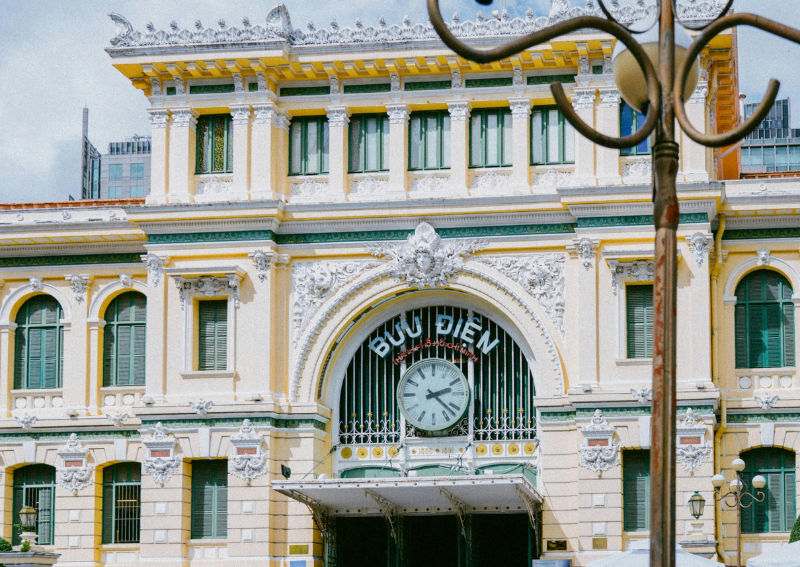
The exterior of the building presents one of the most harmonious architectural compositions in Vietnam. The warm yellow walls, the rhythmic sequence of arched windows, the decorative reliefs featuring palmette ornamen
ts and Roman arches, and the dominant clock centered above the entrance all work together with a discipline and confidence that reflects the serious architectural ambition of the project. The facade faces west, which means morning light falls on it directly and beautifully. For photography, position yourself across Paris Square near Notre Dame Cathedral for a wide shot that takes in the full width of the building.
The Entrance and the First Impression
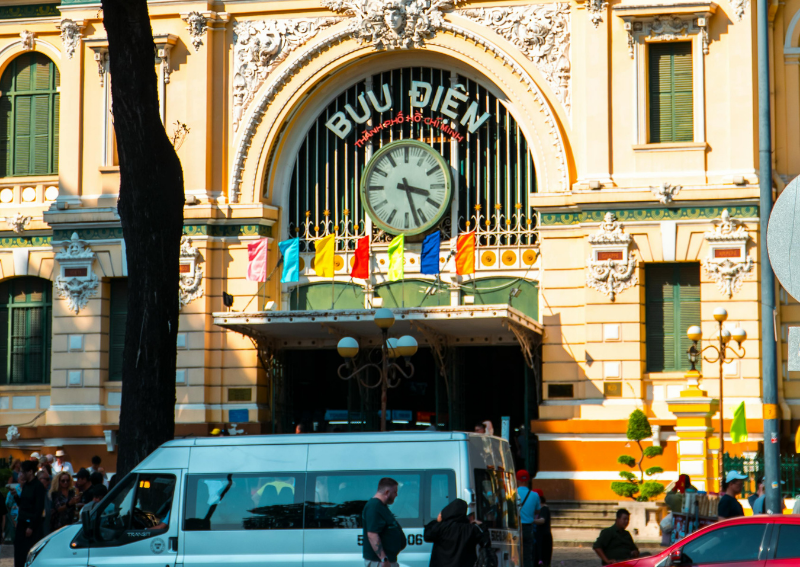
Walking through the arched main entrance is one of the great architectural experiences in Southeast Asia. Nothing visible from the street prepares you for what is inside. The scale of the vaulted hall, the quality of the light, and the combination of the iron framework, the painted ceiling, and the long wooden counters create an atmosphere closer to a great European railway station or a cathedral nave than to any conventional idea of a post office. Most visitors stop in the doorway for a moment, adjusting to the scale of what they are looking at.
The Hand-Painted Colonial Maps
The two large maps on the interior walls are among the most remarkable surviving artifacts of the French colonial period in Ho Chi Minh City. One depicts Saigon and its surroundings as they appeared in the late 19th century. The other shows the telegraph routes connecting southern Vietnam, Cambodia, and the wider network of French Indochina. They were painted with extraordinary detail and have faded only slightly over more than 130 years. Stand in front of them and you are looking at a document that was already old when the Vietnam War began.
The Wooden Telephone Booths
The vintage telephone booths along both sides of the hall are among the most photographed details of the interior. Originally functional telecommunications facilities, they have been preserved as architectural features and now house small souvenir and gift shops. Their dark wood and antique hardware provide a particularly striking contrast against the lighter tones of the surrounding hall.
The Portrait of President Ho Chi Minh
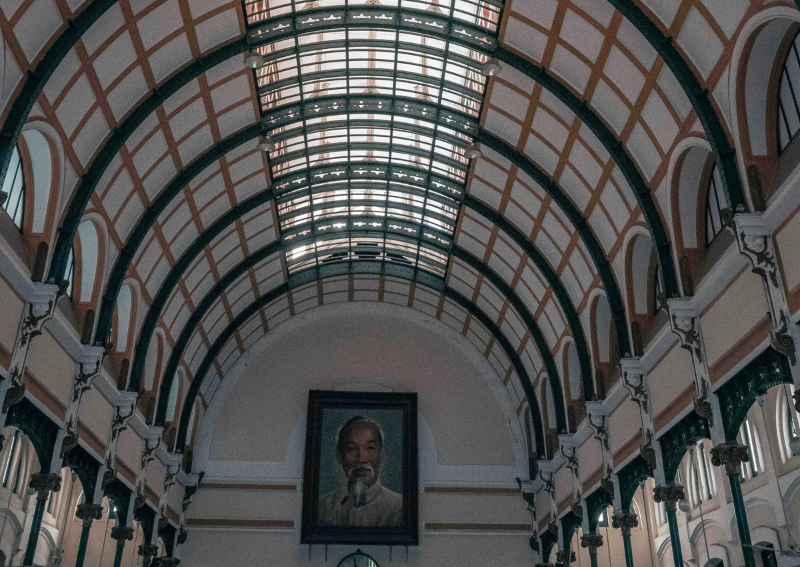
At the far end of the main hall, a large portrait of President Ho Chi Minh occupies the position of visual anchor for the entire space. Its presence is a straightforward marker of political and historical continuity: this building, constructed under French colonial rule, now belongs fully and without ambiguity to the Vietnamese state and the Vietnamese people.
The Stamp Booth Saigon Central Post: Saigon’s Most Charming New Photobooth Experience
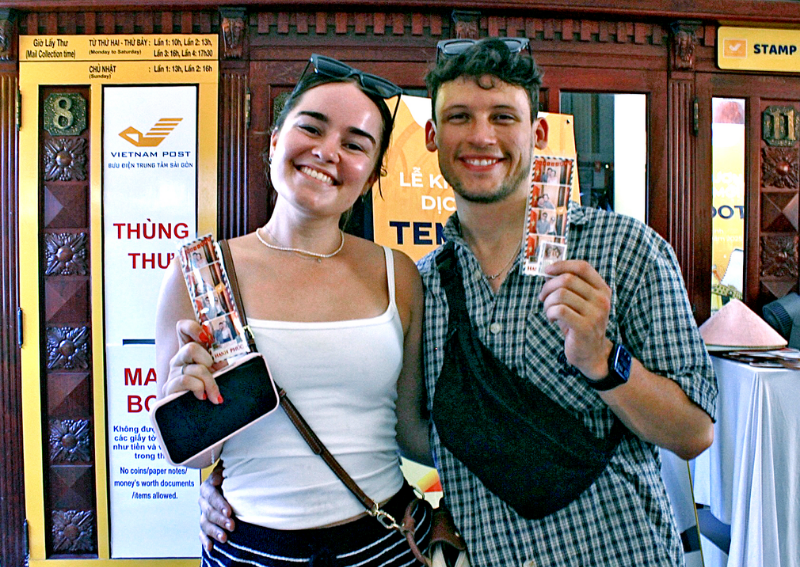
One of the most talked-about recent additions to the Saigon Central Post Office is the Stamp Booth, a photobooth installation that has quickly become one of the most enjoyable and shareable experiences in the building.
The Stamp Booth is the result of a collaboration between Vietnam Post and local creative studio Wis Corner, and has been housed inside one of the old telephone booths on the right side of the main hall, redesigned and repainted in the building’s signature yellow color. The space is decorated with postage stamps depicting some of Vietnam’s iconic structures, red flags with yellow stars, conical hats, and scarves, creating a photo environment imbued with the spirit of old Saigon.
The compact photo station lets visitors print custom postcards or faux postage stamps featuring their own portraits, set against nostalgic backdrops. According to Nguyen Duc Kien, a technician with Wis Corner, the project was designed not only to give travelers a unique souvenir but also to promote Vietnam’s postal heritage and visual culture. “It’s a small way to preserve and reintroduce stamp culture, especially in a building that has witnessed so much of the city’s history,” Kien said.
The concept combines modern technology with Vietnamese culture. Visitors can snap photos and turn them into personalized stamps or postcards, creating a souvenir that is genuinely specific to this building and this moment. An Australian traveler who tried the booth described the equipment as easy to operate and praised the enthusiasm of the support staff, adding that the photo went straight into her Vietnam trip collage.
The Stamp Booth is located on the right side of the main hall as you enter. It has proven popular with both younger Vietnamese visitors and international travelers, and represents a thoughtful way of making the post office’s heritage relevant to a new generation without compromising the building’s character. It belongs in this space, which is precisely why it works.
Five Things to Do Inside the Saigon Central Post Office
Send a Postcard the Old-Fashioned Way
This is the experience that most rewards visitors who treat the post office as more than a backdrop for photographs. Postcards typically cost 20,000 to 40,000 VND, and international postage is surprisingly affordable. Writing a note, choosing a stamp, and handing it over the counter in one of the world’s most beautiful working post offices is a small act that connects your visit to 130 years of history in the most tangible way possible.
Collect Commemorative Stamps
Vietnam Post produces beautiful limited-edition commemorative stamp series, and the post office counters carry the widest selection available anywhere in the city. For collectors and for travelers who want a portable, meaningful, and very packable piece of Vietnamese history, stamps are among the finest souvenirs available in Ho Chi Minh City.
Try the Sai Gon Central Post Stamp Booth
Take five minutes on the right side of the main hall to create your own personalized postage stamp portrait. The experience is quick, the results are charming, and the souvenir is unlike anything you can find anywhere else in Saigon.
Study the Colonial-Era Maps
Allow at least ten minutes to stand in front of the two hand-painted maps on the interior walls. They are genuine historical documents of extraordinary detail and age, and studying them gives the rest of the building a context that deepens everything else you see.
Browse the Souvenir Shops
Unlike many tourist-heavy markets, the vendors inside the Saigon Central Post Office are relaxed, friendly, and non-pushy. The repurposed telephone booths along the hall house shops selling locally made lacquerware, silk accessories, embroidered items, handcrafted gifts, and art at prices that are fair and without pressure.
How to Get to Saigon Central Post Office
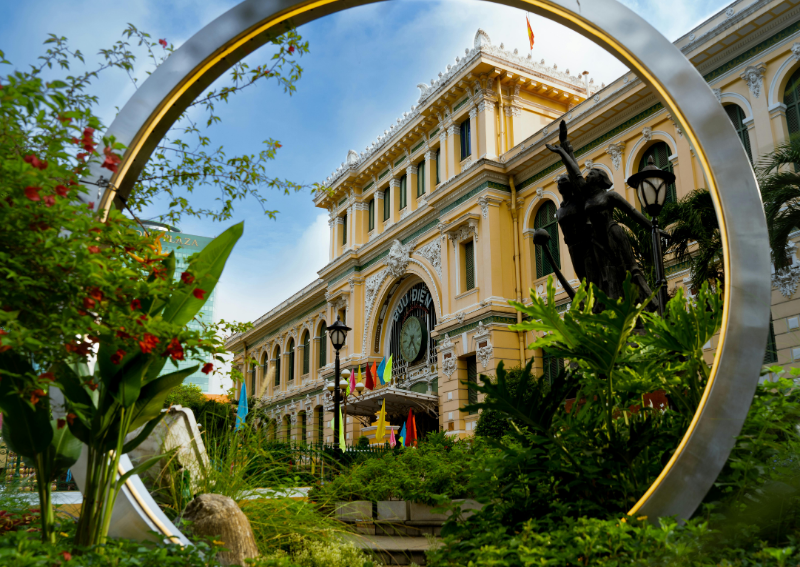
The post office’s location at 2 Cong Xa Paris, directly opposite Notre Dame Cathedral, places it at the most walkable and central point in all of District 1.
- On Foot: From the Nguyen Hue Walking Street, most central District 1 hotels, or the Opera House area, the post office is a 5 to 15 minute walk. The route along Dong Khoi Street is lined with colonial architecture and is one of the most pleasant urban walks in Vietnam.
- By Grab: Vietnam’s rideshare app operates reliably throughout the city. A ride from most District 1 hotels costs between 20,000 and 50,000 VND. Enter “Saigon Central Post Office” or “Buu Dien Trung Tam Sai Gon” as your destination.
- By Taxi: Metered taxis from Vinasun and Mai Linh are widely available across the city. Always confirm the meter is running before departure.
- By Cyclo: For a more atmospheric approach, cyclo (three-wheeled bicycle rickshaw) tours of District 1 typically include the post office as a stop. Negotiate a price and route before departing.
- From Notre Dame Cathedral: If you are visiting the cathedral first, the post office is directly across the square, less than 60 meters away. The two landmarks together form the most iconic architectural pairing in Saigon and are best experienced as a combined visit.
Nearby Saigon Attractions: Making the Most of Your Time in District 1
The Saigon Central Post Office sits at the center of the densest concentration of colonial-era landmarks in Ho Chi Minh City. A morning that begins here can comfortably expand into a half-day walk through some of the most significant Saigon attractions available to international visitors.
- Notre Dame Cathedral Basilica of Saigon (directly opposite, 60 meters): Under comprehensive restoration since 2017 with completion expected around 2027, the cathedral’s exterior and Paris Square remain fully open. The twin bell towers and red-brick facade are among the most photographed subjects in Vietnam, particularly in early morning light.
- Dong Khoi Street (adjacent): Running from the post office toward the Saigon River, this is Saigon’s most elegant boulevard, lined with French colonial buildings, art galleries, boutique shops, and excellent cafes. The full walk to the riverfront takes about 15 minutes.
- Saigon Opera House (700 meters south): One of the finest surviving examples of French Third Republic architecture in Southeast Asia, the Opera House hosts regular evening performances including the acclaimed AO Show and TEH DAR.
- Independence Palace (900 meters southwest): The former seat of South Vietnam’s government and site of the defining moment of April 30, 1975. Its preserved 1960s interiors, underground bunker, and rooftop helipad make it one of the most compelling historical sites in the region.
- Book Street (Duong Sach) (400 meters north): A pedestrian street dedicated to books, cafes, and cultural programming. A pleasant stop for coffee and browsing before or after the post office.
- Ben Thanh Market (1.3 kilometers southwest): The city’s most iconic covered market, a short Grab ride or brisk walk away, for street food, local produce, and souvenirs.
Why the Saigon Central Post Office Is Worth More Than a Quick Stop
Many visitors allocate 15 minutes to the Saigon Central Post Office, treating it as a photo opportunity between Notre Dame Cathedral and Dong Khoi Street. Those who give it 45 minutes come away with a fundamentally different experience.
The Central Post rewards slow attention. The more time you spend in the main hall, the more it reveals: the quality of the iron framework overhead, the detail in the hand-painted maps, the particular way afternoon light enters through the side windows and moves across the wooden counters, the mix of tourists and local workers and students and families going about daily business in an architectural setting that would be considered extraordinary in any major European city.
There is also something quietly significant about the fact that this building is still doing what it was built to do. In a city that has transformed as rapidly and radically as Ho Chi Minh City, the Saigon Central Post Office represents a thread of continuity that stretches back to 1891. Letters have been sent from here across two colonial empires, through wartime, through liberation, through the long arc of a country finding its way into the modern world.
The building has outlasted every ideology that passed through it. It is still standing, still painted yellow, still keeping its clock running, still waiting for your postcard.
Where to Stay for the Best District 1 Experience – La Siesta Premium Saigon Central
The Saigon Central Post Office, Notre Dame Cathedral, Dong Khoi Street, the Independence Palace, and the surrounding cluster of Ho Chi Minh City attractions are all within comfortable walking distance of each other, making your choice of base in District 1 particularly important. Staying at one of the best hotels in Saigon places you steps away from all of these landmarks, with the full richness of the city’s colonial heritage on your doorstep.
Recognized among the Best boutique hotels in Saigon, La Siesta Premium Saigon Central offers elegant comfort in District 1 and is an ideal base for sightseeing. Its Indochine-inspired design and attentive service create exactly the kind of refined, restful environment that complements a day spent exploring some of the most beautiful architecture in Southeast Asia. For international travelers who want their accommodation to reflect the same care and character they have come to admire in the buildings of the city itself, it is a natural choice.