

How to Get Around Ho Chi Minh City 2026: Metro, Grab, Bus and On Foot
Anyone working out how to get around Ho Chi Minh City notices the traffic first, and the second is that it works. Several million motorbikes move through this city every day in what looks from a pavement like chaos and functions, most of the time, like a fluid.
How to get around Ho Chi Minh City is still the thing that shapes a trip here more than anywhere else in Vietnam. Saigon is spread out, it is hot, and the distance between two things you want to see is usually just far enough to be unpleasant on foot and not far enough to feel worth a car.
The good news is that getting around Saigon is cheap and easy once the apps are set up. A ride across the centre costs a couple of dollars, a smartphone replaces every negotiation, and the city now has a metro, which changes the calculation for some journeys.
This guide to how to get around Ho Chi Minh City covers every option, what each one actually costs, and which to use for which kind of trip.
How to Get Around Ho Chi Minh City: All Your Options at a Glance
| Option | Typical cost | Speed | Best for | Avoid when |
|---|---|---|---|---|
| Ride hailing car | 40,000 to 120,000 VND in the centre | Good, slow in rush hour | Almost everything, groups, luggage, rain | Peak traffic on short trips |
| Ride hailing motorbike | 15,000 to 50,000 VND | Fastest in traffic | Solo, short trips, beating a jam | Rain, luggage, after drinking |
| Metro | Around 7,000 to 20,000 VND | Fast and predictable | Journeys along the line, avoiding traffic | Anywhere the line does not go |
| Bus | Around 5,000 to 7,000 VND | Slow | Budget travel, the airport run | Being in a hurry |
| Taxi | Similar to a ride hailing car | Good | When an app fails, hotel ranks | Flagging an unbranded car on the street |
| Walking | Free | Slow | Within District 1 in the cooler hours | Midday, long distances, heavy rain |
| Motorbike rental | 120,000 to 250,000 VND a day | Fast | Confident riders with the right licence | Almost everyone else, see below |
| Cyclo | Negotiated, 150,000 VND and up an hour | Very slow | A short experience, not transport | Treating it as a way to get somewhere |
| Waterbus | Around 15,000 VND | Slow | A river view for the price of a coffee | Needing to be anywhere specific |
The short answer on how to get around Ho Chi Minh City
How to get around Ho Chi Minh City, in one paragraph: use ride hailing for almost everything. Use the metro when your journey happens to run along it. Walk within District 1 in the morning and evening. Ignore the rest unless you want the experience for its own sake.
Ride Hailing Apps: The Default Way to Get Around Ho Chi Minh City
Ride hailing is the honest answer to how to get around Ho Chi Minh City, and it is the single most useful thing to set up before you arrive.
Grab in Saigon
 The dominant app across Southeast Asia and the default here. It does cars, motorbikes, food delivery and parcels. The price is fixed and shown before you book, which removes every negotiation and every meter argument.
Download it at home, create the account there, and link a card. Setting it up on arrival with no data and a Vietnamese phone verification is a worse experience.
The other operators
Vietnam has a competitive ride hailing market and the line-up changes. Local apps operate alongside Grab, including electric vehicle fleets that have expanded quickly in the last couple of years and are popular for being clean, quiet and fixed price.
Having a second app installed is genuinely useful at peak times, when one platform can have no drivers and another has several.
Car or motorbike
Car. Air conditioned, safe, fits luggage, costs more, and sits in the same traffic as everyone else.
Motorbike. Half the price, often half the journey time, and an experience in itself. You get a helmet. You will also arrive hot and slightly windswept.
The honest advice: take a motorbike if you are travelling light, the weather is dry, you are comfortable on two wheels and it is not 2am. Take a car otherwise. Do not take a motorbike with a suitcase, in heavy rain, or after an evening out.
Typical fares to get around Ho Chi Minh City
| Journey | Car | Motorbike |
|---|---|---|
| Within District 1 | 40,000 to 70,000 VND | 15,000 to 30,000 VND |
| District 1 to Cho Lon | 90,000 to 150,000 VND | 45,000 to 80,000 VND |
| District 1 to Thao Dien | 100,000 to 180,000 VND | 50,000 to 90,000 VND |
| District 1 to the airport | 150,000 to 250,000 VND | 70,000 to 120,000 VND |
Fares rise at peak times and in heavy rain, sometimes sharply.
Common problems
The driver cannot find you. Very common outside large buildings and at the airport. Move to a clear landmark and update the pin. Many drivers will call; if you cannot communicate, send a message in the app, which auto translates.
No drivers available. Happens in rain and at rush hour. Try the other app, or wait five minutes.
Address confusion. Pin the destination on the map rather than typing an address. Street numbering in Saigon includes slash notation such as 123/45, and getting it wrong sends you a long way off.
The Metro in Saigon
The metro changed how to get around Ho Chi Minh City for some journeys. The city’s first metro line opened after many years of construction and has changed how some journeys work. It is clean, air conditioned, cheap and, crucially, unaffected by traffic.
Line 1
The line runs from the Ben Thanh Market area in the centre out to the north east of the city. The first few stations are underground and in the heart of District 1, and the rest run on elevated track along the main corridor out of town.
The stops that matter for visitors are the central ones: the Ben Thanh terminus, the station by the Opera House, and the Ba Son station near the riverfront. These three put you within walking distance of most of District 1.
Further out, the line serves the eastern districts, the bus station interchange and the Suoi Tien area.
What the metro is good for
- Skipping traffic in the centre. Three stops in District 1 at rush hour will beat a car.
- Getting east. If you are heading to Thao Dien or further out, the metro is faster and cheaper than a car.
- Air conditioning. Not a trivial point in this climate.
- The novelty. It is new, it is genuinely nice, and Saigon is pleased about it.
What it is not good for
Anything that does not run along the line, which is most of how to get around Ho Chi Minh City. Cho Lon, the airport, the War Remnants Museum and the Mekong Delta are all off it.
Fares and tickets
Fares are low, in the region of a few thousand to around twenty thousand dong depending on distance. Tickets are bought at station machines or counters, and there is an app and a stored value card option.
Confirm the current fare structure, the payment methods accepted and whether foreign cards work before relying on them.
Hours
The line runs through the day from early morning until late evening. Check current operating hours, which have been adjusted since opening.
Future lines
Several further lines are planned or under construction, including one that would eventually serve the airport. None of them are open. Treat anything you read about them as a plan rather than an option.
Buses in Saigon: The Cheapest Way to Get Around Ho Chi Minh City
Buses are the cheapest way to get around Ho Chi Minh City. Saigon’s bus network is extensive, air conditioned on most routes and extremely cheap. It is also the option almost no visitor uses, which is partly a shame and partly reasonable.
Why it is better than you expect
Fares are a few thousand dong, a fraction of any other option. Many buses are modern, air conditioned and clean. Google Maps handles the routing reasonably well, which removes the main barrier.
Why most visitors skip it anyway
It is slow. A bus sits in the same traffic as a car but stops every few hundred metres, and a journey that takes fifteen minutes by motorbike can take fifty. Announcements are in Vietnamese. Stops are not always obvious.
When a ride hailing car across the centre costs two or three dollars, the saving is real but small.
The exception worth knowing
The airport routes. Buses connect Tan Son Nhat with the central districts for a tiny fraction of a taxi fare, and on a quiet road they are not much slower. If you are travelling light, arriving in daylight and not in a hurry, this is a legitimate choice rather than a hardship.
How to pay
Cash to the conductor on board, small notes. Some routes now accept cards or an app. Have change ready.
Practical notes
Buses can be crowded at rush hour and in the hour after schools finish. Keep bags in front of you. Signal clearly when you want to get off, and be ready to move to the door early, because stops are brief.
Taxis in Saigon
Taxis are the oldest way to get around Ho Chi Minh City, still useful, and still worth knowing how to use properly.
The reputable companies
Vinasun and Mai Linh are the two established operators, in white and green liveries respectively. Both run metered, both are reliable, and both have app booking of their own.
The cloned taxi problem
Saigon has a long history of taxis painted in near identical colours with near identical names, a letter or a word different, running fast meters. This is less common than it was but has not disappeared, particularly around tourist areas and the airport.
How to avoid it: book through an app, take a taxi from a hotel rank, or check the company name and the driver’s ID card carefully before getting in. If the meter climbs noticeably faster than the distance suggests, ask to stop and pay what is owed.
When a taxi beats an app
When the apps have no drivers, which happens in heavy rain. When you are at a hotel or airport rank and the queue is moving. When your phone is dead.
Otherwise, the app is simpler, the price is agreed in advance and there is a record of the journey.
Walking: How to Get Around Ho Chi Minh City on Foot
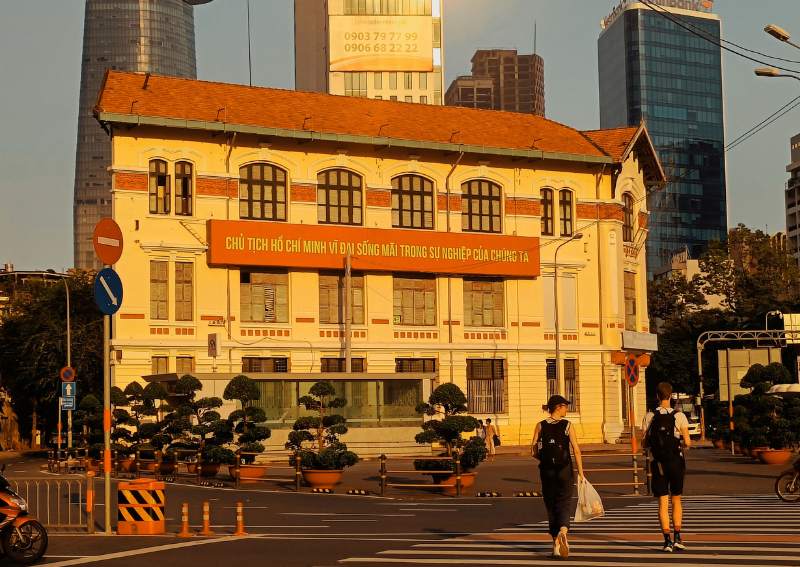 Walking is part of how to get around Ho Chi Minh City: Saigon is more walkable than its reputation and less walkable than Hanoi.
Where walking works
Within District 1, the central landmarks sit within a kilometre or two of each other. The colonial core, Ben Thanh, Nguyen Hue and the riverfront can all be linked on foot comfortably.
Nguyen Hue itself is a proper pedestrian boulevard, and the streets around Dong Khoi and Le Thanh Ton have wide pavements by Vietnamese standards.
Where it does not
Anything beyond District 1. Cho Lon, the airport road and the outer districts are built for vehicles, with long blocks, wide junctions and little shade.
The two real obstacles
The heat. Between about eleven and four, walking more than ten minutes is genuinely unpleasant for most visitors. Plan around it rather than through it.
The pavements. Often occupied by parked motorbikes, outdoor kitchens and tables, which pushes pedestrians into the road. This is normal and manageable, but it means walking requires more attention here than at home.
Crossing the street in Saigon
The technique that works: step off the kerb at a steady pace and keep going at that pace without stopping. Riders read your speed and adjust around you. Stopping suddenly or running back is what causes problems.
At busy junctions, cross alongside a local. At major roads, use the pedestrian crossings and the overpasses, which exist on the big arteries.
It takes a day to get used to and then stops being frightening.
Renting a Motorbike to Get Around Ho Chi Minh City
The honest section on how to get around Ho Chi Minh City by yourself. Plenty of articles present this as the authentic way to see Saigon. It can be, and for most visitors it is a bad idea.
The licence question
To ride legally in Vietnam you generally need a Vietnamese licence, or an International Driving Permit issued under the 1968 Vienna Convention together with your home licence covering the right category.
This matters because an IDP issued under the 1949 Geneva Convention, which is what several countries including the United States issue, is not generally recognised here. Many visitors ride anyway. The consequence is not usually a police matter; it is that your travel insurance will decline a claim if you are hurt, and most policies exclude riding without the correct licence.
Check your own licence, your own IDP type and your own policy wording before you decide. Do not take a rental shop’s assurance as an answer, because they are not the ones paying your medical bill.
The helmet law
Helmets are compulsory for rider and passenger. The ones supplied with rentals are usually minimal. If you intend to ride regularly, buy a better one; they are inexpensive here.
What it costs
Roughly 120,000 to 250,000 VND a day for a scooter, less by the week, plus fuel which is cheap. Most shops want a passport as deposit, which is worth resisting; offer a cash deposit or a copy instead.
Why most visitors should not
Saigon traffic is dense, fast and governed by conventions rather than rules. Riders filter, turn across traffic and use pavements. It works because everyone shares the same expectations, and a visitor who brakes where a local would flow is the unpredictable element.
Ride hailing motorbikes give you the same experience with a driver who grew up in it, for a couple of dollars a trip.
When it does make sense
Renting is a reasonable answer to how to get around Ho Chi Minh City if you are an experienced rider, you hold the correct licence and insurance, you are staying several weeks, and you have already spent a few days watching how the traffic works. Even then, start in a quieter district rather than on Nguyen Hue at six in the evening.
Cyclo and the Waterbus
Neither of these really answers how to get around Ho Chi Minh City. Both are worth half an hour.
Cyclo in Saigon
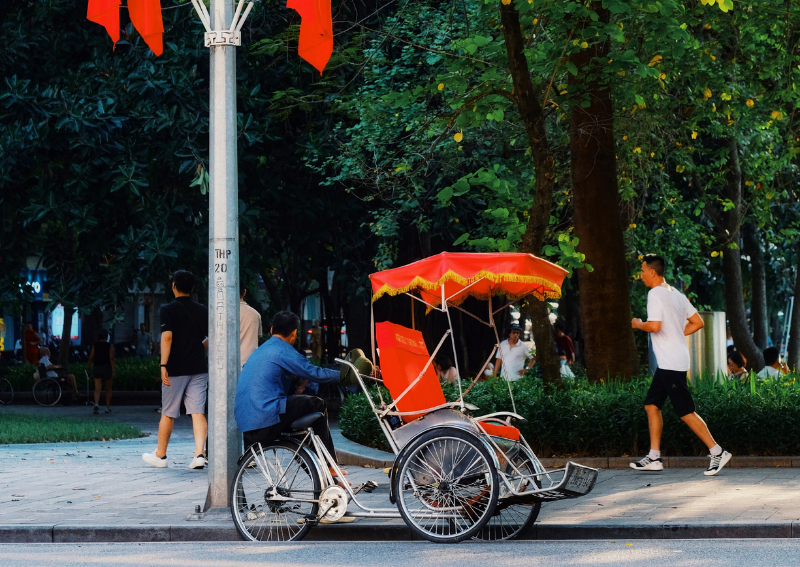 The three wheeled cycle rickshaw, one of the things to do in Ho Chi Minh City that is more experience than transport,, with the passenger seated in front of the driver. Once the standard way to move around Saigon, now almost entirely a tourist activity concentrated around District 1.
If you want to do it: agree the price and the duration before you sit down, in writing on a phone screen if necessary. Expect to pay from around 150,000 VND for a short loop, and expect the driver to suggest a longer route once you are moving.
The common complaint is a price renegotiated at the end. Settling it clearly at the start solves almost all of it.
A cyclo ride along the riverfront or around the colonial quarter in the early evening is pleasant. A cyclo as a way to get to a restaurant is slow and expensive.
The Saigon Waterbus
 A Saigon River service running between the central riverfront and points upriver, intended as commuter transport and used mostly by people enjoying the view.
It costs little, the boats are air conditioned, and the forty minutes on the water gives you a perspective on the city that no road does: the new towers on one bank, working boatyards and older neighbourhoods on the other.
As transport it is almost useless, since it goes where you probably are not going. As a cheap hour out of the heat with a view, it is one of the better small pleasures in Saigon.
Check current timetables, which are limited and change.
How to Get Around Ho Chi Minh City From Tan Son Nhat Airport
The airport run is the one journey where how to get around Ho Chi Minh City matters most. Tan Son Nhat sits inside the city rather than outside it, about seven kilometres from District 1. That sounds convenient and sometimes is not, because the roads approaching it are among the most congested in Vietnam.
| Option | Time | Rough cost | Notes |
|---|---|---|---|
| Ride hailing car | 25 to 50 min | 150,000 to 250,000 VND | Pick up points are signposted and sometimes a short walk from arrivals |
| Ride hailing motorbike | 20 to 35 min | 70,000 to 120,000 VND | Only with hand luggage |
| Airport taxi | 25 to 50 min | 180,000 to 300,000 VND | Use the official ranks and the known companies |
| Hotel transfer | 25 to 50 min | 300,000 to 600,000 VND | Someone waiting with a sign, no app required |
| Public bus | 45 to 70 min | Around 10,000 to 20,000 VND | Cheapest by a wide margin, fine with light luggage |
The traffic warning
Allow considerably more time than the distance suggests, particularly between about 7 and 9am and 4.30 and 7pm, and before public holidays. A journey that takes twenty five minutes at ten in the morning can take an hour at six in the evening.
For a departure, leaving three hours before an international flight is not excessive here.
On arrival
Ride hailing pickup is signposted but not always obvious, and at busy times drivers struggle to reach the kerb. If you have just landed after a long flight with luggage, a pre booked transfer or the official taxi rank is worth the extra few dollars.
Do not accept an offer from someone approaching you inside the terminal.
The metro and the airport
A metro connection to the airport is planned and not open. Anything suggesting otherwise is describing a future line.
How to Get Around Ho Chi Minh City: Practical Tips
A few things worth setting up before you arrive. For wider trip planning, Vietnam’s national tourism site is the official reference.
Apps to install before you fly. These are the foundation of how to get around Ho Chi Minh City. Grab, a second ride hailing app, Google Maps with the Ho Chi Minh City area downloaded for offline use, and Google Translate with Vietnamese downloaded. Set them up at home while you have data and a working phone number.
Get a local SIM or eSIM. Everything about how to get around Ho Chi Minh City depends on it, and our ATM guide and convenience store guide cover the other two things you will need on day one. Everything above depends on data at the moment you need it, which is rarely in a cafe with wifi.
Rush hour. This is when how to get around Ho Chi Minh City stops being simple. Roughly 7 to 9am and 4.30 to 7pm. Journeys can double. Plan museum visits and long lunches for those windows.
Rain. Wet season changes how to get around Ho Chi Minh City within minutes. In the wet season, a heavy downpour in the late afternoon will empty the ride hailing supply and double the fares within minutes. If you see the sky go dark, book before the rain starts rather than after.
Bag snatching. More common here than in Hanoi, usually from a passing motorbike. Do not hold a phone loosely at the kerb, carry bags on the shoulder away from the road, and keep a hand on anything in a basket if you are on the back of a bike.
Paying. Card payment makes how to get around Ho Chi Minh City simpler. Link a card to your ride hailing app so you are not handling cash at the end of every trip. Keep small notes for buses and markets.
Helmets. Part of how to get around Ho Chi Minh City legally. If you take a motorbike taxi, the driver supplies one and you should wear it. It is also the law.
Accessibility. How to get around Ho Chi Minh City is harder for some travellers. Saigon is difficult for wheelchair users and anyone with limited mobility. Pavements are uneven and often blocked, kerbs are high, and few older buildings have ramps or lifts. Ride hailing cars door to door are the practical approach, and it is worth checking individual sites before visiting.
Addresses. This is the one detail that trips up how to get around Ho Chi Minh City. A Saigon address with a slash, such as 123/45 Le Loi, means an alley off the main street. Pin the destination on the map rather than typing it.
How to Get Around Ho Chi Minh City: Frequently Asked Questions
What is the best way to get around Ho Chi Minh City? Ride hailing apps for almost everything, the metro where your journey runs along the line, and walking within District 1 outside the hottest hours.
Is Grab cheap in Saigon? Yes. A car across the centre costs roughly 40,000 to 120,000 VND, about 1.60 to 5 US dollars. A motorbike is about half that.
Is Saigon walkable? District 1 is, in the cooler hours. The wider city is spread out, hot and built for vehicles, so expect to combine walking with short rides.
Does Ho Chi Minh City have a metro? Yes. Line 1 runs from the Ben Thanh area out to the north east, with three central underground stations useful for visitors. Further lines are planned but not open.
How much does the Saigon metro cost? Fares are low, in the region of a few thousand to around twenty thousand dong depending on distance. Check current fares and payment methods before travelling.
Does the metro go to the airport? No. An airport connection is planned and not open. Use a ride hailing car, a taxi or the airport bus.
How do I get from Tan Son Nhat airport to District 1? A ride hailing car takes 25 to 50 minutes and costs 150,000 to 250,000 VND. The airport bus costs a fraction of that and takes longer. Allow extra time at rush hour.
Can tourists rent a motorbike in Ho Chi Minh City? Physically yes, legally it depends on your licence. Vietnam generally recognises a 1968 Vienna Convention International Driving Permit, not the 1949 Geneva version issued by some countries. Riding without the right licence usually voids travel insurance.
Are taxis safe in Saigon? The established companies are reliable. Avoid unbranded cars and lookalike liveries, and prefer app booking so the fare is agreed in advance.
Where to Stay to Avoid Most of This
The cheapest answer to how to get around Ho Chi Minh City is the journey you do not have to make. In a city this hot and this congested, a central base removes more friction than any app.
Recently honored with the Top 9 Best of the Best Hotels in Vietnam award from Tripadvisor and included in the 2026 Selection of the MICHELIN Guide, La Siesta Premium Saigon is one of the best boutique hotels in Saigon and sits in the heart of District 1. The colonial landmarks, Ben Thanh Market, Nguyen Hue and the riverfront are walkable from here in the cooler hours, and the central metro stations are close by.
For travellers researching the best hotels in Saigon, that means most days start on foot rather than in a car, and the rides you do take are short. The Indochine inspired interiors and thoughtful service also make it a reasonable place to retreat to between four and six in the afternoon, which in this climate is a sensible habit rather than an indulgence.
For anyone comparing the best hotels in Saigon District 1, and as one of the Michelin Guide hotels in Saigon and among the Michelin Guide hotels in Vietnam, it offers the simplest answer to the transport question: stay in the middle of what you came to see.