Where Is Vinh Hy Bay?

Vinh Hy Bay sits within Vinh Hai Commune, Ninh Hai District, Ninh Thuan Province, approximately 40 kilometers northeast of Phan Rang-Thap Cham city. It lies along what is widely regarded as one of the most scenic coastal drives in central Vietnam, the road connecting Ninh Thuan with Khanh Hoa Province.
The bay’s geography is part of what makes it so visually distinctive: it’s bordered directly by Nui Chua National Park, which means the deep green of primary forest meets limestone cliff faces at the water’s edge, and those cliffs curve around the bay in a natural arc that shelters the water and gives Vinh Hy its characteristic calm, protected quality. It’s a rare convergence of three ecosystems – open sea, primary forest, and limestone karst – in a single, contained landscape.
The Jewel of Ninh Thuan Coastal Travel?
Vinh Hy Vietnam is often described as the “emerald jewel” of the South Central Coast, and the description is earned rather than promotional. A few things set it genuinely apart:
The water clarity here is exceptional – clear to the seabed in calm conditions, and consistently among the most transparent on Vietnam’s coastline. The coral reefs lie close to shore, making snorkeling and glass-bottom boat viewing accessible even for visitors with no diving experience. White sand beaches remain largely undeveloped, and the surrounding limestone cliffs create natural scenic frames that make even a simple afternoon swim feel cinematic.
The proximity to Nui Chua National Park, one of the few places in Vietnam with a dry tropical forest ecosystem, adds a biodiversity dimension that most beach destinations simply don’t have. Vinh Hy isn’t just a place to lie on a beach. It’s a genuinely multi-layered natural environment.
Best Time to Visit Vinh Hy
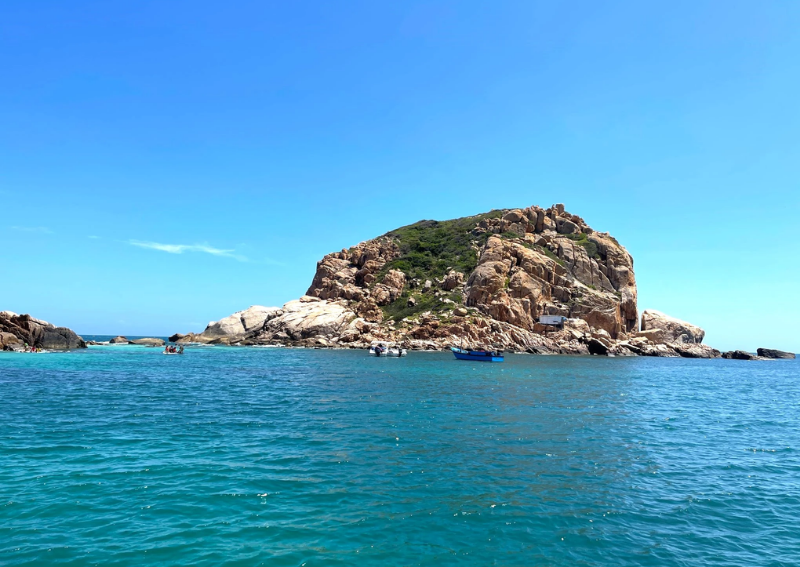
One of Vinh Hy’s advantages over many Vietnamese coastal destinations is its relatively forgiving climate. The sheltered position of the bay, enclosed by forest and limestone – moderates the weather, and the bay is pleasant to visit across most of the year.
That said, May through August delivers the best conditions for water activities: consistent sunshine, calm seas, and that characteristic blue-green color the bay is known for. Visibility for snorkeling and diving is at its clearest during this window, and the beaches are at their most swimmable.
October through December is the period to approach with caution – rainfall increases and the sea can become rough enough to disrupt boat tours and water sports. Outside of these months, Vinh Hy is genuinely accessible and rewarding year-round.
How to Get to Vinh Hy Bay
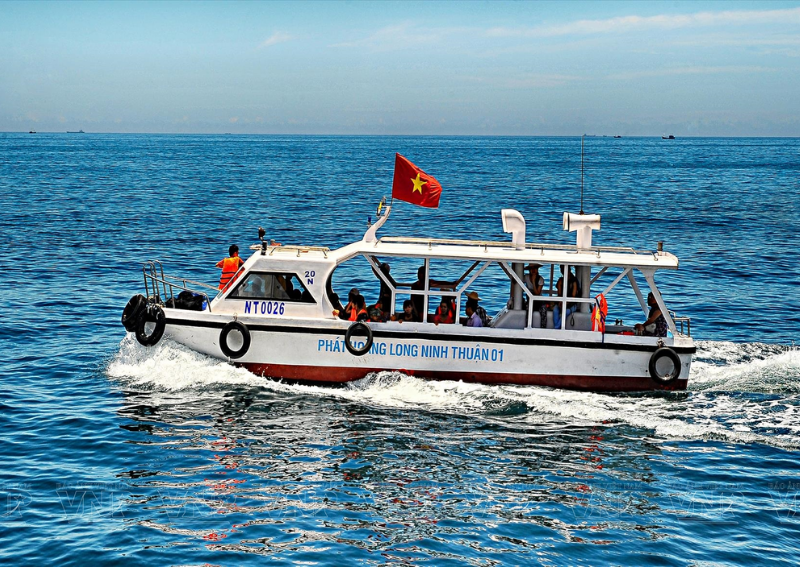
Ninh Thuan Province does not have its own commercial airport, which means most travelers arrive via one of two routes.
By Air to Cam Ranh, then by road The most practical approach for visitors coming from Hanoi, Ho Chi Minh City, or Da Nang is to fly into Cam Ranh International Airport (CXR) in Khanh Hoa Province, approximately 60 kilometers from Vinh Hy. From the airport, a private taxi covers the distance in roughly two hours. Expect to pay approximately $28–$40 (~700,000–1,000,000 VND) for the transfer. Booking flights early is advisable, particularly for travel during the May–August peak season.
By Road from Ho Chi Minh City For travelers already based in Saigon, high-quality coach or limousine bus services run directly toward Vinh Hy, with journey times of approximately six to seven hours. Fares range from around $10–$16 (~250,000–400,000 VND) per person one way depending on the operator and date. During peak season (April through August), booking five to seven days ahead is strongly recommended to secure a seat.
If direct services are full, buses to Phan Rang-Thap Cham city run more frequently, from there, a taxi or rented motorbike covers the remaining 40 kilometers to the bay.
Where to Stay in Vinh Hy
Accommodation in and around Vinh Hy spans a wider range than the bay’s remote reputation might suggest, though it remains appropriately low-key compared to Vietnam’s more developed coastal resorts.
- Bayside Homestays and Guesthouses: The most widely available option, and arguably the most atmospheric: small family-run properties perched along the bay with views of the water and direct access to the fishing village rhythm. Prices run from approximately $10-$20 (~250,000-500,000 VND) per night, excellent value for the setting.
- Resorts and Eco-Lodges: A handful of more developed properties, some located along the scenic Binh Tien – Binh Hung coastal road, offer sea-view rooms, swimming pools, and full-service packages for travelers who want comfort alongside natural beauty. Rates typically range from $40–$80 (~1,000,000–2,000,000 VND) per night.
- Hotels in Phan Rang – Thap Cham: For visitors combining Vinh Hy with broader Ninh Thuan exploration – the Cham Towers, the vineyard landscapes, or Ninh Chu Beach – staying in the provincial capital and making Vinh Hy a day trip is a practical alternative. The 40-kilometer drive is straightforward and scenic.
What to Do in Vinh Hy Bay
Explore the Bay by Boat or Speedboat
Circling the bay by boat is the single best way to understand its scale and beauty. From the water, the full panorama opens up: turquoise bay, curving limestone cliffs, floating aquaculture rafts scattered across the surface, and the dense green of Nui Chua National Park rising steeply beyond the shoreline. Most tours pass through key points including Hang Rai, Bai Coc, Dolphin Cape, and the nearshore coral gardens.
- Group speedboat tours: approximately $6–$8 (~150,000–200,000 VND) per person per trip
- Private speedboat hire: from $52–$64 (~1,300,000–1,600,000 VND) per vessel
Drive the Coastal Ridge Road
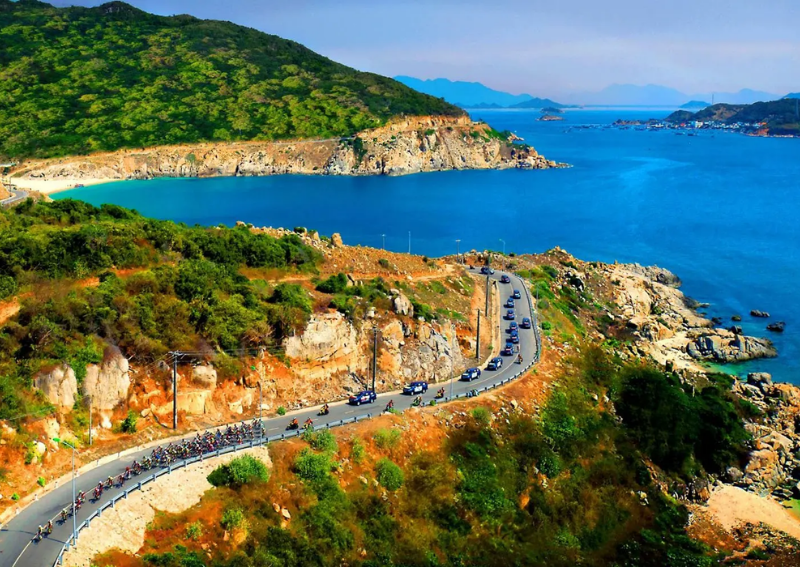
The approach road to Vinh Hy splits before the bay – one fork descends into the fishing village, the other climbs along the mountain ridge above. Taking the high road reveals a series of natural viewpoints where the entire bay spreads out below: the fishing boats at anchor, the village rooftops, and the water shifting between shades of green and blue depending on the light. It’s one of the better drives on the South Central Coast and worth building extra time around.
Swim at the Unspoiled Beaches
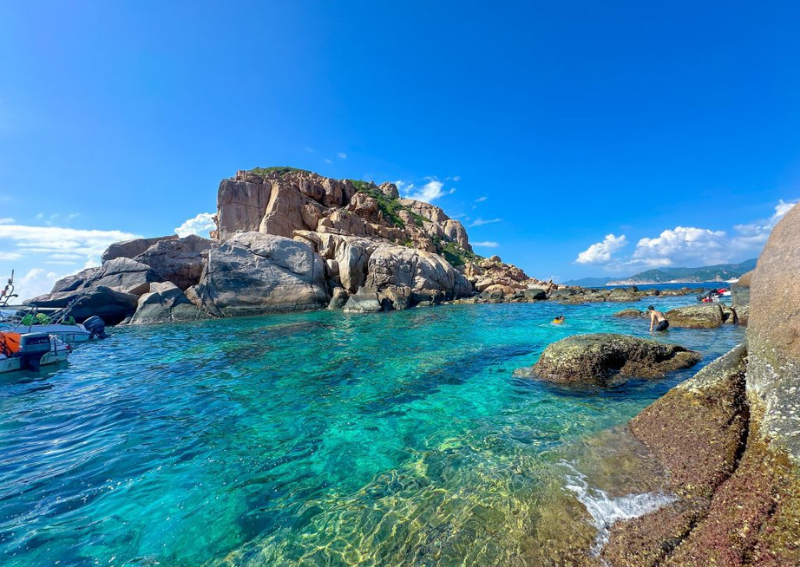
- Bai Hom (Turtle Beach): Situated deep within the bay, this sheltered cove has genuinely clear water, a gently sloping sandy bottom, and very light waves, ideal for swimming at a relaxed pace, or snorkeling the nearshore coral without any equipment beyond a mask and fins.
- Dolphin Cape (Mui Ca Heo): A rocky promontory shaped like a dolphin’s head extending into the bay. Beyond the distinctive natural sculpture, it’s a popular photography spot for good reason – the views from the cape across open water are wide and dramatic.
- Bai Coc, Bai Chuoi, and Binh Tien Beach Three white-sand coves: calm water, no commercial development, and very few visitors. These are the right destinations for a private picnic, wild camping, or simply a long afternoon with a good book and nothing pressing on the agenda.
Underwater Experiences

Vinh Hy is among the few places on Vietnam’s coast where the coral ecosystem remains genuinely intact, both diverse and close enough to shore to be explored without advanced equipment.
- Snorkeling tours (including guide, lifejacket, mask, and fins): approximately $6 – $10 (~150,000 -250,000 VND) per person, 45 – 90 minutes
- Scuba diving: approximately $24 – $36 (~600,000 – 900,000 VND) per person
- Glass-bottom boat tours: offer the same underwater views for visitors who prefer to stay dry – particularly suitable for children and older travelers. Approximately $4 – $6 (~100,000 – 150,000 VND) per person, 30 – 45 minutes.
- Kayaking and Stand-Up Paddleboarding: (SUP) let you move independently through the bay at your own pace, navigating between the aquaculture rafts and along the cliff faces at water level. Rental rates: approximately $8 – $12 (~200,000 – 300,000 VND) per hour. Popular launch points include Turtle Beach and the resort areas along the bay edge.
- Adrenaline options: speedboat rides, banana boat towing, and jet skiing – are available for groups and families who want something faster. Prices vary by activity: approximately $6 – $12 (~150,000 – 300,000 VND) per person per session. Morning and late afternoon offer the calmest sea conditions.
Fishing Village Life and Seafood on the Water
The Vinh Hy fishing village is one of those rare places where the phrase “authentic local experience” is not aspirational marketing, it’s simply accurate. An early morning walk through the village as the night boats return and the waterfront fish market briefly opens is the kind of travel moment that doesn’t require a tour guide or an itinerary.
Visitors can arrange to visit the floating aquaculture platforms where cobia, lobster, abalone, and sea snails are farmed in open-water cages, and participate in feeding sessions or harvest activities. The most memorable way to eat in Vinh Hy is to choose your seafood directly from a floating platform and have it cooked immediately on the raft above the water. Squid dried in the sun, grouper, sea crab, lobster, abalone, all at the peak of freshness, prepared simply to let the ingredients speak.
What to See in Vinh Hy
Hang Rai (Fossilized Coral Rock Field)
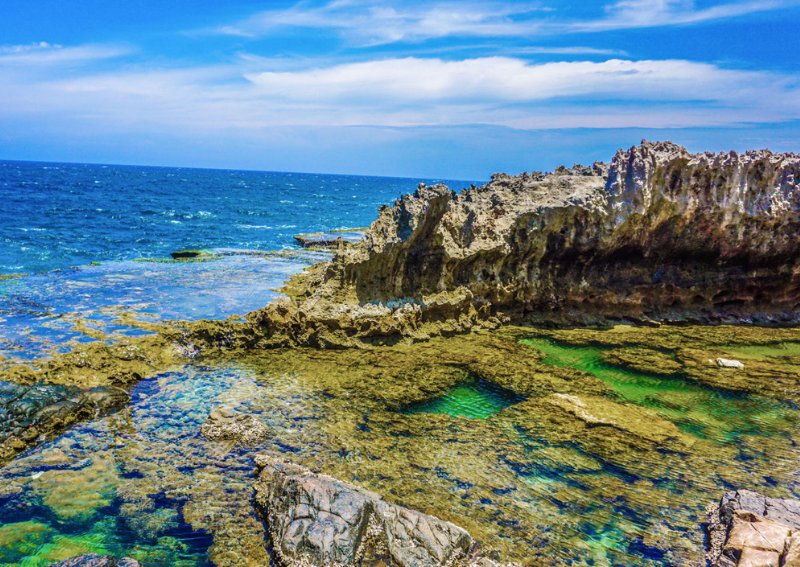
A short distance from the bay, Hang Rai presents one of the most visually arresting geological formations on the South Central Coast: ancient fossilized coral arranged in terraced layers, exposed at the shoreline and carved by wave action into jagged, intricate shapes. When the sea washes across the channels between the rock formations – particularly at sunrise – the effect is genuinely otherworldly. It has become one of Ninh Thuan’s most photographed landscapes for good reason.
Nui Chua National Park
Encircling the bay on the landward side, Nui Chua National Park contains one of the rarest forest ecosystems in Vietnam – a dry tropical forest type found in very few places globally. Trekking trails penetrate the interior, passing natural streams including Suoi Lo O, and climbing to ridgelines with sweeping views over the bay and coastline. For visitors who want more than a beach day, the park adds genuine ecological depth to a Vinh Hy trip.
Ninh Thuan Stone Park

A natural formation of coral rock and limestone shaped by thousands of years of coastal weathering, the Ninh Thuan Stone Park sits directly beside the sea with a surface texture of extraordinary irregular formations – jagged, dramatic, and entirely photogenic. It’s a strong destination for geology enthusiasts and photographers, and a pleasant contrast to the beach-focused activities nearby.
The Vinh Hy – Binh Hung Coastal Pass
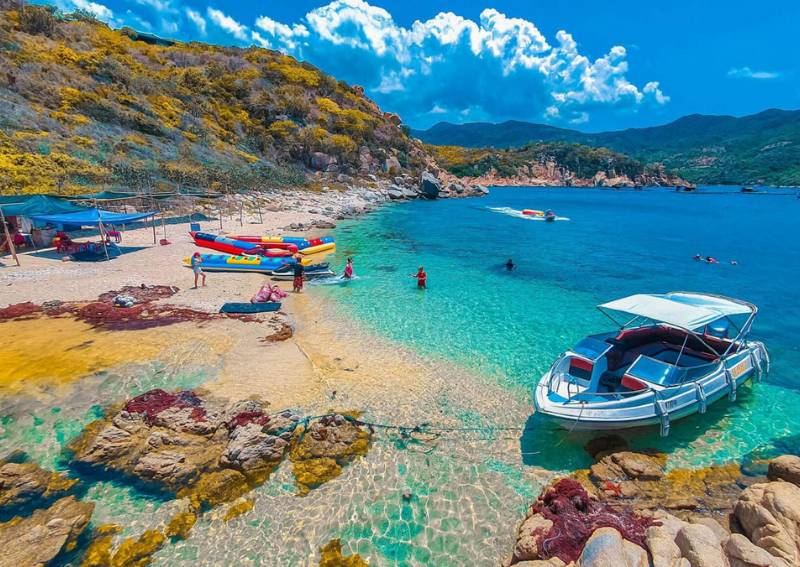
The mountain road connecting Vinh Hy with Binh Hung to the south is one of Vietnam’s most scenic short drives – all sweeping curves hugging cliff faces with unobstructed sea views opening around each bend. For motorcyclists, it’s a road that justifies the journey to Ninh Thuan on its own terms.
Binh Tien Beach and Binh Hung Island
Often compared (with some justification) to a miniature Maldives, Binh Tien Beach and the nearby Binh Hung Island offer powder-white sand and improbably clear water in a setting that still sees relatively few visitors. They make natural additions to a Vinh Hy itinerary, particularly for travelers with an extra day to spend.
Ninh Thuan Vineyards
A distinctive stop for visitors who haven’t encountered Vietnam’s wine country before: Ninh Thuan’s hot, dry climate produces conditions well-suited to grape cultivation, and a number of working vineyards welcome visitors for tours, grape-picking, and tastings of local wine, grape honey, and dried grape products. It’s an unexpectedly charming detour on the way to or from the bay.
Before You Go: Smart Tips for Visiting Vinh Hy
- Pack for the sun seriously. The Ninh Thuan coast is one of the sunniest regions in Vietnam – high-SPF sunscreen, a wide-brimmed hat, UV-protective rash guards, and quality sunglasses are essential rather than optional. The glare off the water intensifies UV exposure considerably.
- Bring cash. Many of the bay’s best experiences – the floating seafood platforms, small boat operators, village food stalls – operate on cash only. ATMs are scarce in the immediate area; withdraw before arriving.
- Book water activities in advance. Snorkeling tours, glass-bottom boat departures, and Binh Hung Island trips all have limited daily capacity. Reserving a day ahead, particularly during the May–August peak, avoids disappointment and often secures better pricing.
- Travel responsibly. The ecological integrity of Vinh Hy Bay is not incidental to its appeal – it’s the entire point. Don’t walk on coral, don’t remove marine life from the water, and carry your waste out rather than leaving it on the beach. This is one of Vietnam’s genuinely pristine coastal environments, and it deserves to stay that way.
- Time your activities by the tide. The best snorkelingconditions and the most dramatic Hang Rai rock formations both occur at low tide. Check tide tables before planning your day on the water.
Extend Your Southern Vietnam Journey – At La Siesta Premium Saigon Central
Vinh Hy makes a natural centerpiece for a broader southern Vietnam itinerary, and for most international travelers, Ho Chi Minh City serves as the logical starting and finishing point for the region. After days of hiking coastal ridges, snorkeling coral gardens, and eating freshly caught seafood on floating platforms above a turquoise bay, the return to Saigon offers a completely different kind of pleasure: the city’s energy, its history, and its extraordinary culinary depth.
La Siesta Premium Saigon Central is ideally positioned to make the most of that urban chapter. Sitting just steps from Ben Thanh Market in the heart of District 1, it places guests within walking distance of the city’s most compelling historical landmarks, street food lanes, rooftop bars, and cultural institutions, everything that makes spending a few days in central Saigon genuinely worthwhile rather than merely a transit stop.
Widely regarded as one of the best boutique hotels in Saigon for its elegant Indochine-inspired interiors and notably personal service, La Siesta Premium Saigon Central offers the kind of considered hospitality that makes a city feel navigable rather than overwhelming. Whether you’re using it as a launchpad before heading south to the Mekong Delta or Vung Tau, or arriving back from a coastal journey through Ninh Thuan and Phu Quoc, it provides a genuinely comfortable and well-located base in one of Southeast Asia’s most dynamic cities.
For travelers who want their Saigon stay to be as rewarding as the journey that surrounds it, this is consistently among the best hotels in Saigon for balancing character, location, and the kind of hospitality that leaves you with a genuinely positive impression of a city that already has a lot going for it.
See also: Phu Quoc Island Vietnam 2026: Your Complete Guide | Vung Tau Beach Guide: Southern Vietnam’s Most Accessible Coastal Escape | Mekong Delta Trip Vietnam: The Complete Guide
